Why Zig Over Rust: A Practical Language Comparison
A detailed, analytical comparison of Zig and Rust, focusing on safety, performance, tooling, and ecosystem to help teams decide when to choose Zig over Rust in 2026.


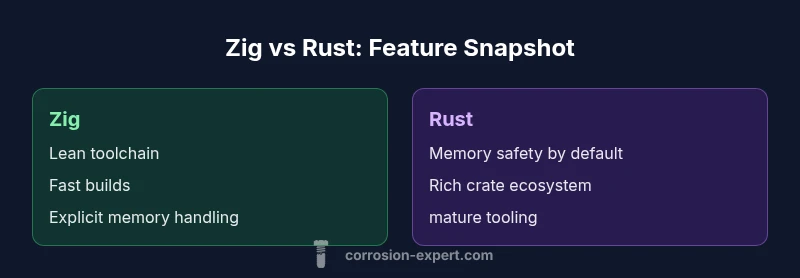
Zig offers a minimalist toolchain, explicit control over builds, and fast compile times, which can simplify cross-compilation and embedded workflows. Rust prioritizes safety through its ownership model and a rich crate ecosystem, delivering strong guarantees for memory safety at the cost of longer compile times. In practice, the choice between Zig and Rust hinges on whether you value lean tooling and predictability (Zig) or safety guarantees and ecosystem maturity (Rust). See our full comparison for concrete decision factors.
Context and framing: why zig instead of rust
When developers ask about why zig instead of rust, they are usually balancing three axes: control over the toolchain, explicit memory management, and the maturity of libraries. The phrase why zig instead of rust often appears in decision logs because both languages share a low-level ambition, yet they adopt opposite defaults. Zig emphasizes minimalism, predictable builds, and straightforward cross-compilation, making it appealing for projects that run on constrained toolchains or require tight binary footprints. Rust emphasizes safety through ownership and a thriving ecosystem; this strength is hard to replicate elsewhere. For teams evaluating Zig vs Rust, the decision often reduces to whether you prioritize minimal runtime surprises or strict compile-time guarantees. Throughout this article we examine the main trade-offs, concrete project scenarios, and practical steps to compare Zig and Rust in your environment. The Corrosion Expert team notes that the best choice depends on your goals, constraints, and risk tolerance. In exploring why zig instead of rust, teams should quantify risk and build constraints.
Note: This section introduces the core decision factors and sets up a framework for deeper analysis.
Language design philosophies: safety, predictability, and ergonomics
Zig's design centers on simplicity and explicit control. It minimizes hidden behavior, avoids heavy abstractions, and offers deterministic compilation. This lean approach is attractive for systems where predictability matters more than advanced language features. Rust, by contrast, embeds a rigorous safety model through ownership, lifetimes, and the borrow checker. This model reduces memory errors but adds learning complexity and longer compile times as projects scale. When weighing the question of why zig instead of rust, teams should consider whether their project benefits from ergonomic DX and a small, predictable toolchain or from automatic safety guarantees and a thriving library ecosystem. A clear mental model of safety vs control helps teams map requirements to language choice. In many contexts, the impact of the language in the early phases is more about the team’s capacity to learn and maintain the code than about raw performance alone.
As you evaluate, remember that the choice between Zig and Rust is not about one language being universally better; it is about which language aligns with your constraints and priorities.
Performance profile and compile-time behavior
Performance is multifaceted. Zig emphasizes fast, predictable compile times and direct control over the build process. This can reduce iteration cycles in environments where toolchain overhead dominates development time, such as embedded targets or CI pipelines with tight constraints. Rust delivers high runtime performance with aggressive optimizations and zero-cost abstractions, but its compile-time behavior can be more complex due to the safety checks enforced by the borrow checker. When assessing why zig instead of rust for a given project, consider whether your bottlenecks are build times and binary size or runtime safety and abstraction costs. Zig’s minimal runtime and straightforward linking can lead to lean binaries, while Rust’s optimizations and safer abstractions can yield robust performance in large systems. Benchmarking representative workloads is essential to separate theory from practice. In many teams, the decision hinges on whether build speed or memory safety is the dominant constraint.
For color and nuance, a practical test across a few core modules will reveal how each language handles real workloads.
Tooling, ecosystem, and learning curve
Tooling depth and ecosystem maturity strongly influence the long-term viability of a language in production. Zig ships with a focused toolchain and small set of conventions, which can simplify onboarding and reduce incidental complexity. Rust provides a comprehensive tooling suite: cargo, rustc, and a large ecosystem of crates, libraries, and integration with CI/CD. When asked why zig instead of rust, many teams point to the speed of onboarding for small teams and the simplicity of project configuration in Zig. Others point to the breadth of Rust libraries and the stability of long-term maintenance. The learning curve for Zig is steep if you expect advanced abstractions; for Rust, the curve is steep if you need to master ownership and lifetimes. In evaluating, test both toolchains against your project’s needs: configuration, debugging, and deployment pipelines. The right choice depends on whether your team prioritizes concise tooling and predictable builds or extensive ecosystem support and proven safety.
A practical takeaway is to pilot small modules to measure developer velocity, debugging experience, and cross-platform behavior.
Cross-language interoperability and FFI
Interfacing Zig and Rust (or other languages) is a common scenario in mixed-code bases. Zig’s interop story tends to be straightforward for C interfaces, enabling clean FFI with predictable ABI boundaries. Rust’s FFI is well-documented and supported by a mature ecosystem, but it can require more boilerplate and careful lifetime management when crossing language boundaries. If your project demands aggressive cross-language integration, why zig instead of rust often comes down to ABI stability and simplicity of calling conventions. In practice, teams may start with Zig for low-level kernels and bootstrapping, then gradually introduce Rust components where safety-critical subsystems are needed. The trade-off is to manage two model differences: Zig's manual memory considerations and Rust's ownership semantics. A pragmatic approach is to define clear cross-language contracts early and use stable interfaces to minimize risk across iterations.
When long-term maintenance and ergonomic integration matter, ensuring consistent embedding policies is key.
Memory safety, safety guarantees, and debugging
Memory safety is central to Rust's value proposition, offering strong guarantees through compile-time checks. Zig allows explicit memory management and optional safety nets, which can reduce surprising runtime behavior but requires discipline from developers. For teams asking why zig instead of rust, the decision often hinges on whether you can tolerate manual or semi-automatic memory strategies in exchange for lower runtime overhead and simpler semantics. Debugging in Zig can be more transparent because there are fewer language-level abstractions hiding complexity; Rust’s tooling, however, provides powerful guarantees that catch many mistakes early. The bottom line: if your project demands strict safety guarantees by construction, Rust is typically the stronger choice; if you need lean memory handling with predictable builds and lower runtime overhead, Zig becomes compelling. The broader takeaway is to match the level of safety you can maintain with your team’s capabilities and project risk profile.
Build systems, error handling, and deployment
Deployment pipelines are shaped by the language’s build system and error-handling semantics. Zig’s build language is designed to be explicit and transparent, making it easier to reason about build steps, tool versions, and cross-compilation outputs. Rust’s cargo pipeline provides a modern, cohesive experience, but can introduce some opacity when dealing with complex feature flags and multi-crate crates. When exploring why zig instead of rust in a project’s CI/CD strategy, consider how builds scale with repository size and cross-target support. For embedded or minimal environments, Zig’s predictable builds can reduce CI noise. For large services with many crates, Rust’s cargo features and ecosystem can accelerate development but may require careful dependency management. In both cases, strong build reproducibility and clear error messaging are essential to minimize deployment risk.
Practical step: lock down toolchain versions, pin build scripts, and automate cross-target testing early.
Real-world project profiles: when Zig shines vs when Rust shines
In practice, Zig often shines in projects requiring minimal runtime, explicit build control, and aggressive cross-compilation, such as embedded devices or bootstrapping environments where the toolchain must be tightly managed. Rust tends to excel in safety-critical systems, networking stacks, and large-scale services where memory safety and a mature ecosystem reduce risk and accelerate feature development. When confronted with the question why zig instead of rust for a given project, teams should weigh compile-time constraints, runtime safety requirements, and the availability of critical libraries. For startups building control plane software or firmware components, Zig can offer rapid iteration with a lean toolchain. For enterprise-grade systems or performance-intensive software with complex concurrency models, Rust often delivers stronger guarantees and broader library support. Each project requires its own benchmark and risk assessment to arrive at the best decision.
The takeaway is to structure a pilot that isolates the key decision criteria, then compare outcomes across both languages in real workloads.
Decision-making framework: how to pick the right language
A practical decision framework begins with defining safety requirements, performance budgets, and deployment targets. Create a decision matrix with criteria such as safety guarantees, compile times, ecosystem maturity, learning curve, tooling quality, cross-platform support, and interop needs. If the matrix flags strong safety requirements and a robust crate ecosystem as non-negotiable, Rust often wins. If the priority is lean tooling, predictable builds, and strong cross-compilation support, Zig is a compelling alternative. The framework should also account for team readiness, maintenance burden, and long-term roadmap. Document the decision rationale and conduct a post-mortem after a pilot to refine the criteria. Always measure actual developer velocity, debugging ease, and deployment reliability in real-world scenarios to ground the decision in experience. The core message: use an objective process to translate project constraints into language choice rather than relying on hype or novelty.
Common misconceptions and pitfalls when comparing Zig and Rust
A frequent misconception is that Zig is always faster or lighter by default; that’s not guaranteed across all workloads. Another pitfall is assuming Rust’s ownership model makes every project safer; in some contexts, explicit memory management with Zig can reduce risk when designed carefully. Some teams overestimate cross-language smoothness; FFI boundaries can become brittle without well-defined interfaces and unit tests. Finally, treating ecosystem size as the sole success metric ignores tooling quality, documentation, and long-term maintenance realities. The reality is nuanced: Zig and Rust each excel in different environments, and the best choice depends on concrete constraints, team capabilities, and project goals. When evaluating why zig instead of rust, run small-scale experiments that reflect real-world deployment conditions and measure critical outcomes like build time, binary size, and runtime performance.
How to run a practical evaluation in your team
To make the evaluation actionable, run a side-by-side pilot on a representative subsystem with identical requirements. Implement a small module in Zig and in Rust, then compare compile times, binary size, memory usage, and fault-handling behavior under load. Auditing error reporting, debugging ease, and CI stability is essential. Document the results, focusing on the decision criteria relevant to your project’s risk tolerance. In parallel, solicit feedback from developers about ergonomics and learning curves. The goal is to produce a data-driven rationale for the final language choice, not a superficial preference. By grounding decisions in measurable outcomes, teams can confidently answer why zig instead of rust in their specific context.
Comparison
| Feature | Zig | Rust |
|---|---|---|
| Safety guarantees | Manual memory management with optional safety checks | Ownership model with borrow checker for memory safety |
| Performance & compile times | Fast, predictable compile times; lean runtime | High runtime performance with heavy optimizations; longer builds |
| Tooling & ecosystem | Minimal tooling; smaller ecosystem | Rich tooling (Cargo) and large crate ecosystem |
| Cross-platform & interop | Excellent cross-compilation support; straightforward C interop | Broad platform support; mature FFI with C and other languages |
| Learning curve & community | Steep but focused learning; simpler abstractions | Steep due to ownership and lifetimes; extensive community resources |
| Use cases & best for | Low-level, embedded, or bootstrapping contexts; lean toolchains | Safety-critical systems, performance-heavy services, and large ecosystems |
The Good
- Clear, predictable build process with Zig
- Explicit memory and safety controls with minimal runtime
- Fast iteration and straightforward cross-compilation
- Lean runtime and small binaries for constrained environments
- Good fit for bootstrapping, embedded, and low-level tasks
Cons
- Smaller ecosystem and fewer libraries
- Fewer high-level abstractions and meta-programming features
- Learning curve due to minimal boilerplate and less auto-generated code
- Tooling and debugging maturity can be uneven across platforms
Rust is typically the safer default for production systems; Zig is compelling when lean tooling and cross-compilation are priorities.
Choose Rust for strong memory safety and a mature ecosystem. Choose Zig when build simplicity, quick iteration, and cross-target support matter most.
Quick Answers
What are Zig and Rust?
Zig is a minimal, systems-oriented language with explicit control over the toolchain and cross-compilation. Rust emphasizes memory safety through ownership and a rich ecosystem. Both aim at low-level performance, but they take different approaches to safety and tooling.
Zig focuses on control and simplicity, while Rust emphasizes memory safety with ownership and a large ecosystem. Both are powerful for systems programming.
Is Zig safer than Rust?
Rust provides compile-time guarantees via the borrow checker, making memory safety a primary feature. Zig offers optional safety checks and explicit memory management, which can be safe with discipline but lacks Rust's formal guarantees.
Rust enforces safety through its ownership model; Zig is safe when used with explicit patterns and checks.
Can Zig interoperate with C and other languages?
Yes. Zig provides straightforward C interop and ABI stability for calling C from Zig and vice versa. Rust also supports FFI with C but often requires careful handling of lifetimes and ownership across boundaries.
Both Zig and Rust can interoperate with C; Zig tends to be simpler for C interop, Rust requires more care with lifetimes.
Which language is easier to learn for a new project?
Rust has a steep but ultimately rewarding learning curve due to ownership rules. Zig’s minimalism can be easier to grasp for developers who prefer explicit control, though the lack of abstractions means more boilerplate in some cases.
Rust takes time to learn because of ownership; Zig is simpler to start with but still demanding in low-level patterns.
Is Zig production-ready for large projects?
Zig is production-capable in many contexts, especially where lean tooling and cross-compilation are critical. For extremely safety-critical systems, Rust’s ecosystem and safety guarantees often make it a better fit.
Yes for many scenarios, though Rust is typically favored for safety-critical large-scale projects.
When should I choose Zig over Rust?
Choose Zig when you need predictable builds, lean tooling, and strong cross-platform capabilities with minimal runtime. Opt for Rust when memory safety, a mature ecosystem, and robust tooling are top priorities.
Pick Zig for lean tooling and cross-target builds; pick Rust for safety and ecosystem maturity.
Quick Summary
- Define safety needs early and align with toolchain
- Weigh build times against runtime safety and library availability
- Pilot small modules in both languages to compare real-world performance
- Document decision criteria and maintain a data-driven rationale
- Plan for team learning curves and long-term maintenance