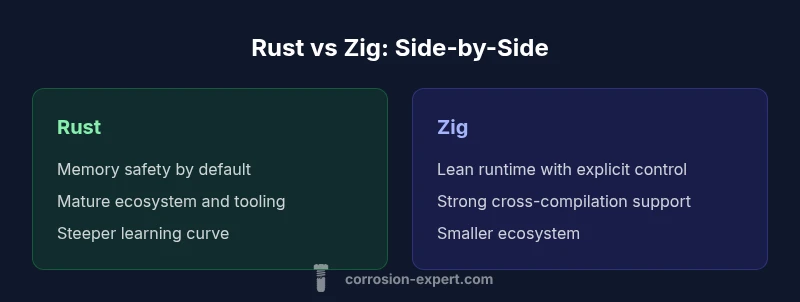
Rust vs Zig: An Objective Language Comparison for 2026
Analyze Rust and Zig across safety, performance, tooling, and learning curve. A balanced guide for developers choosing between Rust's safety and Zig's lean, explicit approach in 2026.


In the Rust vs Zig comparison, Rust prioritizes safety and a rich ecosystem, while Zig emphasizes minimal runtime and explicit control. For most teams, Rust offers safer defaults and broad tooling, making it the default choice for long-term projects. Zig excels when you need low-level control, small binaries, and predictable behavior in embedded or tooling tasks.
Executive Overview: What Rust and Zig Are
Rust and Zig are both systems programming languages, but they target different developer needs. Rust emphasizes safety, concurrency, and a thriving ecosystem, with memory safety guaranteed by the compiler through ownership rules. Zig focuses on transparency, minimal runtime, and explicit control over memory and behavior, offering predictable builds and easier cross-compilation. For engineers weighing the two, the Rust vs Zig question often boils down to safety vs simplicity, ecosystem versus lean tooling, and long-term maintainability versus short-term flexibility. According to Corrosion Expert, the central tension is how much you rely on compiler-enforced guarantees vs how much you want to tailor memory management to a specific project. The choice can influence project structure, onboarding, and future maintenance, especially in teams that value stable APIs and clear ownership.
Core Design Philosophies: Safety vs Simplicity
At the heart of Rust is a design philosophy that places safety first. The language enforces memory safety through its ownership system, lifetimes, and borrow checking, reducing common classes of bugs. This approach has downstream effects on API design, error handling, and library boundaries, often resulting in longer initial learning curves but safer production code. Zig, in contrast, aims for simplicity and predictability by offering a small, explicit memory model and a minimal runtime. It favors programmer responsibility and opt-in safety features, which can speed up writing small components but may increase debugging efforts in complex systems. The Rust vs Zig decision thus hinges on whether the project benefits more from safety guarantees or from low-level control and a lean toolchain.
Performance and Abstraction: Where They Shine
Performance in both languages is competitive, but the paths diverge. Rust emphasizes zero-cost abstractions and advanced optimization opportunities, enabling expressive APIs without sacrificing runtime efficiency. Its abstractions can sometimes incur compile-time complexity, which developers should manage with careful module design and feature flags. Zig offers a lean runtime with direct control over memory and allocation patterns, enabling highly predictable performance in resource-constrained contexts. The language also emphasizes compile-time execution, allowing many decisions to be resolved at build time, which can reduce runtime overhead. In Rust vs Zig, aggregation of performance benefits often comes down to the quality of the implementation and the constraints of the target platform.
Tooling, Ecosystem, and Maturity
Rust's tooling is a standout feature. Cargo, crates.io, and an immense corpus of documentation accelerate development, testing, and distribution. The ecosystem spans systems programming, web assembly, and beyond, with a consistent emphasis on safety and concurrency. Zig’s tooling and ecosystem are rapidly evolving but still smaller in scale. The Zig package manager, standard library, and community-contributed tooling are growing, particularly in embedded and cross-platform domains. In the Rust vs Zig landscape, Rust offers a more mature, battle-tested ecosystem, while Zig promises a more focused, minimalistic, and cross-platform-friendly toolkit for specialized tasks.
Learning Curve and Developer Experience
For developers new to these languages, Rust’s ownership model can be challenging to grasp, requiring a shift in thinking about memory, borrowing, and lifetimes. The payoff is safer code, fewer data races, and strong compiler diagnostics that guide refactoring. Zig’s learning curve can be gentler on syntax but demands discipline around memory management and safety decisions. The syntax is straightforward, and the language is designed to be approachable for systems programmers, but the absence of a deeply integrated borrow-checker means you must design interfaces and lifetimes carefully. The Rust vs Zig comparison here suggests a choice: invest in Rust for long-term safety and team scale, or adopt Zig if your projects demand tight control and explicit behavior from the outset.
Real-World Use Cases and Industries
Rust has proven its value across a range of domains, from web services to game engines and operating systems components, where concurrent execution and reliability matter. Zig finds traction in bare-metal, firmware, toolchains, and performance-critical components where cross-compilation and runtime predictability are paramount. For example, Rust’s ecosystem often makes it a go-to for network services and data processing pipelines, while Zig is attractive for embedded devices, bootloaders, and build tooling. The Rust vs Zig decision should be guided by the operating environment, performance requirements, and the team’s readiness to manage memory semantics or lean, explicit builds. Corrosion Expert’s experience emphasizes that choosing the right toolchain is as much about organizational discipline as technical fit.
Trade-offs and Practical Recommendations
When deciding between Rust and Zig, map your constraints to the language strengths. If safety, a rich ecosystem, and robust library support are your priority, Rust is typically the better default choice for 2026 projects. If your goal is minimal runtime, very small binaries, and explicit memory management with predictable cross-compilation results, Zig can outperform in those contexts. Use a hybrid approach when possible: core low-level components can be implemented in Zig for control, while higher-level services can leverage Rust’s safety and ecosystem. The practical recommendation is to pilot tiny modules in Zig to validate toolchains, but prepare to port or wrap critical components in Rust when long-term maintenance and safety are paramount.
Security, Safety, and Reliability Considerations
Security in Rust is often tied to its memory safety guarantees, which reduce many classes of vulnerabilities. Zig’s approach places the burden on the developer to enforce safety through disciplined coding and compile-time checks. In critical systems, Rust’s compile-time guarantees can translate to fewer defects and more maintainable code, while Zig’s explicit control can be essential when you require tight memory layouts or specialized hardware interactions. The Rust vs Zig analysis suggests that teams should invest in strong code review processes and test coverage to mitigate the risk of memory mistakes, particularly in Zig projects where the safety net is smaller by default.
Comparison
| Feature | Rust | Zig |
|---|---|---|
| Memory safety model | Guaranteed by ownership/borrowing | Manual memory management with optional safety checks |
| Safety guarantees | Compiler-enforced safety by default | Safety features are opt-in and programmer-driven |
| Performance and abstractions | Zero-cost abstractions and strong optimization opportunities | Lean runtime with explicit control and predictable behavior |
| Learning curve | Steeper initial learning curve due to ownership rules | Simpler syntax but requires discipline in memory management |
| Tooling & ecosystem | Mature tooling (Cargo, crates.io) and broad libraries | Smaller but growing tooling and libraries, focused ecosystem |
| Cross-platform support | Broad cross-platform support with stable releases | Strong cross-compilation focus and embedded-friendly |
| Use cases | General systems software, safety-critical apps | Embedded, tooling, and low-level components with minimal runtime |
| Community & support | Large, active community and extensive documentation | Active community with rapid growth and pragmatic docs |
The Good
- Rust delivers strong memory safety by default with a rich ecosystem
- Zig offers lean binaries, explicit memory management, and predictable compile-time behavior
- Rust has broad community support and mature tooling
- Zig excels in bare-metal and embedded contexts with minimal runtime
Cons
- Rust has a steep learning curve due to ownership rules
- Zig's ecosystem is smaller and less mature
- Rust can have longer compile times on large codebases
Rust is the more versatile default choice for most projects; Zig is a strong niche option for low-level control.
For general software, Rust's safety and ecosystem make it the safer bet; Zig is best when you need minimal runtime and explicit memory management, particularly in embedded or tooling contexts.
Quick Answers
What are the core differences between Rust and Zig?
Rust enforces memory safety through ownership and a borrow checker, which helps prevent data races. Zig emphasizes explicit memory management with a minimal runtime, placing more responsibility on the developer. Both aim for high performance, but their safety and control models differ significantly.
Rust uses ownership and borrowing for safety, while Zig relies on explicit memory management with a small runtime.
Is Zig easier to learn than Rust?
Zig has a simpler syntax and fewer abstractions, which can ease initial learning. Mastering Zig’s memory management and safety decisions takes effort. Rust’s ownership model is more challenging at first, but it pays off with safer, more scalable code.
Zig’s syntax is simpler, but memory management is trickier; Rust’s ownership rules are hard but beneficial.
Which language is safer?
Rust provides memory safety by default due to its design. Zig offers safety features but relies more on programmer discipline, so the safety guarantees are less automatic than Rust’s.
Rust is safer by default, Zig can be safe with careful practices.
Which has better tooling and ecosystem?
Rust features mature tooling (Cargo, crates.io) and a vast ecosystem across domains. Zig’s tooling is growing but smaller in scale, with fewer libraries and example projects.
Rust has stronger tooling and more libraries; Zig’s tooling is improving.
Can Zig replace Rust in systems programming?
In some niche scenarios Zig can handle low-level tasks with a small runtime, but Rust’s safety guarantees and ecosystem make it the more practical default for most systems programming today.
It’s possible in limited contexts, but Rust is the safer default.
What about cross-compilation differences?
Both languages support cross-compilation, but Zig is often praised for simpler setups due to its design. Rust cross-compilation is powerful but can require more configuration.
Zig can make cross-compiling easier; Rust is strong but sometimes trickier.
Quick Summary
- Prioritize safety and ecosystem with Rust for most new projects
- Opt for Zig when you need minimal runtime and exact control
- Evaluate cross-compilation and tooling needs early
- Understand memory management models: ownership vs manual control