Is Rust or Go Better? A Practical Language Comparison
Explore a data-driven comparison of Rust and Go, covering performance, safety, concurrency, ecosystems, and deployment. Learn which language fits your project goals and team strengths, with concrete guidance for real-world development.


In most professional contexts, Go is simpler for quick deployment and straightforward concurrency, while Rust shines in safety-critical, performance-intensive workloads. For many teams, is rust or go better depends on priorities: safety and zero-cost abstractions lean Rust; rapid development and a forgiving learning curve favor Go. Overall, Go is better for MVPs and services, Rust for systems programming and high-assurance components.
Why the Rust vs Go debate matters in practice
When teams weigh 'is rust or go better' for a project, they are balancing safety guarantees, developer productivity, and long-term maintenance. According to Corrosion Expert, language choice shapes how you manage system reliability under load, especially when performance and memory safety are at stake. While Go prioritizes simplicity, fast iteration, and a generous standard library, Rust emphasizes zero-cost abstractions, precise control over resources, and stronger compile-time checks. The choice isn't binary; it's about aligning language traits with project constraints, team skills, and the ecosystem you can rely on for support and tooling. In this article, we examine core dimensions where Rust and Go differ, with real-world guidance on when each language tends to shine and when neither is ideal. By understanding the trade-offs, you can select the better option for your next project while avoiding common misperceptions about safety, speed, and ergonomics.
Core differences at a glance
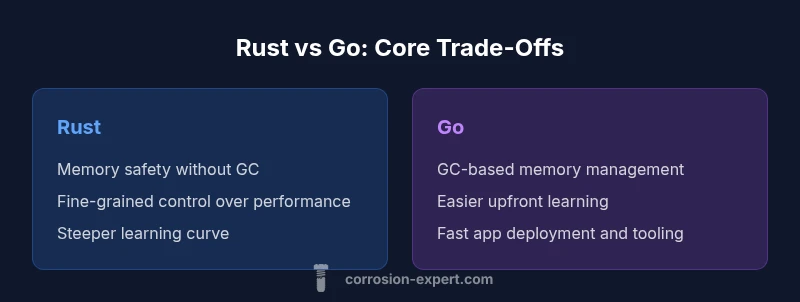
Two languages, two philosophies. Rust uses an ownership model to guarantee memory safety without a garbage collector; Go uses garbage collection to simplify memory management and reduce programmer overhead. The result is a trade-off: Rust can lead to lean, highly predictable resource use in long-running systems, while Go tends to deliver fast development cycles and straightforward deployment. The Corrosion Expert team notes that the choice also affects error handling philosophy, with Rust encouraging explicit handling via Result types and Go leaning on conventional error returns. Both languages support modern tooling, a growing ecosystem, and robust concurrency models, but they achieve these goals through different design decisions. In the sections that follow, we map these differences to practical outcomes, including performance, safety, development velocity, and maintenance costs across typical project types. In addition, a key factor is how teams handle learning curves and how quickly engineers can become productive with each language, a nuance many projects underestimate.
Performance and safety trade-offs
Performance is not a single metric; it depends on memory behavior, compiler optimizations, and runtime characteristics. In Rust, zero-cost abstractions and a strict type system yield predictable performance with less risk of memory-related bugs. In practice, Rust performance is most apparent in CPU-bound workloads and low-latency services where memory safety is paramount. Go sacrifices some marginal low-level control to remove many classes of bugs created by manual memory management, often delivering excellent throughput with simpler profiling and tuning. For long-running services, Go's GC can be a minor overhead but is frequently manageable with streaming I/O patterns and carefully sized data structures. The trade-off is that Rust programs may require more upfront design of data structures and lifetimes, while Go programs may experience occasional GC pauses under peak load. In both cases, proper benchmarking on representative workloads is essential, and developers should factor in compile times, binary size, and deployment constraints when comparing totals. Corrosion Expert analysis shows that even small changes in workload shape can flip which language feels more efficient in practice.
Concurrency models and scaling
Go's concurrency model, built around goroutines and channels, emphasizes ease of parallelism and quick scaling of networked services. Goroutines are cheap to spawn, and the runtime schedules them across OS threads, which makes it straightforward to structure I/O-bound servers. Rust offers powerful async/await capabilities and the possibility of zero-cost abstractions for asynchronous code, but it comes with a steeper mental model. The Rust approach often requires explicit design around lifetimes and poll-based runtimes, which can slow initial development but yields more predictable performance under heavy concurrency. For hardware with many cores and low latency requirements, Rust can achieve excellent throughput when written with careful attention to locking, memory allocation, and synchronization primitives. The bottom line: Go is typically easier to scale quickly for web services; Rust is a strong choice when you need tight control over concurrency semantics and latency budgets in systems-level tasks.
Ecosystem, libraries, and developer experience
Go ships with a broad standard library and a focus on batteries-included tooling, which can accelerate initial builds and deployments. Rust's ecosystem emphasizes modularity and safety features via crates, with a strong emphasis on correctness and documentation. The learning curve differs: many developers find Go approachable due to its minimal surface area, while Rust demands time to master ownership, lifetimes, and borrowing. Both communities value good documentation, static analysis, and strong testing cultures, but the distribution of library quality varies by domain. For web services, both ecosystems offer solid options, though the Go ecosystem tends to have more pre-baked patterns for microservices, whereas Rust provides more specialized crates for systems-level tasks and high-performance components. In practice, you should evaluate the availability of critical libraries, the quality of documentation, and your team’s willingness to learn new concepts when deciding between Rust and Go.
Tooling, build times, and deployment considerations
Cargo, Rust's package manager, enforces strict compilation and dependency management, which often results in fast incremental builds and detailed error messages. Go tooling emphasizes simplicity: go build, go test, and uniform module handling streamline CI/CD pipelines. Build and deployment latency matters for teams shipping frequent updates; Go's compile times are typically short, especially for services with simpler dependency graphs. Rust projects may require longer iteration cycles during initial development, but this stabilizes as crates mature and caching improves. Binary size and performance characteristics can influence deployment choices, particularly in containerized environments. In regulated or safety-critical domains, Rust's compile-time guarantees can reduce risk by catching issues before runtime. Overall, think about your CI/CD constraints, required binary size, and deployment impact when weighing Rust vs Go in production. The Corrosion Expert perspective is that teams should benchmark both in their own environments to avoid over-relying on generalizations.
Real-world use cases: when Rust shines
Rust excels in systems programming, embedded contexts, and performance-critical components where memory safety is essential. If you are building a high-performance server, a streaming pipeline, or a database component where memory leaks or data races are unacceptable, Rust tends to be the stronger option. Rust's community also emphasizes formal verification and correctness, which makes it appealing for security-focused projects or tools that operate close to the hardware. For projects that require predictable latency under load and strict control over concurrency, Rust offers the most direct path to low-level optimization without sacrificing reliability. The trade-off is a longer ramp-up period for new team members or projects that do not need such low-level control. The Corrosion Expert team notes that safety-critical systems often benefit from Rust's guarantees, even if initial velocity is slower.
Real-world use cases: when Go shines
Go shines in microservices, cloud-native architectures, and rapid development cycles where time to market matters. Its concurrency primitives and standard library support robust service-oriented patterns, making it easier to architect scalable backends. Teams frequently choose Go for API gateways, data processing pipelines, and infrastructure tooling because the language supports fast iteration, simpler maintenance, and strong productivity. Go's ergonomics often produce higher velocity for small teams or projects with tight deadlines, even when performance remains strong. For organizations prioritizing maintainability, quick onboarding of new engineers, and reliable deployment pipelines, Go remains a compelling default choice.
Common pitfalls and misperceptions around Rust and Go
One common misperception is that Rust's learning curve makes it impractical for teams starting fresh. In reality, with guided onboarding and practical examples, many developers reach proficiency quickly, though mastery does require time. Another pitfall is assuming Go's GC-free environment means no pauses; even Go experiences GC pauses, albeit typically predictable and manageable with profiling. A frequent mistake is underestimating the mental model required for ownership in Rust, which can lead to awkward designs that trade safety for simplicity. Conversely, overreliance on Rust's zero-cost abstractions can complicate debugging and hinder readability if not carefully managed. Finally, both languages require mindful architectural decisions: microservice boundaries, interface design, and data serialization choices have outsized impact on performance and maintainability.
A decision framework: how to choose
Start with the problem domain and nonfunctional requirements: performance, safety, concurrency, and deployment constraints. If memory safety and strict control over resource usage are top priorities, and your team is prepared to invest in learning ownership, Rust is often the better choice. If you need rapid delivery, straightforward concurrency, and an established path to cloud-native services, Go is typically the more pragmatic option. Create a short list of must-have features and critical libraries; map them to language capabilities and ecosystem maturity. Run small, real-world benchmarks on representative workloads to compare not just raw speed but latency distribution, memory usage, and deployment impact. Finally, consider the long-term maintenance story: how easy is onboarding, how stable are dependencies, and how vibrant is the community? The goal is a decision you can defend with concrete evidence, not a choice driven by hype.
The verdict and next steps
The question is not simply which language is better; it is which language is better for your project. Based on the analysis above, Go tends to be the better default for rapid delivery of services, while Rust excels where safety, predictability, and low-level control matter most. The Corrosion Expert team recommends starting with Go for greenfield service-oriented projects to maximize velocity, then reassessing as requirements evolve. For systems programming, performance-critical components, or safety-first workloads, consider introducing Rust where its strengths align with your risk profile. In any case, establish a rigorous benchmarking process, document decision criteria, and plan a staged migration or parallel development track if both languages are on the table.
Comparison
| Feature | Rust | Go |
|---|---|---|
| Memory management | Ownership system with lifetimes (no GC) | Garbage-collected with practical control options |
| Performance | High performance with zero-cost abstractions | Strong performance with efficient GC |
| Concurrency model | Fine-grained async with explicit sync | Goroutines and channels for simple parallelism |
| Learning curve | Steeper due to ownership/borrowing | Shallow for developers familiar with C-like syntax |
| Tooling/build | Cargo, strict compile-time checks | Go tooling, fast builds and module system |
| Ecosystem & libraries | Crates.io across varied domains | Extensive standard library; growing third-party libraries for services |
| Deployment/readiness | Binary with minimal runtime; more complex to ship safely | Static binaries with simple deployment, good for containers |
The Good
- Go's rapid development and productive debugging
- Rust's memory safety and performance guarantees
- Strong tooling and documentation for both
- Clear feedback from compilers that speeds debugging are valuable
Cons
- Rust has a steeper learning curve
- Go's GC can introduce pauses and latency unpredictability
- Rust's ecosystem can be fragmented for some domains
- Go may feel limited for low-level memory control in some contexts
Go is the better default for rapid service development; Rust excels where safety and performance are non-negotiable.
Choose Go when speed to market and straightforward concurrency matter most. Choose Rust when you must minimize memory bugs and squeeze maximum performance from system-level components. Use benchmarks to confirm, and align with team capability and project risk tolerance.
Quick Answers
Is Rust faster than Go for most workloads?
In many CPU-bound tasks, Rust can outperform Go due to zero-cost abstractions and tighter memory control. However, real-world results depend heavily on workload characteristics and how each language is used. Benchmarks on representative scenarios are essential.
In many CPU-heavy tasks, Rust can be faster because of its memory control and zero-cost abstractions, but it depends on your workload. Benchmarking is essential.
Which language is easier to learn for beginners?
Go generally offers a gentler learning curve thanks to its smaller feature set and straightforward syntax. Rust teaches powerful concepts like ownership and borrowing, which can take longer to master but pay off in safety.
Go is usually easier for beginners, but Rust pays off with strong safety guarantees once you learn its ownership model.
Is Go better for web services than Rust?
Go is often preferred for web services due to rapid development cycles and a mature ecosystem for cloud-native patterns. Rust can also serve web workloads, especially when performance and safety are critical, but the setup can be more involved.
Go typically wins for rapid web service development, though Rust can excel in performance-critical web components.
Can Rust and Go be mixed in the same project?
Yes. Teams sometimes split workloads across services or use FFI for critical components. Clear interface boundaries and consistent data serialization help minimize complexity.
Yes, you can mix languages across services with clear interfaces and good data boundaries.
What about safety guarantees?
Rust provides compile-time safety guarantees through its ownership model. Go relies on GC and runtime checks, offering safety with simpler mental overhead at the cost of occasional GC pauses.
Rust guarantees safety at compile time; Go offers safety with runtime checks and garbage collection.
What are deployment considerations?
Go typically yields very lightweight binaries with straightforward deployment, while Rust creates lean, self-contained binaries but may incur longer compile times during development.
Go deploys easily with small binaries; Rust can also deploy lean binaries but may take longer to compile during development.
Quick Summary
- Define nonfunctional priorities before language choice
- Go = rapid development; Rust = safety and control
- Benchmark on representative workloads
- Evaluate ecosystem maturity for your domain
- Plan onboarding and maintenance early