Difference between Rust and Go
An analytical comparison of Rust and Go, covering memory safety, concurrency, performance, tooling, ecosystem maturity, and learning curves to guide language choice for your next project.


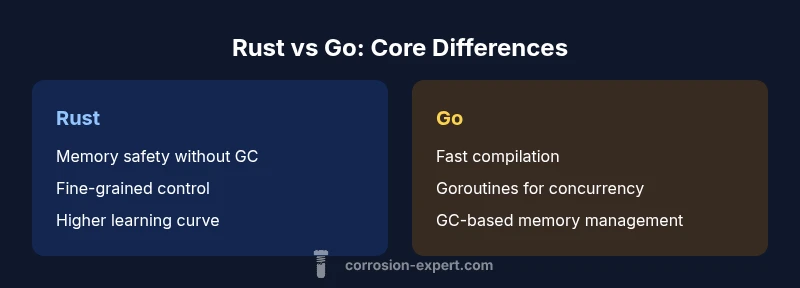
Rust and Go embody two distinct philosophies for building software. The difference between rust and go centers on safety guarantees, memory management, and concurrency models: Rust delivers memory safety without a GC through ownership and borrowing, while Go emphasizes simplicity and fast iteration with garbage collection and a built-in scheduler for concurrency. In short, Rust targets low-level systems with tight control, and Go targets productive backend development with reliable, scalable concurrency.
What are Rust and Go? A primer
The difference between rust and go is more than syntax; it signals two distinct philosophies for building software. Rust is a systems programming language designed to deliver memory safety without a garbage collector, while Go (GoLang) emphasizes simplicity and rapid iteration for scalable services. Both languages aim to modernize tooling, yet they approach safety, performance, and concurrency from different angles. According to Corrosion Expert, the difference between rust and go depends on the problem space you tackle and the constraints you face.
For developers evaluating which to use, it's essential to articulate project goals: will you value absolute control over memory and fine-tuned performance, or do you prioritize quick prototyping and straightforward concurrency? Throughout this article we analyze Rust and Go across common criteria — memory management, concurrency, performance, ecosystem, and learning curve — to illuminate the practical implications of each option. The goal is to help you pick the language that best fits your architecture, team skills, and deployment realities.
Design philosophies: safety, simplicity, and pragmatism
Rust prioritizes safety and correctness through a strict ownership model, lifetimes, and borrow checking. The compiler enforces rules at compile time, preventing data races and null-pointer dereferences, which is why many teams associate Rust with reliability in low-level systems. Go, by contrast, pursues simplicity and pragmatic concurrency. Its design favors a small, readable surface area, a fast compile cycle, and a built-in concurrency model via goroutines. The difference between rust and go here isn't about performance alone; it's about how developers think about correctness and speed: Rust asks you to prove safety as you code, while Go lets you move quickly and refactor with solid tooling. Both communities value robust tooling ecosystems and clear error messaging, but the path to mastery diverges: Rust invites deep attention to memory semantics, while Go invites faster onboarding and a more forgiving workflow for multi-service architectures. In practice, teams often choose based on whether the project demands maximum control or rapid feature delivery with consistent runtime behavior.
Memory management and safety: ownership vs garbage collection
Rust uses a strict ownership model with borrowing and lifetimes that enforces memory safety at compile time without a runtime garbage collector. This design means developers can write low-level code with precise control over allocation and deallocation, reducing the risk of leaks and use-after-free errors. The borrow checker prevents data races by enforcing rules about aliasing and mutation. The trade-off is a steeper learning curve and more upfront architectural discipline, especially in large codebases. The payoff is predictable performance and fine-grained resource control, which is crucial for systems programming and performance-critical libraries.
Go takes a different path by relying on a garbage collector for automatic memory management. This simplifies programming and accelerates development speed, but introduces non-deterministic pauses and potential latency in latency-sensitive applications. While modern Go runtimes minimize GC impact, architects still need to design to reduce allocations and consider pooling strategies for hot paths. The practical difference in this dimension is whether you want deterministic memory behavior and zero GC pauses (Rust) or a simpler model with dependable developer velocity (Go).
Concurrency models: goroutines vs asynchronous patterns
Go provides a built-in concurrency model based on lightweight threads called goroutines and a channel-based communication mechanism. The Go runtime schedules thousands of goroutines efficiently, making it easy to express parallelism and build scalable services with minimal boilerplate. This model is particularly attractive for web services, batch processing, and tooling where predictable deployment and rapid iteration matter.
Rust supports concurrency through a combination of ownership guarantees and asynchronous programming. The language enforces data-race freedom, and the async/await ecosystem enables non-blocking I/O with executors like Tokio or async-std. There is no universal runtime to learn, so teams pick an executor that fits their workload. The result is highly scalable systems with explicit control over threading and memory, but it requires careful planning of lifetimes, task boundaries, and error handling. The key difference is that Go optimizes for developer ergonomics and a shared scheduler, while Rust offers more granular safety controls and potential performance benefits at scale.
Performance characteristics and compilation times
Rust typically delivers excellent runtime performance due to zero-cost abstractions and precise memory control. In compute-heavy workloads, Rust can approach C/C++ performance, making it an attractive choice for performance-critical components. However, Rust’s compile times can be longer, especially for large projects, and incremental builds require thoughtful modularization.
Go emphasizes fast compilation and rapid build cycles, which translates into quick iteration and faster feedback during development. Runtime performance is strong for many server workloads, though GC pauses can affect latency in certain edge cases. For API servers and cloud-native workloads, the practical difference often hinges on deployment velocity and predictable latency more than raw throughput. The trade-off is clear: Rust offers potential peak performance with a steeper development curve, while Go prioritizes quick delivery and stable run-time behavior.
Tooling, libraries, and ecosystem maturity
Rust ships with Cargo as its primary build system and package manager, paired with crates.io, a thriving ecosystem for systems programming, cryptography, and data processing. The tooling emphasizes precise dependency management, reproducible builds, and careful licensing considerations. For complex, performance-sensitive projects, the crate ecosystem provides powerful options, but developers may need to curate dependencies more carefully to avoid bloat and compilation delays.
Go provides a robust, opinionated toolchain: go fmt, go test, go vet, and a coherent module system (go mod) support predictable workflows. The standard library is broad and battle-tested, with strong support for network services, databases, and cloud-native patterns. Go’s ecosystem tends to favor cloud-native and microservice architectures, enabling rapid prototyping and straightforward deployment. The practical takeaway is that Rust has a rich, niche-focused ecosystem suitable for high-performance components, while Go offers a broad, ready-to-run toolkit for service-oriented development.
Learning curve and developer experience
Rust’s learning curve is steep due to mastering ownership, borrowing, lifetimes, and the borrow checker’s feedback. New Rustaceans often spend time adjusting to compile-time checks before writing ergonomic, safe code. Once those concepts click, developers gain confidence in memory safety across contexts, including multi-threaded scenarios. The payoff is long-term reliability and fewer runtime surprises in production.
Go offers a gentler ascent with a simpler syntax and fewer language concepts to grasp initially. Developers can become productive quickly, particularly for backend services and tooling. The trade-off is sacrificing some of Rust’s strict safety guarantees in exchange for faster ramp-up and easier maintenance for many standard cloud-based workloads.
Use-case mapping: when to pick Rust vs Go
When building performance-critical systems, embedded software, or components where memory safety and determinism matter, Rust often shines. If your project demands predictable performance with tight control over resource usage and low-level access, Rust is a strong candidate. For cloud-native backends, microservices, CLI tools, and fast time-to-market needs, Go’s straightforward concurrency, rapid iteration, and deployment simplicity provide a practical advantage.
In multi-language ecosystems, teams sometimes adopt a hybrid approach: core performance-sensitive modules in Rust, complemented by Go for orchestration, APIs, and tooling. This strategy can offer the best of both worlds but requires careful interface design and cross-language calling patterns to avoid maintenance headaches.
The overarching lesson from the difference between rust and go is to map language choice to the problem domain, team expertise, and operational constraints rather than chasing an abstract ideal.
Industry adoption and real-world patterns
Go has achieved broad adoption in cloud-native infrastructure, container tooling, and microservice ecosystems, backed by long-term industry usage and strong community support. Rust is increasingly adopted in areas demanding maximal performance and safety guarantees, such as systems components, cryptography, and performance-critical libraries. Real-world deployments often involve Rust for core libraries and Go for services and tooling, underscoring a pragmatic balance between speed-to-market and performance.
Deployment strategies matter: Go’s tendency toward single-binary deployments simplifies containerization and DevOps workflows, while Rust projects may require more deliberate packaging and dependency management. Governance and community standards continue to shape language evolution, but both languages benefit from clear testing practices, robust CI pipelines, and a culture of architectural clarity.
Interoperability and cross-language considerations
Interoperability is a practical concern when integrating languages into a shared codebase. Rust offers strong C FFI support, enabling interoperability with existing C/C++ ecosystems and high-performance modules. Go supports C interop via cgo, but this path can introduce complexity, portability considerations, and potential safety concerns when crossing language boundaries. For teams, the key is to plan interface contracts, data layout, and memory ownership early to minimize integration friction.
Cross-language boundaries often benefit from clear boundary abstractions and well-defined serialization formats, reducing the cognitive load when moving between languages. If you anticipate frequent cross-language interactions, evaluate the cost of FFI wrappers, build tooling, and debugging complexity as part of your decision framework.
Decision framework: practical steps to choose
Begin with a prioritized list of criteria: safety requirements, performance targets, concurrency needs, team expertise, and deployment constraints. Create a small pilot project in both languages to assess developer experience and maintenance costs. Map the results to a decision matrix: rate memory control, runtime latency, build times, and ecosystem support. Finally, consider long-term maintenance: who will support the codebase, how easy is it to onboard new engineers, and what is the expected total cost of ownership.
The goal is to build a reproducible, evidence-based assessment rather than a single winner. The difference between rust and go is not a binary choice, but a spectrum of trade-offs aligned to project reality.
Common misconceptions and caveats
One common misconception is that Rust automatically outperforms Go in every scenario. In practice, performance is domain-dependent and influenced by architecture and workload characteristics. Another pitfall is assuming Go cannot compete in systems-like workloads; with careful design, Go can deliver impressive back-end performance and reliability. Finally, don’t confuse learning curves with capability: both languages require good software engineering practices, but their cognitive costs differ. A balanced evaluation reduces bias and leads to a more informed decision.
The data we can rely on (no hype)
This section provides a grounded frame for interpreting the topic. While there are no universal benchmarks, developer surveys and industry reports highlight Go’s long-standing popularity in cloud-native environments and Rust’s rising adoption in performance-critical domains. In this article we rely on established patterns and community consensus rather than sensational claims. The intent is to equip engineering teams with practical criteria to guide language selection in real-world projects.
Comparison
| Feature | Rust | Go |
|---|---|---|
| Memory management | Ownership-based with borrow checking; no GC | Garbage-collected with automatic memory management |
| Concurrency model | Fine-grained control; async/await with optional runtime (e.g., Tokio) | Goroutines with built-in scheduler and channels |
| Performance characteristics | Near-C performance in many workloads; zero-cost abstractions | Strong runtime performance with GC; fast enough for many workloads |
| Compilation/build speed | Longer compile times; modularization helps | Fast compile times and rapid iteration |
| Learning curve | Steep due to ownership, lifetimes | Gentler due to simplicity and minimalism |
| Tooling and ecosystem | Cargo, crates.io; strong for systems programming | Go toolchain; standard library; broad cloud ecosystem |
| Use cases | Systems programming; performance-critical libraries; embedded | Backend services; cloud-native apps; tooling |
| Memory safety guarantees | Compile-time safety without GC | Safety through GC and runtime checks |
The Good
- Rust delivers strong safety guarantees with high performance
- Go enables rapid development with easy concurrency and fast iteration
- Cargo and Go tooling streamline builds and dependency management
- Rust’s zero-cost abstractions scale to large codebases
- Go’s straightforward syntax reduces onboarding time
Cons
- Rust has a steeper learning curve due to ownership and lifetimes
- Go’s GC can introduce latency in latency-sensitive apps
- Rust compile times can be longer for large projects
- Go lacks as fine-grained memory control as Rust
Rust is the safer, higher-performance choice for low-level systems; Go excels in rapid backend development.
Choose Rust when memory safety and deterministic performance matter most, especially in systems programming. Choose Go when you need fast deployment, straightforward concurrency, and rapid iteration for cloud-native services. The best choice depends on project goals, team expertise, and deployment constraints.
Quick Answers
What is the main difference between Rust and Go?
Rust focuses on memory safety without garbage collection and high performance, while Go emphasizes simplicity and fast iteration with garbage collection and built-in concurrency primitives.
Rust prioritizes safety and control; Go emphasizes simplicity and quick development.
Is Rust harder to learn than Go?
Yes, Rust's ownership model and lifetimes create a steeper learning curve. Go is generally easier to pick up due to its minimal feature set and straightforward syntax.
Rust takes more time to learn because of ownership and lifetimes.
Which language is better for backend services?
Go is commonly preferred for backend services due to rapid development and strong concurrency support, though Rust can perform exceptionally well in compute-heavy backends.
Go is usually a better fit for backend services, but Rust can excel in performance-critical backends.
Do Rust and Go interoperate with C?
Yes, both languages offer C interoperability, but Rust has more mature and flexible FFI options, while Go's cgo path can introduce portability considerations.
Both can talk to C, but Rust has broader FFI support.
Which language has better tooling?
Both have strong tooling. Rust uses Cargo and crates.io; Go relies on the go toolchain and modules. Your choice may depend on ecosystem needs and developer preferences.
Both offer excellent tooling; it depends on your project needs.
Is Go faster at runtime than Rust?
Not universally. Rust often achieves higher raw performance, while Go delivers strong performance with GC-managed memory and fast iteration, suitable for many services.
Rust usually edges out Go on raw speed, but Go is very fast to develop with.
Quick Summary
- Choose Rust for memory-safe, high-performance systems
- Prefer Go for rapid development and scalable backends
- Assess ecosystem alignment with your domain
- Consider build times and deployment constraints
- Match team skills to language paradigms
- Both languages offer strong tooling; pick by problem space