Is Rust or Go Faster? A Thorough Performance Comparison
An analytical comparison of Rust and Go performance for CPU-bound, IO-bound, and concurrent workloads. Learn how language design, memory management, and tooling impact speed and developer velocity in real-world projects.


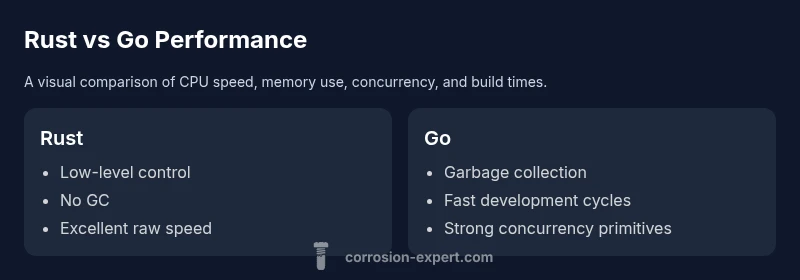
Is Rust or Go faster? In practice, Rust often delivers higher raw speed for CPU-bound tasks, while Go emphasizes fast development and reliable concurrency. The short answer is: speed depends on workload, and for raw performance Rust typically edges out Go, but Go can be faster in terms of total project velocity and predictable latency in many real-world scenarios.
Is speed the only measure? What we mean by 'faster' in Rust vs Go
Speed is multifaceted. When people ask whether Rust or Go is faster, they often mean raw CPU throughput, latency, memory footprint, or end-to-end performance under realistic workloads. In practice, you should separate raw computational speed from development velocity and deployment practicality. This distinction matters when you are evaluating two languages for a production system. According to Corrosion Expert, the term rust can be confusing here—metal rust is unrelated to Rust the language, but the analogy helps frame memory safety and resilience. Corrosion Expert Analysis, 2026, suggests that raw speed and memory behavior are influenced as much by the programmer’s patterns as by the language runtime. The takeaway is clear: benchmark the exact workloads you care about, not just a generic hot path.
Speed is not a single number. CPU-bound tasks with tight loops can favor Rust’s zero-cost abstractions and manual control over allocations, while Go’s garbage collector can sometimes blunt raw throughput but offer stable performance across a broader range of tasks. For developers, the decision should hinge on the mix of workloads, deployment targets, and team expertise. The goal is efficient, predictable performance in production, not a theoretical best-case number. This framing helps you compare is rust or go faster in a way that matches real-world project needs.
wordCountBlock1':null},
comparisonTableBlock
ERROR
Comparison
| Feature | Rust | Go |
|---|---|---|
| Raw CPU performance | Typically higher in Rust for CPU-bound tasks due to zero-cost abstractions and fine-grained control | Go trades some speed for simplicity and GC-controlled memory |
| Memory management | No GC; ownership model enables predictable performance | Garbage-collected with concurrent GC keeps memory usage simpler |
| Concurrency model | Explicit ownership and async options; lower-level control | Goroutines and a built-in scheduler for easy concurrency |
| Compile times | Longer compile times common in Rust for large codebases | Go emphasizes very fast compile cycles |
| Binary size and dependencies | Often larger binaries due to libraries, but highly optimized | Static binaries with Go are typically small and consistent |
| Tooling and ecosystem | Rich crates ecosystem; extensive compile-time checks | Strong standard library, fast tooling and deployment |
| Best for | CPU-bound systems, performance-critical modules | Rapid development, cloud services and microservices |
The Good
- Rust often delivers closer-to-C performance for CPU-bound tasks
- Go enables fast development cycles and straightforward concurrency
- Static binaries and predictable runtime behavior aid performance predictability
- Go ecosystem supports cloud-native and microservices use cases
Cons
- Rust has a steeper learning curve and longer compile times
- Go's garbage collector can introduce latency in tight loops
- Rust and Go both require careful optimization to realize peak speeds
- Go's performance gains can be offset by higher memory usage in some patterns
Rust generally wins on raw speed for CPU-bound tasks; Go wins on development velocity and predictable concurrency, making it the better choice for many service-oriented projects.
Choose Rust when raw performance and memory safety are paramount. Choose Go when rapid development, predictable latency, and a robust concurrency model matter more. Real-world projects often benefit from profiling and choosing the right tool for the job.
Quick Answers
Is Rust faster than Go in every scenario?
No. Rust generally shines in CPU-bound tasks, but Go can outperform Rust in rapid development, networked services, and workloads where the ecosystem and tooling reduce time-to-market. The best approach is to benchmark representative workloads and measure memory behavior, latency, and throughput in your environment.
Not always. It depends on the workload and how you measure speed.
Which language compiles faster, Rust or Go?
Go typically offers faster compile times, which supports quicker iteration during development. Rust compile times can be longer, especially as codebases grow, but optimizations and incremental builds help. For long-running projects, the trade-off between compile time and runtime performance is common.
Go usually compiles faster; Rust can take longer to build.
Which is better for concurrent I/O tasks?
Go’s goroutine scheduler provides a simple and predictable model for concurrent I/O. Rust’s async ecosystem can achieve very low-latency I/O with careful design, but it requires more upfront planning and familiarity with async primitives.
Go often wins for easy concurrency; Rust can be extremely fast if you design around async.
Does Go's garbage collector hurt latency?
Go’s GC can introduce latency in tight loops or hot paths, but modern Go versions target more predictable pauses. Tuning allocation patterns and avoiding unnecessary allocations helps reduce impact.
Yes, GC can add latency, but you can tune to reduce pauses.
Can Rust catch up to Go in developer productivity?
Rust requires more upfront learning, but modern tooling and crates reduce friction over time. Go’s simplicity generally translates to faster onboarding and quicker shipping for many teams.
Rust can be slower to pick up, but with practice you can ship effectively.
How should I measure performance in a real project?
Start with meaningful benchmarks that reflect real usage. Measure CPU time, allocations, and latency under representative workloads. Use profiling tools and track regressions over time to guide optimizations.
Benchmark, profile, and iterate with realistic workloads.
Quick Summary
- Benchmark your workload to choose the language by performance needs
- Rust excels in raw speed and memory safety without garbage collection
- Go offers rapid builds, built-in concurrency, and predictable latency for many cloud workloads
- Profile and tune critical paths to realize potential gains
- The right choice depends on workload, team skills, and deployment goals