Rust vs Go: A Practical Language Showdown
A comprehensive, objective comparison of Rust and Go, focusing on safety, concurrency, performance, and ecosystem to guide developers deciding between rust or go.


Rust emphasizes memory safety and deterministic performance through ownership and zero-cost abstractions, often favored for low-level systems. Go prioritizes simplicity and rapid development, with lightweight concurrency that scales for cloud services. When deciding between rust or go, weigh safety and control against development speed and ecosystem maturity. Both can excel depending on project requirements and team strengths.
The Core Question: rust or go
In modern software engineering, teams frequently encounter a fork in the road when choosing between two standout languages: rust or go. The question isn’t merely which is faster, but which aligns with your project goals, team skills, and long-term maintenance plan. For many developers, the decision hinges on how you balance safety, performance, and development velocity. When you say rust or go, you’re weighing different design philosophies: Rust prioritizes memory safety and fine-grained control, while Go emphasizes simplicity and rapid iteration. In practice, this choice affects architecture, deployment, and even how you structure teams. According to Corrosion Expert, the most important part of this decision is understanding the trade-offs in safety guarantees, concurrency models, and ecosystem maturity. As you read on, you’ll see how these factors play out in real-world contexts and why rust or go might be the right call for your next project.
Underlying Philosophies: safety, concurrency, and simplicity
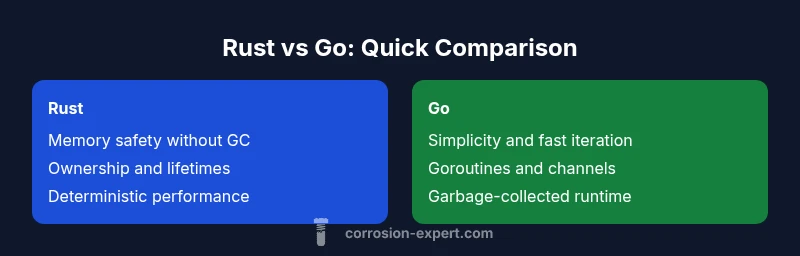
Rust and Go embody distinct philosophies that influence every design decision. Rust’s core philosophy is memory safety without a runtime GC, achieved through the ownership model, lifetimes, and strict borrow checking. This yields predictable performance and reduces a broad class of runtime errors, but it also raises the learning curve as developers master ownership patterns. Go, by contrast, embraces simplicity, a garbage-collected runtime, and a focus on productive coding sessions. Its concurrency primitives—goroutines and channels—make parallel tasks feel natural and approachable, which accelerates initial development and onboarding. When you compare rust or go, you are weighing the precision and rigor of Rust against the ergonomic speed of Go. In teams that prioritize long-term safety and predictable latency, Rust often wins; in teams that need rapid prototyping and scalable network services, Go tends to shine.
Language Design Trade-offs
Choosing between rust or go involves considering how each language balances expressiveness, safety, and complexity. Rust trades a steep learning curve for strong guarantees: no data races, explicit memory management, and zero-cost abstractions that can outperform higher-level languages in tight loops. This makes Rust a strong candidate for systems programming, database engines, and performance-critical components where reliability matters. Go minimizes friction with a simpler syntax, a pragmatic standard library, and a straightforward toolchain. It excels in microservices, cloud-native architectures, and teams that value fast shipping and clear maintenance paths. The trade-offs are clear: Rust offers maximum control and safety at the cost of complexity; Go offers speed of development and simplicity at the potential cost of latency spikes due to garbage collection. In your planning, consider which balance better aligns with your project’s constraints and your team’s strengths.
Performance and Efficiency: what matters
Performance for rust or go is not just about raw speed; it’s about predictable behavior under load and clear resource usage. Rust’s lack of a traditional GC means fewer hiccups in latency-sensitive contexts and more deterministic memory management, which is critical for embedded systems, real-time processing, or high-frequency workloads. Go’s performance benefits emerge from fast compilation, lightweight concurrency, and an efficient runtime that handles many simultaneous tasks with relatively low cognitive overhead. In practice, Rust may deliver tighter control over memory and latency, while Go often delivers faster development cycles and robust concurrency in scalable services. When evaluating performance, look beyond peak numbers to consider startup time, warm-up behavior, and how the language’s model interacts with your deployment environment. This is a core aspect of rust or go decisions in production systems.
Ecosystem and Tooling: crates vs modules
The ecosystem and tooling surrounding rust or go are pivotal to long-term success. Rust’s ecosystem centers on crates.io, strong type systems, and a focus on correctness. Build times can be longer, and the borrow-checking rules may require design adjustments, but this ensures a resilient codebase as projects scale. Go’s ecosystem emphasizes pragmatic tooling, minimal boilerplate, and rapid build cycles. The standard library covers many common needs, and packages are designed to interoperate smoothly, contributing to faster initial iteration. For teams that need mature, battle-tested tooling and seamless deployment pipelines, both languages offer solid options; the choice largely depends on whether you value maximum safety and performance (Rust) or fastest time-to-first-value and clean concurrency primitives (Go).
Real-World Scenarios: when to pick Rust vs Go
In practice, rust or go choices often align with domain needs. For low-level systems programming, performance-critical components, or safety-critical software, Rust tends to be favored due to its strict memory model and zero-cost abstractions. For distributed systems, microservices, and cloud-native applications where speed of development and maintainability are paramount, Go often provides a better fit thanks to its simplicity and robust concurrency model. When teams are inheriting legacy codebases, Go can enable quick modernization with readable code and predictable release cycles, while Rust can offer a gradual, careful migration path where memory safety is a high priority. Additionally, consider your existing skill sets: if your engineers are familiar with C/C++ and value strict correctness, rust or go can be a natural progression; if your team prioritizes rapid onboarding and cross-functional collaboration, Go’s approachable philosophy can reduce ramp-up time.
Learning Curve and Maintenance: developer experience
The learning curve for rust or go reflects their core philosophies. Rust demands time to learn ownership, lifetimes, and borrowing concepts, but this investment pays off with safer code and fewer runtime surprises. Maintenance benefits include improved reliability and fewer memory-related bugs, especially in long-running services. Go offers a gentler entry point, with straightforward syntax and a coaching-friendly concurrency model that reduces cognitive load. Maintenance becomes a win for Go when teams need clear, readable code and predictable updates over time. However, Go’s garbage collector introduces occasional latency considerations in latency-sensitive systems. For teams weighing long-term maintenance and safety guarantees, Rust provides strong support; for teams emphasizing quick iteration and operational simplicity, Go is a reliable, pragmatic choice.
Security, Reliability, and Long-Term Support
Security and reliability considerations shape rust or go adoption. Rust’s compile-time guarantees and absence of data races provide a strong foundation for secure software, particularly in embedded or systems contexts where vulnerability exposure is high. Go’s runtime and standard library emphasize safety through language features and a mature ecosystem; its approach to concurrency supports robust, fault-tolerant services. Long-term support will depend on community momentum and corporate backing. Both languages enjoy active development, with frequent updates that address security concerns and performance improvements. When planning for the future, assess your organization’s risk tolerance, compliance needs, and the availability of experienced developers to sustain the chosen path.
Practical Migration Paths and Interoperability
Migration paths between rust or go depend on project constraints and integration points. Interfaces via FFI allow Rust and Go to interoperate, enabling gradual migration rather than wholesale rewrites. If you’re moving from Go to Rust, identify critical modules with strict safety requirements and progressively rewrite them, keeping the rest of the system intact. Conversely, if you move from Rust to Go, target components where latency constraints are less critical and the team benefits most from faster iteration. Interoperability considerations include data representation, error handling, and async vs sync boundaries. While Rust may require more upfront design, Go can deliver incremental improvements without large-scale disruption. Evaluate the complexity, risk, and team readiness before initiating any migration plan.
Decision Framework: quick-start guidelines
Start with a decision rubric that weighs project requirements, team skills, and risk tolerance. If you prioritize memory safety, deterministic latency, and fine-grained control, rust or go—assuming you can invest in learning and tooling—may be the right choice. If you need rapid iteration, straightforward concurrency, and strong operational tooling, Go is a compelling option. For teams with mixed skill sets, consider a two-track approach: implement core services in Go for speed, and progressively introduce Rust components where control or safety is crucial. By documenting decisions and results, you build a repeatable pattern that reduces uncertainty in future projects. Remember, the best choice aligns with your long-term goals and the practical realities of your development pipeline.
Comparison
| Feature | Rust | Go |
|---|---|---|
| Memory safety model | Ownership + borrow checker for compile-time guarantees | Garbage-collected runtime with memory safety guarantees via runtime checks |
| Concurrency model | Explicit, safe concurrency with data-race prevention | Lightweight goroutines and channels for scalable parallelism |
| Performance characteristics | Deterministic latency with fine-grained control | Strong performance with fast iteration and efficient runtime |
| Learning curve | Steep at first due to ownership lifetimes | Gentle, approachable for most developers |
| Ecosystem & tooling | Crates.io, rigorous compile-time checks | Mature tooling and standard library |
| Use-case sweet spots | Systems programming, safety-critical components | Cloud-native services, microservices, rapid development |
The Good
- High control over memory and performance in Rust
- Faster correct-by-construction code via strict safety rules
- Go enables rapid development and clean concurrency
- Strong ecosystem and cross-platform support in both languages
- Clear, pragmatic tooling supports productive workflows
Cons
- Rust has a steeper learning curve and longer feedback loop
- Go’s garbage collection can introduce latency in tight loops
- Rust compile times can be longer during iteration
- Go may sacrifice some low-level control for simplicity
Rust is the more suitable choice for safety-critical, performance-intensive components; Go shines for rapid development of scalable services.
Choose Rust when memory safety and deterministic performance are paramount. Pick Go when you need quick iteration, straightforward concurrency, and robust cloud-native tooling. Both are valuable; the right pick depends on project constraints and team strengths.
Quick Answers
What are the main differences between Rust and Go?
Rust emphasizes safety and control through ownership, lifetimes, and zero-cost abstractions. Go emphasizes simplicity and fast development with lightweight concurrency. The choice depends on whether you value strict safety guarantees or rapid iteration and cloud-native ergonomics.
Rust focuses on safety and control, while Go emphasizes simplicity and speed of development.
Which language is better for systems programming?
For systems programming where memory safety and latency predictability matter, Rust is often favored. Go can handle systems-level work but generally serves best where rapid deployment and scalable services are the priority.
Rust is typically preferred for systems programming because of its safety and control.
Is Go better for cloud-native microservices?
Yes, Go frequently shines in cloud-native microservices due to fast compile times, easy concurrency, and strong standard tooling. Rust can also be used effectively, especially where performance and memory safety are critical.
Go is a strong choice for cloud-native microservices.
Does Rust guarantee memory safety without a GC?
Yes. Rust enforces memory safety at compile-time via ownership and borrowing rules, avoiding a runtime garbage collector while ensuring safety. This can reduce runtime pauses and improve predictability.
Rust achieves memory safety without garbage collection.
How hard is it to learn Rust vs Go?
Rust has a steeper initial learning curve due to ownership concepts. Go offers a gentler path with a concise syntax and straightforward tooling, though both require time to master advanced patterns.
Rust is tougher to learn, but Go is easier to pick up.
What about interoperability between Rust and Go?
Interop is possible through FFI interfaces, enabling gradual migration or mixed-language architectures. Plan around data representation, error handling, and contract boundaries to minimize complexity.
You can mix Rust and Go via FFI when needed.
Quick Summary
- Prioritize memory safety and performance with Rust for critical systems
- Favor Go for rapid development and scalable cloud services
- Assess team skills and ecosystem maturity before deciding
- Plan migration paths with explicit interfaces to reduce risk