Rust vs Go (Golang): A Practical Comparison for Developers
An objective comparison of Rust and Go (Golang), highlighting safety, performance, and ease of use. Learn where each language shines and practical guidance for choosing tool.


When comparing rust vs golang, you’re choosing between performance with safety and fine-grained control versus rapid development and simple concurrency. Rust excels at memory safety, zero-cost abstractions, and predictable performance, often at a steeper learning curve. Go emphasizes fast compilation, ergonomic concurrency, and straightforward tooling, which accelerates development. For safety-critical systems, Rust often wins; for network services and tooling, Go frequently leads.
The Core Trade-offs: Safety, Performance, and Complexity
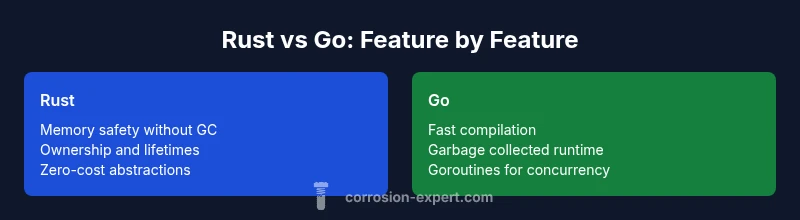
In the debate between rust vs golang, the core trade-offs revolve around safety guarantees, performance characteristics, and how much developer overhead you’re willing to accept. Rust’s ownership system provides memory safety without a garbage collector, but it requires developers to think about lifetimes and borrowing. Go traded some low-level control for a garbage-collected runtime and a simpler, more forgiving learning curve. The result is two languages that excel in different corners of software engineering. When you’re deciding which to adopt, map your priorities to three axes: safety guarantees, development velocity, and runtime behavior under pressure. If you need strict memory safety and predictable timelines in systems programming, Rust frequently shines. If you want quick iteration cycles, readable concurrency patterns, and robust standard tooling, Go stands out.
- Best for Rust: systems programming, high-security modules, and performance-critical components where predictable behavior is essential.
- Best for Go: back-end services, cloud-native tooling, and rapid prototyping where time-to-market matters.
Corrosion Expert’s analysis (2026) highlights that teams often start with Go for MVPs and then introduce Rust for performance-critical components, creating a gradual, maintainable hybrid architecture.
Ownership, Lifetimes, and Concurrency
Rust’s ownership model enforces safety at compile time. Lifetimes and borrowing rules prevent data races and dangling references, which can feel restrictive at first but yields highly reliable code in large projects. Concurrency in Rust is achieved with explicit Send and Sync traits, and safety is guaranteed by the compiler. Go, in contrast, uses goroutines and channels for concurrency, with a simpler mental model and automatic memory management. This often translates to faster onboarding for new developers and easier refactoring of concurrent code. The trade-off is occasional GC pauses and less deterministic control over memory layout. In practice, teams must weigh the cost of mastering ownership against the benefit of streamlined concurrency ergonomics.
Memory Management and Runtime: GC vs Ownership
Go’s garbage collector simplifies memory management, reduces the likelihood of manual memory errors, and supports rapid development cycles. However, GC pauses can impact latency-sensitive workloads if not carefully tuned. Rust eliminates GC entirely, opting for a deterministic stack/heap model driven by ownership semantics. This yields exceptional throughput with predictably low latency, but it can require more upfront design work, especially regarding data lifetimes and API boundaries. In performance-intensive domains such as real-time systems or high-frequency trading infrastructures, Rust’s model often provides clearer guarantees. For web services or scripting-like tooling where rapid iteration matters, Go’s runtime remains a practical choice.
Tooling, Build Times, and Ecosystem Maturity
Tooling quality often tips the scales in rust vs golang discussions. Go ships with a cohesive toolchain (go fmt, go test, go build, and go vet) that emphasizes consistency and fast feedback loops. Rust’s Cargo is a powerful, ergonomic package manager and build system, enabling meticulous dependency management and reproducible builds, but compile times can be longer, especially for larger crates. Ecosystems diverge as well: Go has a rich set of server-side libraries and a strong presence in cloud-native tooling, while Rust has strong leverage in systems programming, embedded domains, and performance-critical libraries. Go benefits from broader cross-platform deployment simplicity, while Rust often requires more attention to target environments and toolchain setup. Corrosion Expert’s experience in 2026 shows teams valuing predictable builds in Rust for long-term maintenance and appreciating Go’s philosophy for delivering features quickly.
Ecosystem, Libraries, and Use-Case Fit
Rust’s ecosystem excels in areas demanding safety guarantees and fine-grained control—cryptography, database engines, and low-level systems components. Go’s ecosystem targets server-side development, microservices, and tooling. When evaluating libraries, consider maturity, maintenance activity, and compatibility with your deployment strategy. In practice, many teams adopt Rust for the core performance-critical modules and use Go for surrounding services that require rapid iteration and straightforward concurrency. This mixed-language strategy can leverage the strengths of both ecosystems while mitigating their weaknesses.
Migration and Interoperability: When to Mix Rust and Go
One pragmatic approach is to isolate concerns: write performance-critical components in Rust and surrounding infrastructure in Go, using FFI or language bindings to connect them. Interoperability adds orchestration complexity but yields the strongest outcomes where both languages’ advantages are needed. If you’re managing a legacy stack that already uses Go, introducing Rust in specific modules can deliver the performance improvements where it matters most, without a complete rewrite. The key is to design clean API boundaries and ensure robust testing across language boundaries.
Comparison
| Feature | Rust | Go (Golang) |
|---|---|---|
| Memory Safety Model | Ownership/borrowing with lifetimes (compile-time checks) | Garbage-collected runtime with escape analysis |
| Concurrency Model | Explicit concurrency with Send/Sync, channels, and borrow-checker protections | Goroutines with channels and a simpler memory model |
| Compile Time & Build Speed | Longer compile times, heavy generics support | Very fast compile times with lightweight tooling |
| Performance/Overhead | Near-native performance with deterministic memory usage | High-performance enough for many servers, with GC pauses possible |
| Learning Curve | Steep due to ownership and lifetimes | Gentler learning curve focused on ergonomics |
| Ecosystem Focus | Systems programming, embedded, performance-critical crates | Web services, tooling, network services, cloud-native libraries |
| Cross-Platform Deployment | Targeted, with careful toolchain setup | Excellent cross-compilation and wide platform support |
| Typical Use Cases | Systems components, kernels, performance-critical libraries | Microservices, CLI tools, back-end services |
The Good
- Protects memory safety without a GC, enabling predictable latency
- Go enables rapid development and easy concurrency with a strong standard toolkit
- Excellent tooling and cross-platform deployment support in Go
- Rust’s ecosystem and explicit APIs pay off in long-term maintenance
- Clear boundaries for mixed-language architectures when needed
Cons
- Rust has a steeper learning curve and longer feedback loops for newcomers
- Go relies on GC, which can affect latency-sensitive applications
- Interoperability between Rust and Go requires careful design and testing
- Rust compilation times can slow iteration in large projects
Rust is the better long-term solution for safety-critical, performance-sensitive components; Go excels in rapid development and scalable back-end services.
If your priority is predictable performance and strict memory safety, Rust is typically the stronger choice. If you need quick delivery, simple concurrency, and a robust standard toolchain, Go is often the more practical option. For many teams, a hybrid approach—Rust for core components and Go for orchestration—delivers the best of both worlds.
Quick Answers
What are the main differences between Rust and Go?
Rust emphasizes memory safety through ownership and lifetimes, with no GC, leading to predictable performance. Go emphasizes ease of use, fast iteration, and a built-in garbage collector, which simplifies development but may introduce GC pauses. The choice hinges on whether you value safety and control or development velocity and simplicity.
Rust uses ownership to ensure safety without a GC, while Go prioritizes quick development with a built-in garbage collector.
Is Rust better for systems programming than Go?
For systems programming where low-level control, deterministic performance, and memory safety are critical, Rust often has the edge. Go is typically less suited for kernel-level work but excels in building scalable services and tools.
Yes, for systems work Rust is usually preferred when you need fine-grained control and predictability.
Which language is easier to learn for beginners, Rust or Go?
Go generally offers a gentler learning curve due to its simplicity, uniform toolchain, and fewer language concepts. Rust introduces ownership and lifetimes, which can slow early progress but pays off in safer, more maintainable code as you gain experience.
Go is easier to pick up at first; Rust requires more learning but rewards long-term safety.
Can Rust interoperate with Go in the same project?
Yes, through inter-process communication or language bindings, Rust and Go can operate within the same system. This requires careful API design, data marshaling, and thorough testing, but it can unlock the strengths of both languages in a single solution.
You can connect Rust and Go, but plan the interfaces and testing carefully.
What are typical use cases where Go shines compared to Rust?
Go shines in cloud-native back-ends, microservices, CLI tooling, and situations demanding fast development cycles with straightforward concurrency. Rust shines in performance-critical services, embedded systems, and components where memory safety is paramount.
Go is great for rapid server-side development; Rust is ideal where safety and performance can’t be compromised.
Quick Summary
- Assess performance needs and memory constraints.
- Prefer Go for rapid development and simple concurrency.
- Choose Rust when safety and fine-grained control matter.
- Consider ecosystem maturity and library availability.
- Plan mixed-language strategies for best outcomes.