Why Rust Over Zig: A Practical Side-by-Side Guide Today
A practical, data-informed comparison of Rust and Zig, focusing on memory safety, performance, tooling, and ecosystem maturity. Learn when Rust is preferable over Zig and when Zig fits lean codebases.


Rust generally offers stronger safety and a richer ecosystem for larger, safety-critical projects, making it the recommended default for many systems programming scenarios. Zig shines when you need tight control over binary size and a minimal runtime, with simpler ergonomics for small teams or embedded contexts. In practice, choose Rust for reliability; choose Zig for lightweight, low-dependency builds.
What the comparison is really about when we say 'why rust over zig'
In modern systems development, the choice between Rust and Zig often boils down to how you balance safety guarantees with control over resources. The question of why rust over zig is not just about language features; it’s about ecosystem maturity, tooling, and long-term maintenance. According to Corrosion Expert, the Rust vs Zig decision hinges on your project’s risk tolerance, team size, and deployment targets. This article dives into the factors that influence that choice and what practical outcomes look like in real-world projects. You’ll see how memory safety, debugging ergonomics, and interoperability shape whether Rust or Zig is the better fit for your next project.
Core criteria you should use to compare Rust and Zig
To assess which language to choose, start with a clear set of criteria: memory safety and runtime guarantees, performance predictability, tooling and package management, library and ecosystem maturity, learning curve and developer experience, and cross-language interoperability. These criteria are not equally weighted for every project. For a safety-critical system with a large codebase and long-term support, Rust’s ecosystem and safety model often win; for ultra-tight binaries and minimal runtimes, Zig may be preferable. This framework helps you avoid treating Rust and Zig as mere syntax differences and forces a deliberate trade-off analysis.
Language design philosophies: ownership vs minimal runtime
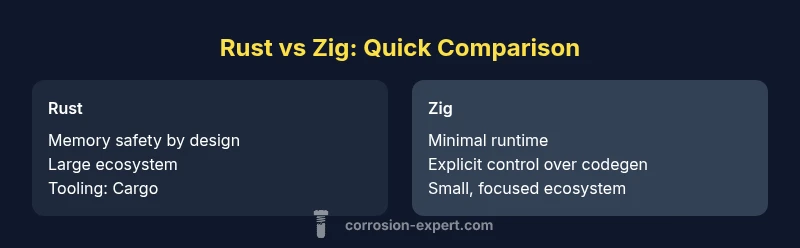
Rust builds its design around ownership, borrowing, and lifetimes. This architectural choice enforces memory safety at compile time, reducing a broad class of runtime bugs. Zig, meanwhile, emphasizes a minimal runtime and explicit control over memory and code generation. The Zig approach can lead to leaner binaries and more predictable build outputs, but it requires discipline and a willingness to manage safety more manually. Understanding these core philosophies helps you map each language to your project’s risk profile.
Memory safety and error handling in practice
Rust’s borrow checker catches many mistakes at compile time, preventing data races and invalid memory access. It often eliminates the need for heavy runtime checks, while still allowing ergonomic abstractions. Zig offers optional safety features and runtime checks, but it leaves more responsibility in the hands of the developer. For teams prioritizing safety guarantees across a large, evolving codebase, Rust’s model reduces debugging overhead. Zig can be a strong choice when you want tight control and are comfortable with manual memory management in critical paths.
Performance, abstractions, and predictability
Both languages deliver strong performance, with different trade-offs. Rust’s zero-cost abstractions can yield highly expressive, safe code without sacrificing speed. Compile times may be longer in some scenarios due to aggressive analysis and safety checks. Zig focuses on predictable performance with a simpler abstraction layer and a compact runtime, which can lead to faster compile cycles and more deterministic codegen. Your decision should consider whether you value expressive safety layers or minimal, explicit control.
Tooling, libraries, and ecosystem maturity
Rust’s tooling (Cargo, crates.io, rustup) and ecosystem are among the strongest in the systems programming space. The breadth of libraries covers networking, cryptography, and systems work, which accelerates development. Zig’s tooling is rapidly maturing and tends to emphasize minimalism and portability, with a smaller but dedicated ecosystem. If your project benefits from broad library support and a robust package manager, Rust has the edge; for tiny, embedded, or highly specialized stacks, Zig can be persuasive.
Learnability and developer experience
Rust’s rigorous safety model introduces a steeper learning curve, especially around lifetimes and borrowing. Newcomers may experience a longer ramp-up, but the payoff is fewer hidden bugs and better maintainability. Zig offers a more approachable path for developers with C-like familiarity and a style focused on explicit control, which can shorten initial onboarding for some teams. The best choice depends on your team’s background and willingness to invest in mastering the model that best fits your goals.
Interoperability, FFI, and embedded use cases
Interoperability with C is robust in both ecosystems but pursued with different angles. Rust emphasizes safe FFI patterns that minimize boilerplate while preserving safety across boundaries. Zig focuses on transparent cross-language interop and minimal runtime coupling, which can simplify embedding and low-level work. For projects that rely on existing C libraries and require strong safety guarantees, Rust tends to be a natural fit; Zig shines when you need precise control over compatibility and resource usage in constrained environments.
Real-world project scenarios: where Rust shines, where Zig shines less
In a large-scale server application requiring long-term maintenance, strong safety guarantees, and a broad library base, Rust often leads. If you’re building a tiny utility, a kernel-like component, or an embedded system where binary size and runtime footprint are at a premium, Zig can outperform in practical terms. In mixed-language stacks, a hybrid approach—Rust for core safety-critical components and Zig for low-level, performance-critical modules—can yield the best of both worlds.
Drawbacks and caveats of each language
Rust can incur longer compile times and a steeper learning curve, particularly around lifetimes and advanced type features. Zig’s smaller ecosystem and comparatively lean tooling can slow progress on ambitious projects that require many third-party integrations. Neither language is a universal cure-all; the best choice is guided by your project’s constraints and your team’s strengths.
Comparison
| Feature | Rust | Zig |
|---|---|---|
| Memory safety model | Ownership/borrowing with borrow-checker | Manual memory management with optional safety features |
| Ecosystem maturity | Mature ecosystem with crates.io and broad community | Smaller but growing ecosystem with Zig standard library and tooling |
| Binary size and runtime | Richer runtime with safety features; often larger binaries | Very small runtime and explicit codegen control |
| Learning curve | Steeper due to ownership and lifetimes | Gentonler for C-like control but with its own quirks |
| FFI & C interop | Excellent, well-documented FFI patterns | Strong C interop with a focus on minimal runtime coupling |
| Tooling & build systems | Cargo, crates.io; extensive tooling | Integrated Zig build system; lighter tooling footprint |
| Cross-platformability | Broad, mature cross-platform support | Solid cross-platform support with emphasis on portability |
| Best for | Safety-critical systems, large codebases, long-term maintenance | Lean binaries, low-runtime projects, embedded contexts |
The Good
- Clear safety guarantees reduce debugging time
- Rich, mature ecosystem accelerates development
- Strong tooling and community support
- Robust FFI patterns ease cross-language work
- Excellent performance with zero-cost abstractions
Cons
- Rust can have longer compile times and steeper learning curve
- Zig has a smaller ecosystem and lighter tooling
- Fewer high-level abstractions can slow rapid development
- Adoption may require restructuring teams accustomed to GC or manual C
Rust is generally the safer default for most projects; Zig is the leaner alternative for tight binaries and explicit control.
Choose Rust when safety, ecosystem breadth, and long-term maintenance matter most. Choose Zig when you need minimal runtime, smaller binaries, and very explicit resource management; consider a hybrid approach if appropriate.
Quick Answers
What is the primary difference between Rust and Zig?
The core difference is Rust’s safety-first model with a strong ownership system, versus Zig’s minimal runtime and explicit control. Rust emphasizes memory safety and expressive abstractions, while Zig prioritizes lean binaries and predictable codegen. This shapes how you approach maintenance, performance, and safety in projects.
Rust prioritizes safety and abstractions, Zig emphasizes lean runtime and explicit control.
When should I choose Rust over Zig?
Choose Rust when you need strong safety guarantees, a large ecosystem, and robust tooling for long-term maintenance. It’s well-suited for servers, networking, and safety-critical components where bugs are expensive. If your team values mature libraries and predictable behavior, Rust is typically the safer default.
Pick Rust when safety and a large ecosystem matter most.
When should Zig be considered instead of Rust?
Consider Zig when you need tiny binaries, minimal runtime, and maximum control over the build process. It’s attractive for embedded projects and scenarios where predictability and explicit memory management are paramount. Zig is a strong option for lean systems where Rust’s safety guarantees are not the top priority.
Choose Zig for lean binaries and explicit control.
Is Zig’s lack of a borrow checker a risk?
Zig does not enforce a borrow-checked ownership model like Rust. This can be riskier if you require automatic safety guarantees, but it also offers flexibility for certain low-level optimizations. Teams must rely on disciplined coding practices and static analysis to maintain safety.
Zig trades safety guarantees for flexibility.
Can I use Rust and Zig together in one project?
Yes. Both languages can interoperate via C FFI, so you can isolate safety-critical components in Rust while using Zig for low-level, performance-sensitive modules. A careful architectural boundary helps you reap benefits from both ecosystems.
Interoperate Rust and Zig via FFI when needed.
Quick Summary
- Prioritize project goals: safety and ecosystem vs. minimal runtime.
- Lean toward Rust for most safety-critical projects.
- Consider Zig for embedded or constrained environments where binary size matters.
- Use cross-language strategies to blend Rust and Zig if needed.