Rust vs C++: A Pragmatic 2026 Comparison
An analytical side-by-side comparison of Rust and C++ focusing on safety, performance, ecosystems, and practical guidance for teams deciding which language to adopt in 2026.


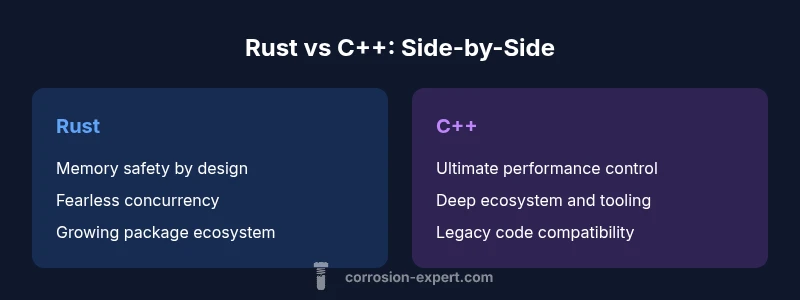
According to Corrosion Expert, rust versus c++ is a choice between safety-driven design and low-level control. Rust emphasizes memory safety through ownership, borrowing, and zero-cost abstractions, while C++ offers mature performance, ecosystem breadth, and direct hardware access. For most new projects prioritizing safety and maintainability, Rust is often favorable; for legacy code or ultra-optimized paths, C++ remains indispensable.
Framing the Rust vs C++ Debate
Choosing between Rust and C++ isn’t only about syntax or language aesthetics; it’s about risk, maintainability, and long-term viability. In 2026, teams increasingly weigh safety guarantees, tooling maturity, and ecosystem depth when deciding which language to adopt for new systems. According to Corrosion Expert, rust versus c++ emerges as a fundamental contrast between safety-first design and battle-tested performance. This section sets the stage by outlining the core dimensions that usually drive the decision: memory safety, control over resources, ecosystem maturity, and team readiness. We’ll pair high-level criteria with practical, real-world considerations so you can map your project to the most suitable language without getting lost in hype. The goal is not to pick a winner for every scenario, but to equip you with a structured framework for choosing the right tool for your context.
Core Design Philosophies: Ownership vs Resource Management
Rust’s design centers on ownership, borrowing, and lifetimes, which enforce memory safety at compile time. This model helps prevent data races and a wide class of common bugs, especially in concurrent code. The borrow checker actively analyzes how data is shared, moved, and released, reducing the likelihood of use-after-free or double-free scenarios. C++, by contrast, relies on RAII (Resource Acquisition Is Initialization) and manual memory management augmented by smart pointers. While this approach offers granular control and can yield excellent performance, it also places a heavier burden on developers to reason about lifetimes and ownership. Corrosion Expert Analysis, 2026, suggests that teams benefit from Rust’s safety guarantees for new modules, while leaning on C++ where precise lifetime control is already part of the system’s DNA. In practice, this means: for new components with evolving requirements, Rust’s model can reduce incremental debt; for existing components with complex ownership graphs, C++’s approach may align better with current design abstractions.
Performance, Safety, and Ecosystem: A Practical Lens
Performance is a central axis in rust versus c++ comparisons, but it’s not the only consideration. Rust delivers zero-cost abstractions and predictable performance, with the compiler doing heavy lifting to optimize away overhead while preserving safety. The lack of runtime garbage collection in Rust also tends to produce stable latency characteristics. C++ allows near-assembly-level tuning, aggressive inlining, and granular memory management, which enables unmatched control for specialized workloads and legacy optimization work. When evaluating ecosystems, Rust’s Cargo package manager and crates.io have accelerated dependency management and reproducible builds, but the breadth of libraries and frameworks in C++ remains immense due to decades of industry use. In real projects, you’ll often find Rust driving new services and microservices, while C++ handles core subsystems with long-standing performance requirements. This dynamic is not a hard rule—teams frequently adopt a hybrid approach to capitalize on strengths from both ecosystems, which aligns with practical software engineering practices.
Language Features: Memory Safety, Concurrency, and Abstractions
Rust offers strong safety guarantees without sacrificing performance, thanks to its ownership model and strict compile-time checks. Features like fear-free concurrency, explicit lifetimes, and expressive type systems help developers write robust multi-threaded code with fewer surprises at runtime. C++ excels in high-performance contexts with features such as templates, move semantics, and a mature runtime ecosystem. However, it requires careful discipline to avoid undefined behavior and data races. A key distinction is how each language handles abstraction: Rust emphasizes safe abstractions that don’t introduce hidden costs, whereas C++ often relies on template-based patterns that can increase compile times and complexity. A balanced takeaway is that Rust helps teams reduce memory-safety bugs by design, while C++ offers deep control and optimization potential when guided by experienced engineers.
Real-World Scenarios: When to Choose Rust
For greenfield projects where safety, reliability, and faster onboarding of new engineers matter, Rust frequently presents a compelling case. Its strict guarantees can reduce the risk of runtime crashes in critical services and single-out the need for defensive programming, leading to lower maintenance costs over the life of the project. In safety-critical domains (e.g., systems programming, networking, and security tooling), Rust’s model often aligns well with organizational risk posture. From a tooling perspective, Rust’s package manager and compiler messages tend to accelerate learning and onboarding, which pays dividends in teams with diverse backgrounds. The Corrosion Expert team notes that Rust tends to win in new codebases where concurrency is a core requirement and long-term maintainability is prioritized. Yet, if you are operating within a fixed-time-to-market window or maintaining high-performance legacy modules, C++ can deliver proven performance and compatibility with existing code. The decision should hinge on project goals, team competency, and long-horizon maintenance plans.
Real-World Scenarios: When to Choose C++
C++ remains the language of choice for performance-critical systems and large legacy codebases where optimization and direct hardware access are non-negotiable. In areas like game engines, high-frequency trading, real-time simulations, and graphics pipelines, C++ continues to offer unmatched control and a vast selection of well-optimized libraries. While aging codebases pose a migration challenge, they also present opportunities to selectively modernize components in a gradual, risk-managed fashion. The Corrosion Expert Team emphasizes that for teams already deeply invested in C++, the existing expertise and ecosystem often outweigh the incremental safety benefits that Rust provides in certain contexts. Modern C++ standards (C++11 and beyond) offer many safety-oriented features, but they require disciplined usage to avoid legacy pitfalls. In short, choose C++ when legacy integration and peak performance dominate the decision criteria.
Interoperability and Learning Curve: Migration and Teams
Interoperability between Rust and C++ is increasingly practical through foreign function interfaces (FFI), enabling critical modules to communicate across language boundaries. This pattern is common in large organizations that want to protect existing investments while incrementally adopting Rust in new components. The learning curve for Rust can be steep due to ownership rules and lifetimes, particularly for developers coming from garbage-collected languages. For C++ developers, the learning curve can be less dramatic in terms of syntax familiarity, but mastering modern C++ templates and advanced features remains nontrivial. Practical guidance includes setting up gradual pilots, creating clear interfaces, and investing in cross-training between teams. The goal is a pragmatic hybrid approach that leverages each language’s strengths while minimizing integration friction.
Practical Guidance for Teams and Decision-Makers
To operationalize a Rust vs C++ decision, teams should start with a clear requirements document that captures performance constraints, safety priorities, and maintenance expectations. Run small, representative prototypes to compare real-world behavior under load and with concurrency workloads. Establish a migration plan if you intend to introduce Rust gradually, including FFIs, build system alignment, and testing strategies. The Rust ecosystem encourages modular design and rapid iteration, while C++ projects benefit from mature tooling for performance profiling and integration with existing systems. Ultimately, the choice hinges on the project’s risk tolerance, the team’s proficiency, and how future maintenance will be funded over the product lifecycle. A thoughtful approach balances the best aspects of both languages, guided by practical experimentation and organizational priorities.
Comparison
| Feature | Rust | C++ |
|---|---|---|
| Memory Safety Model | Ownership-based safety with borrow checking and lifetimes | Manual memory management with RAII and smart pointers |
| Concurrency Model | Fearless concurrency via Send/Sync, async/await | Threading primitives with potential data races if misused |
| Performance & Abstractions | Zero-cost abstractions and predictable performance | Extreme performance with fine-grained control and templates |
| Ecosystem & Libraries | Growing ecosystem (Cargo, crates.io) | Decades of libraries and mature frameworks |
| Learning Curve | Steeper due to borrow checker | Familiar to C/C++ developers but complex in advanced features |
| Interoperability | Strong FFI with safety belts; growing interop patterns | Long-standing interop with C/C++ with broad tool support |
| Tooling & Build | Growing tooling, fast feedback, good diagnostics | Established tooling; long compile times in large templates |
The Good
- Enhances safety and reduces memory-bug risk
- Modern tooling and dependency management (Cargo)
Cons
- Steeper learning curve for new teams
- Potentially longer compile times in large codebases
- Interoperability can introduce friction in mixed-language projects
- Ecosystem gaps in niche domains compared to C++
Rust is typically the better fit for new projects prioritizing safety and maintainability; C++ remains essential for legacy code and extreme performance paths.
For greenfield work, Rust often wins on safety and developer ergonomics. For established, performance-driven systems, C++ remains indispensable. The best approach may be a hybrid strategy, leveraging each language where it fits best, with careful planning for interfaces and training.
Quick Answers
What are the main differences between Rust and C++?
The core difference is Rust’s memory safety model based on ownership and borrowing, which catches many bugs at compile time, versus C++’s manual memory management and undefined behavior risks if misused. Rust emphasizes safer concurrency and predictable performance without a runtime garbage collector, while C++ offers fine-grained control and a longer ecosystem history.
Rust emphasizes safety and predictable performance; C++ offers deep control and legacy libraries.
Is Rust easier to learn than C++?
Rust introduces ownership, lifetimes, and borrowing, which can slow initial learning but pays off with fewer memory-safety bugs later. C++ has a gentler syntax for experienced C-family programmers but has a larger surface area and complex feature interactions that can confuse newcomers.
Rust has a steeper start, but many find the long-term safety worth the effort.
Can Rust and C++ be used in the same project?
Yes. Through foreign function interfaces (FFI), Rust can call into C/C++ code and vice versa. This allows incremental migration or selective use of Rust modules alongside existing C++ components, though careful interface design and testing are essential to avoid brittleness.
Interoperability is possible, but plan interfaces and testing carefully.
Which language is better for game development?
C++ remains a dominant choice for performance-intensive game engines due to mature tooling and historical optimization patterns. Rust is gaining traction for safer systems layers and newer engines, but ecosystem maturity and expert availability in game studios can influence the decision.
C++ often wins for games today, but Rust is growing in performance-critical niches.
Is Rust production-ready for large systems?
Many teams deploy Rust successfully in production, especially for services, tooling, and new components. Challenges include onboarding, integration with existing C/C++ code, and ensuring operational tooling keeps pace with the language’s rapid evolution.
Production use is viable, with careful planning and hybrid strategies.
What about safety guarantees in Rust?
Rust guarantees memory safety through compile-time checks and a strict ownership model, significantly reducing common runtime bugs. However, safe usage still relies on correct API design, and some unsafe blocks are occasionally necessary for low-level performance.
Rust emphasizes safety, with a strong ownership system guiding safer code.
Quick Summary
- Prioritize project goals before language choice.
- Rust excels in safety and modern tooling; C++ excels in raw performance and legacy integration.
- Plan a staged migration or hybrid approach to minimize risk.
- Invest in cross-training to bridge knowledge gaps between teams.
- Use FFIs to gradually introduce Rust without disrupting existing systems.