Rust vs C++: A Deep Side-by-Side Comparison
An analytical, objective comparison of Rust and C++, focusing on memory safety, performance, tooling, and ecosystems to guide your language decision.


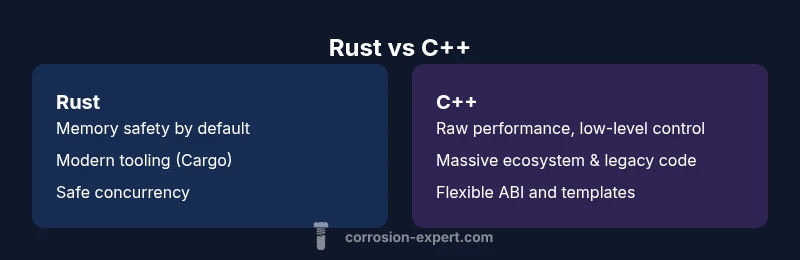
Rust and C++ sit at the intersection of safety, performance, and ecosystem maturity. The difference between rust and c++ hinges on ownership and safety guarantees versus raw control and legacy performance. Rust emphasizes memory safety, modern tooling, and safer concurrency, while C++ prioritizes speed, manual memory control, and a broad, battle-tested ecosystem. This quick comparison highlights core tradeoffs and typical use cases to guide your choice.
Language Paradigms and Philosophies
Both Rust and C++ inhabit the same niche: systems programming where control over hardware, performance, and resource usage matters. Yet they approach the problem from different angles. The difference between rust and c++ is not only syntax but design philosophy. Rust emphasizes safety from first principles—ownership, borrowing, and lifetimes guard memory at compile time. C++, by contrast, offers powerful abstractions and near-hardware control but relies on programmer discipline, library conventions, and well-tuned compilers to unlock peak performance. For teams, this means choosing a language often maps to how you want to think about safety, concurrency, and maintenance over the lifecycle of a project. In practice, most projects fall into two broad camps: greenfield systems where you value safety and quick iteration, and performance-critical code with long-lived, large codebases where maturity and ecosystem matter are prioritized.
Memory Safety and Ownership
Memory safety remains the most visible difference: Rust provides a strict ownership model with rules enforced by the compiler and a borrow checker. This model eliminates many classes of memory errors at compile time. C++ gives you raw pointers, manual allocation, and destructors; you can achieve similar safety, but you must rely on patterns, code reviews, and tools like sanitizers. The tradeoff is complexity: Rust's guarantees sometimes require different coding patterns, such as explicit lifetimes and careful design of data structures. In real-world projects, this leads to fewer heap-related bugs and data races when parallelism is involved, but it can also create a steeper initial learning curve as teams adjust to new idioms.
Performance and Zero-Cost Abstractions
Both languages can deliver high performance; neither inherently guarantees slow code by default. Rust's zero-cost abstractions mean you can write high-level code that compiles down to efficient machine instructions. C++ also uses templates and inlining to achieve similar results, but the burden is on the programmer to understand when abstractions do not translate to actual performance. In practice, Rust tends to yield predictable performance with strong compile-time checks, while C++ allows aggressive optimization strategies that are often tuned to a specific domain, such as graphics or high-frequency trading. For developers, this means you should measure and profile early, choosing idioms that align with your performance goals rather than assuming one language will win automatically.
Concurrency Model and Safety
Rust's concurrency story centers on fearless parallelism through ownership and the Send/Sync traits, which help prevent data races at compile time. The language nudges you toward safe patterns like message passing and shared state with synchronization, but it keeps risks visible. C++ has a long tradition of concurrent programming, with a rich set of threading primitives and libraries; it offers great flexibility but allows subtle races if care is not taken. The tradeoff for teams is: Rust reduces the mental overhead of correctness, often leading to more robust concurrent systems out of the box; C++ can be more flexible for low-latency, highly tuned synchronization but demands rigorous code reviews and testing. When scale matters—multi-core compute, network servers, or real-time processing—understanding each model helps you architect solutions that remain maintainable.
Tooling, Build Systems, and Ecosystems
Rust ships with Cargo, a unified package manager and build tool that simplifies dependency management, compilation, and publishing crates. The ecosystem is younger than C++, but it grows rapidly, offering batteries-included libraries for serialization, async IO, cryptography, and more. C++ relies on a mosaic of tools—CMake, Meson, Bazel, conan, vcpkg, and a wide network of library ecosystems—that provide power at scale but demand more boilerplate and domain-specific knowledge. For teams, the choice often hinges on productivity and maintenance costs: Cargo can reduce boilerplate, streamline testing, and make reproducible builds easier; CMake and friends offer deep customization for complex projects but come with a steeper setup cost. In the end, tooling quality often affects developer velocity just as much as language features, so teams should evaluate their CI/CD practices, platform targets, and existing skill sets.
Learning Curve and Language Maturity
Rust introduces a new mental model around ownership, lifetimes, and borrowing, which can be a hurdle for developers taught to manage memory manually in C or C++. The payoff is a safer, more maintainable codebase. C++ has matured over decades and benefits from a vast and established corpus of patterns, idioms, and resources, along with a large pool of experienced engineers. The downside is that C++ complexity often leads to inconsistent code styles and long onboarding times for new contributors. For teams deciding between these languages, consider your willingness to invest in training, your project's risk profile, and your target developer market. While Rust is growing rapidly, it remains a smaller ecosystem in some niche domains; C++ remains deeply entrenched in areas like game development and high-performance computing, where legacy code and specialized libraries persist.
Interoperability with C and Foreign Function Interfaces
Both languages offer robust C interoperability, which is crucial for integrating with legacy code or system-level libraries. Rust's FFI model is clean and explicit; you can expose safe wrappers around unsafe blocks to preserve invariants. C++ offers a straightforward path to call into C and vice versa, plus mature language features for linking with existing binaries. In practice, teams often use Rust for new modules inside a larger C++ codebase or gradually port components to Rust to improve safety. Migration strategies include starting with isolated subsystems, providing well-defined FFI boundaries, and embracing clear ownership semantics to minimize cross-language complexity.
Debugging, Diagnostics, and Safety Tools
Rust benefits from strong compile-time diagnostics, helpful messages, and options like clippy and rustfmt to enforce style and catch common mistakes. The language's tooling ecosystem emphasizes safety at compile time, reducing a broad class of runtime bugs. C++ debugging tools are mature and diverse, with sanitizers, debuggers, and performance profiling suites that are well integrated into IDEs; however, runtime issues can slip through without comprehensive testing. For teams, a combined approach often works best: use Rust for safety-critical modules to minimize data races; rely on C++ tooling for existing performance-sensitive portions while applying modern testing practices. Ultimately, the quality of diagnostics and the ecosystem around your stack can materially affect project health.
Use-Case Alignment: When to Choose Rust vs C++
Consider you are building a new network service that prioritizes safety, long-term maintainability, and cross-platform portability. In that scenario, Rust may be the better choice because its safety guarantees reduce the risk of memory bugs and allow rapid iteration. If you are extending a large, performance-critical engine with years of optimized code and a need to reuse established libraries, C++ is often the pragmatic option. Then, for mixed teams where some subsystems benefit from Rust and others from C++, a layered approach leveraging both languages via clear boundaries can deliver the best of both worlds. The decision should be guided by concrete factors: safety requirements, time-to-market, platform targets, existing code assets, and team expertise.
Interoperability and Hiring Considerations for Teams
Your team composition matters as much as the language features themselves. A Rust-first team tends to hire for safety-minded, modern tooling experience, while a C++-focused team looks for deep optimization skills and legacy code familiarity. When hiring, consider the cognitive load of the language, available mentors, and the domain-specific libraries you depend on. For organizations with significant legacy assets, maintaining a mixed-language stack with well-defined interfaces can maximize value. Budget for training, tooling, and CI environment changes as you evolve your codebase. Overall, the mix of needs, risk tolerance, and future roadmap should guide the balance between Rust and C++ in your architecture.
Ecosystem, Community, and Long-Term Viability
Rust's community is active and growing, with official documentation, community-driven crates, and ongoing language evolution through Rust RFCs. The C++ ecosystem remains vast, with ubiquitous compilers, a long track record in performance-critical fields, and a deep reserve of third-party libraries. For developers evaluating the long-term viability of a project, consider not just language features but the health of the ecosystem, availability of specialists, and the likelihood of sustained tooling improvements. The landscape continues to shift as both languages mature, and organizations should stay adaptable and ready to adopt hybrid approaches when appropriate.
Practical Decision Framework and Roadmap
To close the loop, create a decision framework that weighs safety, performance, ecosystem, and team readiness. Start by listing the main success criteria for your project, then score Rust and C++ against each criterion. For greenfield projects with safety as a priority, start with Rust and plan a staged migration path if you anticipate future integration with existing C++ assets. For legacy-heavy environments, map a careful path to maintain performance while gradually introducing Rust components. Finally, establish a governance model for cross-language interfaces, testing, and deployment to ensure reliability.
Comparison
| Feature | Rust | C++ |
|---|---|---|
| Memory safety | Strict ownership, borrowing, and lifetimes enforced at compile time | Manual memory management with pointers; safety relies on discipline and tooling |
| Performance potential | Zero-cost abstractions and predictable performance | Mature optimization paths and aggressive tuning possibilities |
| Learning curve | Steeper at first due to ownership model | Longer, broad learning curve due to feature scope and legacy patterns |
| Tooling & ecosystem | Cargo, crates, rapid iteration; ecosystem growing quickly | Mature toolchains (CMake, Bazel, conan) and extensive libraries |
| Interoperability with C | Excellent C interoperability via FFI; safety wrappers common | Direct C interoperability; strong ABI compatibility with C |
| Compile times | Often slower due to safety checks in large crates | Variable; can be fast with modular design and tooling |
| Community & support | Active, safety-focused community; RFC-driven evolution | Large, established community; long-standing vendor and academic support |
The Good
- Strong safety guarantees reduce debugging time and security risks
- Growing, modern tooling (Cargo) and ergonomic APIs
- Excellent C interoperability via FFI and wrappers
- Predictable performance with zero-cost abstractions
Cons
- Steep initial learning curve due to ownership model
- Rust compile times can be longer in large projects
- Ecosystem, while growing, is not as mature in some domains as C++
Rust is the better choice for safety-first systems; C++ remains unparalleled for raw performance and extensive legacy codebases.
If your primary goal is memory safety and concurrent correctness with modern tooling, choose Rust. If you rely on extreme performance, legacy libraries, or domain-specific optimizations, C++ is typically the more pragmatic option. In many organizations, a hybrid approach can deliver the best of both worlds.
Quick Answers
What is the core difference between Rust and C++?
Rust enforces memory safety through ownership and borrowing, preventing data races at compile time. C++ provides manual memory control and relies on programmer discipline for safety. The choice depends on whether you value safety guarantees or maximum control and legacy performance.
Rust enforces safety through ownership, while C++ relies on programmer discipline for safety. The choice depends on your priorities.
Is Rust faster than C++ in practice?
Both can be extremely fast; Rust emphasizes safety with predictable performance, while C++ can achieve very high raw speeds through meticulous optimization. Real results depend on algorithms, libraries, and how you implement features.
Both languages can be very fast; performance often comes down to implementation details.
Can Rust interoperate with C or C++?
Yes. Rust supports strong C interoperability through FFI, and you can wrap unsafe blocks safely. C++ interop is feasible via C interfaces and wrappers; plan for well-defined boundaries to minimize ABI issues.
Yes, you can mix Rust with C or C++ using FFI, but plan your interfaces carefully.
Which language has a steeper learning curve?
Rust presents a steeper early learning curve due to ownership and lifetimes. C++ has a long but varied learning path because of its vast feature set and historical patterns.
Rust is tougher at first due to ownership; C++ learning can be intense but familiar to many.
What should guide a team when choosing between Rust and C++?
Focus on safety requirements, existing code assets, team expertise, and long-term maintenance. If safety and rapid iteration matter, Rust is compelling; for legacy performance and mature libraries, C++ remains strong.
Safety needs, assets, and team skills should drive the choice.
Is it feasible to learn Rust if you know C++?
Yes. Your C++ background helps conceptually with memory models, and learning Rust's ownership is smoother with practical hands-on projects. Expect a learning curve, but performance and safety gains can be worth it.
Yes, your C++ background helps, but expect some adjustment with ownership and lifetimes.
Quick Summary
- Assess memory-safety needs early to guide language choice
- Use Rust for safety-focused, greenfield projects
- Choose C++ for performance-critical, legacy-heavy codebases
- Plan cross-language interfaces with clear boundaries