When to Use Rust vs C++: A Practical Systems Guide
A rigorous, objective comparison of Rust and C++ to help developers decide when to use Rust vs C++. Explore safety, performance, ecosystems, tooling, and practical decision criteria.


Rust and C++ are both high-performance languages, but Rust prioritizes safety and modern tooling, while C++ focuses on raw performance and ecosystem maturity. Use Rust when memory safety, fearless concurrency, and predictable behavior matter—especially in long‑running servers or embedded contexts. Choose C++ when you need the absolute best performance, access to decades of libraries, or compatibility with legacy code. This guide helps you decide when to use rust vs c++.
The decision landscape: when to use rust vs c++
Deciding between Rust and C++ is a core choice for systems programming, affecting safety, performance, and long-term maintenance. The question when to use rust vs c++ is not about a single feature but about how a language's strengths align with your project’s risk profile and lifecycle. According to Corrosion Expert, the decision hinges on safety requirements, deployment constraints, and team experience. The Corrosion Expert team found that for new codebases with long lifetimes and complex concurrency, Rust often reduces bugs and operational risk. In contrast, C++ remains the go-to for projects that demand raw performance, aggressive optimization, or extensive legacy code. This article walks through practical decision criteria, domain patterns, and concrete guidelines to help you pick the right tool for the job.
Core differences: safety, performance, and ecosystem
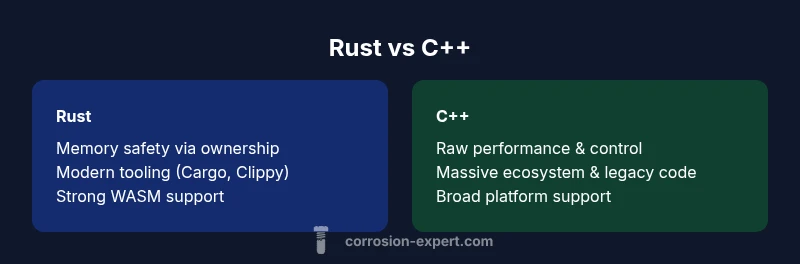
Rust and C++ share a goal of giving developers low-level control and high performance, but they take different paths. The most evident differences lie in memory management, safety guarantees, and tooling philosophy. Rust enforces memory safety at compile time through ownership, borrowing, and lifetimes, which prevents a broad class of bugs common in C++. C++ offers fine-grained control with manual memory management and a huge feature set, but places the burden of correctness squarely on the programmer. Performance is highly competitive in both languages when code is well optimized; in practice, code written in either language can reach similar throughput with careful design. Tooling diverges as well: Rust ships with Cargo, Clippy, and rustfmt for consistent workflows, while C++ relies on a broad ecosystem around CMake, Make, various compilers, and a diverse set of libraries. When evaluating when to use rust vs c++, weigh runtime safety needs, iteration speed, and long-term maintenance over raw micro-optimizations.
Rust strengths: safety-first design, modern tooling, and WASM support
Rust emphasizes safety without sacrificing performance. Its ownership model, lifetime checks, and borrow semantics reduce memory errors and data races, which translates into more maintainable, reliable code for multi-threaded environments. The language ships with a modern tooling suite—Cargo for dependency management and builds, rustfmt for consistent formatting, and Clippy for lints—promoting a productive developer experience. Rust also has strong WebAssembly (WASM) support, enabling safe, portable modules for web and edge deployments. The embedded ecosystem is growing, with no-std support and cross-compilation workflows that help bring safety guarantees to constrained environments. For projects where long-term reliability matters, Rust’s approach often yields safer code with fewer surprises during maintenance.
C++ strengths: performance frontier, ecosystem breadth, and industry adoption
C++ remains the workhorse for performance-critical systems and large-scale codebases. Its low-level control, mature optimizations, and decades of library development enable ultra-fast applications, real-time systems, and high-frequency workloads. The ecosystem spans game engines, finance, scientific computing, and embedded domains, with a wealth of tooling, debugging, and profiling options. C++ also offers deep integration capabilities with other languages and platforms, which is essential for legacy code and multi-language setups. When the project hinges on existing C++ code, or when developers require absolute maximum control and micro-optimizations, C++ often delivers the most predictable results. For teams evaluating when to use rust vs c++, consider legacy constraints, performance targets, and ecosystem needs that only decades of C++ maturity can satisfy.
Decision framework: map requirements to language characteristics
To decide between Rust and C++, translate project goals into language characteristics. Start with safety: if memory safety and data race prevention are your top concerns, lean toward Rust. Next, assess legacy code and integration: if you must interface with large existing C++ systems, plan for robust FFI or gradual migration. Evaluate library ecosystems: C++ offers breadth in domains like graphics and HPC; Rust offers modern crates and WASM tooling that accelerate new projects. Consider maintenance and team familiarity: Rust’s newer concepts may require training, while C++ knowledge predates many teams. Finally, prototype critical paths: implement a representative component in each language to compare performance, safety, and iteration speed. This structured approach clarifies when to use rust vs c++ for your specific project.
Interoperability and migration: mixing Rust and C++
In mixed-language environments, define clear boundaries with a stable ABI surface. Expose a C-compatible API from Rust to call into Rust code from C/C++, or vice versa, to minimize integration risk. FFI crates in Rust and the extensive C++ toolchain enable bridging components gradually, allowing a staged migration rather than a full rewrite. Before bridging, establish module ownership, memory ownership boundaries, and error handling conventions. When used carefully, mixed Rust/C++ systems let teams leverage Rust’s safety for new modules while preserving legacy functionality in C++, achieving safer upgrades without wholesale rewrites.
Domain patterns: where each language shines
- Systems programming and safety-critical services: Rust is often preferred for new modules where memory safety and predictable concurrency are paramount.
- High-performance computing, game engines, and legacy-heavy projects: C++ remains compelling for raw performance and mature libraries.
- Web and edge deployments: Rust’s WASM ecosystem frequently provides safer, portable components with good performance.
- Embedded and constrained environments: Both languages are viable; Rust’s no-std support is advantageous in safety-critical devices, while C++ may have broader hardware vendor support in some stacks.
- Tooling and developer experience: Rust’s modern tooling can accelerate onboarding of new teams; C++ benefits from a deep talent pool and proven workflows in large organizations.
Practical evaluation checklist and caveats
- Safety requirements: prioritize Rust for memory safety and data race elimination, especially in long-running services.
- Legacy constraints: lean toward C++ if you must integrate with large existing codebases.
- Performance targets: both languages can meet demanding performance needs; benchmark representative workloads.
- Team skillset: weigh the cost of retraining on Rust’s ownership model versus leveraging established C++ expertise.
- Build and deployment: consider CI/CD maturity, platform availability, and toolchain stability.
- Maintenance outlook: plan for long-term maintenance, updates, and community support in your chosen language.
The Corrosion Expert perspective: practical guidance for teams
From the Corrosion Expert viewpoint, the choice between Rust and C++ should align with risk management and long-term sustainability. For new systems where safety and reliability are non-negotiable, Rust often provides a safer foundation with modern tooling. In contrast, when rapid feature delivery and ecosystem maturity are decisive, C++ remains a robust option. The Corrosion Expert team emphasizes validating decisions with real-world prototypes and cross-functional reviews, ensuring the selected language scales with your project’s lifespan.
Comparison
| Feature | Rust | C++ |
|---|---|---|
| Memory safety | Strong safety guarantees via ownership/borrowing | Manual memory management and risk of undefined behavior |
| Performance potential | Near-metal control with safe abstractions | Mature optimizations and aggressive inlining |
| Learning curve | Steep due to ownership concepts and lifetimes | Steep due to broad feature set and legacy patterns |
| Library ecosystem | Modern crates with active development | Massive, battle-tested libraries across domains |
| Tooling & build systems | Cargo, rustfmt, Clippy; cohesive DX | CMake/Make/MSVC, diverse tooling landscape |
| WASM & embedded | Excellent WASM support and growing embedded story | Embedded tooling is strong but more fragmented across platforms |
| Interop & FFI | Safe FFI patterns and crates | Broad C/C++ interoperability via ABI interfaces |
| Community & support | Vibrant, fast-moving community | Longstanding, enterprise-backed ecosystem |
The Good
- Rust reduces memory-safety bugs through ownership and borrow checking
- Cargo and modern tooling streamline dependency management and code quality
- C++ offers unmatched performance potential and ecosystem breadth
- Strong interop options with C/C++ for gradual migration
Cons
- Rust has a steeper learning curve for teams new to ownership concepts
- Long compile times in some build configurations can slow iteration
- C++ projects can suffer from undefined behavior without disciplined practices
- Interfacing Rust with C/C++ may require careful FFI design and maintenance
Rust often wins as the safer default for new systems; C++ remains essential when legacy code and peak performance drive the project.
Choose Rust for safety-critical, future-proof modules and faster onboarding with strong tooling. Choose C++ when existing codebases, performance tailwinds, and a mature library ecosystem are the primary drivers.
Quick Answers
Is Rust slower than C++ in practice?
In most workloads, Rust performance is on par with C++. With zero-cost abstractions and aggressive optimization, Rust can match or exceed C++ efficiency for many tasks. Real-world results depend on algorithm design and compiler options.
Rust performance is typically on par with C++, with careful optimization. Benchmark your workloads to confirm parity in practice.
Can I use Rust and C++ in the same project?
Yes. You can expose a C API from Rust and call into Rust from C/C++, or use FFI crates to bridge the two. Plan clear boundaries, ABI stability, and error-handling guarantees to minimize integration risk.
Yes—use a stable C API boundary and clear ownership rules when mixing languages.
Which language is easier to learn?
C++ has a very broad feature set and long history, which can make it challenging. Rust introduces new concepts (ownership, lifetimes) that require time to learn, but many developers find safety benefits worth the effort.
C++ is broadly used but complex; Rust teaches safer patterns that some teams pick up faster, especially for new code.
When is C++ preferred for embedded systems?
If hardware constraints, toolchain maturity, and legacy interfaces demand maximum control, C++ is often preferred. Rust's embedded ecosystem is growing but may not cover every niche yet.
C++ is typically preferred for established embedded stacks with strong toolchain support.
How do I migrate a C++ codebase to Rust?
Plan module boundaries, rewrite critical components, and use FFI to bridge gradually. A staged migration minimizes risk while preserving functionality.
Tackle migration module by module, bridging with a stable interface as you go.
What about WebAssembly support?
Rust has strong WASM tooling with a cohesive pipeline from code to WASM modules. C++ supports WASM too, but setup can be more intricate depending on tooling and targets.
Rust generally offers smoother WASM paths; assess your web/edge deployment needs first.
Quick Summary
- Evaluate safety requirements first to guide language choice
- Consider legacy code and existing libraries in the decision
- Assess team readiness and tooling maturity early
- Prototype critical paths to compare performance and safety
- Plan integration strategy if mixing Rust and C++