Rust vs C++: A Practical Comparison
A thorough, data-informed comparison of Rust and C++ across safety, performance, tooling, and ecosystem to guide rust or c++ decisions for modern projects.


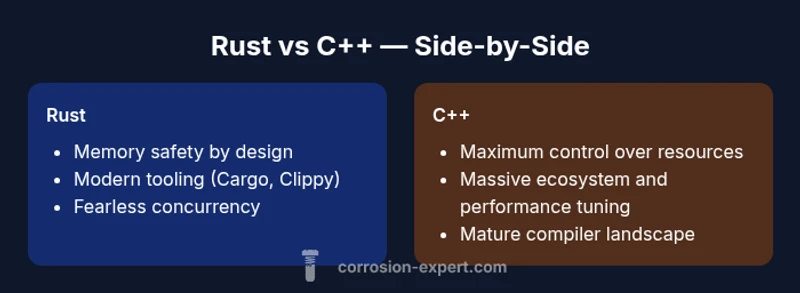
Rust and C++ are two dominant systems programming languages, each with strengths and trade-offs. If safety, modern tooling, and predictable memory usage matter, Rust often wins. If you need raw performance, minimal runtime overhead, and strong compatibility with existing C/C++ code, C++ remains the pragmatic choice. The rust or c++ decision depends on project goals, team expertise, and ecosystem alignment.
Core Philosophies: Safety versus Control
Rust and C++ approach software safety and control from different angles. Rust enforces memory safety at compile time through ownership, borrowing, and lifetimes, which dramatically reduces common classes of bugs without sacrificing runtime performance. C++, by contrast, gives developers control over memory management through manual allocation, RAII, and deterministic destructors, but that control comes with a higher burden of correctness guarantees. The result is a choice between a language that actively protects you from certain bugs and one that trusts your discipline. This section compares the underlying philosophies, the risks each language mitigates, and how teams balance safety with performance pressures. In practice, teams adopting Rust often experience fewer null pointer mistakes, dangling references, and use-after-free incidents. Those shifting from C++ to Rust frequently cite improved long-term maintainability due to clearer ownership boundaries, even though borrowing rules impose an upfront cognitive load. From a project-management perspective, the Rust approach tends to favor safer defaults and explicit error handling, while C++ tends to reward experienced engineers who can devise sophisticated resource-management strategies. According to Corrosion Expert, the safety versus control continuum guides tool choice, architectural decisions, and the pace of feature delivery in any rust or c++ project.
Comparison
| Feature | Rust | C++ |
|---|---|---|
| Memory Safety | Strong, borrow checker prevents data races and dangling references | Manual memory management with RAII; risk of use-after-free without discipline |
| Performance & Optimization | Predictable performance with safety guarantees and minimal runtime overhead | Maximum control allows aggressive optimizations and low-level tuning |
| Tooling & Ecosystem | Cargo, rustup, Clippy; growing crates ecosystem | Mature, compiler-driven toolchain; vast library and framework options |
| Learning Curve | Steep due to ownership and lifetimes; many new concepts | Familiar to C++ developers but still language differences |
| Concurrency Model | Fearless concurrency with safety checks | Fine-grained control but requires careful design to avoid data races |
| Interop & Legacy Code | Excellent C-ABI interop; smooth gradual migration | Interfacing with Rust via extern C is common; ABI considerations exist |
| Community & Support | Active, fast-moving; strong safety community | Long-standing ecosystem with mature resources and corporate support |
The Good
- Strong safety model reduces memory errors
- Excellent package management and modern tooling
- Growing, active community and rapid language evolution
- Excellent interop with C APIs enabling gradual migration
Cons
- Steeper learning curve for newcomers
- Smaller domain-specific ecosystems for some sectors
- ABI stability considerations in cross-language projects
- Tooling fragmentation in some legacy environments
Rust is the safer modern alternative for new projects; C++ remains optimal for legacy code and extreme performance.
Choose Rust when safety and maintainability are primary drivers, especially for new codebases. Choose C++ when you must maximize performance in legacy code, rely on existing C/C++ ecosystems, or need granular control over system resources. In practice, many teams adopt a mixed approach, shipping new components in Rust while gradually integrating with established C++ modules.
Quick Answers
What are the core safety differences between Rust and C++?
Rust enforces memory safety through strict compile-time checks (ownership, borrowing, lifetimes), which reduces common bugs. C++ relies on programmer discipline for manual memory management and RAII, which can lead to defects if misused. Undefined behavior in C++ remains a risk that needs vigilant testing and code reviews.
Rust enforces safety by design, while C++ relies on programmer discipline and testing.
Is Rust actually faster than C++ in practice?
Both languages can deliver high performance; real-world speed depends on implementation quality, algorithms, and compiler optimizations. In some domains, Rust’s safety abstractions may introduce minimal overhead, but modern compilers optimize aggressively, narrowing gaps with C++. For workloads that exploit extreme low-level control, C++ can still edge ahead when developers optimize mindfully.
Both can be very fast; the winner is usually the implementation, not the language by itself.
How steep is the learning curve for Rust if I know C++?
Rust introduces concepts such as ownership and lifetimes that are fundamentally different from C++. If you’re already proficient in C++, you’ll recognize patterns, but you’ll still need time to internalize borrow checking and lifetime annotations. The payoff is safer code and clearer resource management once you adapt.
If you know C++, you’ll pick up Rust patterns, but ownership concepts take time to master.
Which language has better tooling?
Rust’s tooling (Cargo, rustup, Clippy) is integrated and beginner-friendly, driving a smooth developer experience. C++ tooling is broad and mature but more fragmented across compilers, IDEs, and build systems, which can slow standardization. Your mileage varies by project and organization.
Rust tooling is cohesive and strong; C++ tooling is powerful but less unified.
Is it feasible to mix Rust and C++ in a single project?
Yes, via foreign function interfaces (FFI). You’ll typically define clear C interfaces for crossing language boundaries and manage ABI boundaries deliberately. This approach lets you port gradually or isolate high-safety components from high-performance ones.
You can mix them, but plan interfaces and safety boundaries carefully.
What about learning resources and community support?
Rust has a rapidly growing community with excellent official docs and community-driven guides. The C++ community is older and vast, with extensive libraries and established patterns. Both languages offer robust online resources, but Rust benefits from a more cohesive onboarding experience for new learners.
Rust has strong, focused learning resources; C++ has a long, broad ecosystem.
Quick Summary
- Prioritize safety to reduce defects: Rust excels here
- Leverage C++ for legacy integration and ultimate performance
- Plan ABI interfaces carefully when mixing languages
- Rust tooling is strong and growing; C++ ecosystem is broad but older
- Assess team readiness to adopt ownership and lifetimes