Is Rust or C++ Faster? A Practical Performance Look
Compare Rust and C++ performance in real-world scenarios, focusing on safety, tooling, and bottlenecks to help developers choose the right language for speed.


Is Rust or C++ faster? In practice, performance depends more on algorithms, data structures, and how well you optimize than language choice alone. Both languages can reach near-identical speeds for many workloads when compiled with optimization flags and careful coding. This comparison highlights core speed factors and when each language typically shines.
is rust or c++ faster: framing the question
In this section we define what 'faster' means and how to evaluate it in practice. From the outset, the question is not about raw clock speed in isolation but about end-to-end performance under real workloads. According to Corrosion Expert, the fastest language for a given task is the one that minimizes total overhead, memory latency, and synchronization cost while preserving correctness. This framing helps avoid over-simplified claims that one language is inherently faster than another. We will examine speed in microbenchmarks, algorithmic efficiency, compiler behavior, and real-world systems, and we will show where Rust and C++ can converge or diverge. The goal is to move beyond headlines and focus on measurable factors such as inlining efficiency, memory access patterns, and branch prediction. Readers should keep in mind that performance is task-dependent; a well-designed Rust program can outperform a poorly written C++ program, and vice versa, depending on the problem domain.
Comparison
| Feature | Rust | C++ |
|---|---|---|
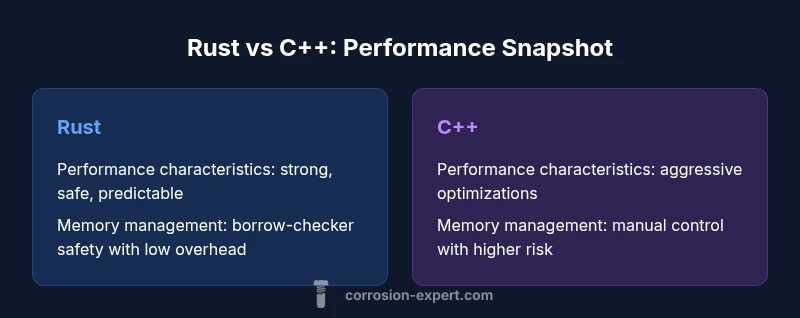
| Performance guarantees | Predictable, safety-first performance with zero-cost abstractions | Peak performance can be achieved with aggressive optimizations and careful use of unsafe blocks |
| Memory management | Borrow checker enforces lifetimes with minimal runtime overhead | Manual memory control can yield speed gains but risks bugs and safety holes |
| Compile-time behavior | Strong compile-time checks reduce runtime surprises | Templates and heavy metaprogramming can increase compile times |
| Tooling & ecosystem | Growing crates ecosystem and profiling tools for Rust | Mature toolchains, broad optimization experience in C++ |
| Best use cases | Safety-critical systems, parallel workloads, correctness guarantees | Performance-critical systems with legacy C++ codebases |
The Good
- Rust delivers safety with zero-cost abstractions and predictable per-call overhead
- Zero-cost abstractions enable high-level design without runtime penalties
- Strong concurrency primitives reduce data races and debugging time
- Growing ecosystem and tooling support aids performance engineering
Cons
- Learning curve and borrow-checker complexities can slow initial progress
- Longer compile times for large, template-heavy codebases
- Interoperability with existing C/C++ code can require careful FFI planning
No single winner; both Rust and C++ can reach top performance with proper optimization.
In many scenarios, performance comes down to the workload and how you implement it. Rust tends to be safer out of the box, which can speed up development and reduce bugs, while C++ offers granular control that can shave cycles when used by experienced teams. For most projects, align speed goals with safety and maintainability, then benchmark accordingly.
Quick Answers
Is Rust faster than C++ in practice?
In practice, neither language has an inherent speed advantage. Both can achieve top-tier performance when optimized for the workload. Rust’s safety features can reduce runtime surprises, while C++’s low-level control can squeeze out extra cycles in expert hands. Benchmark with realistic workloads to decide for your project.
In practice, neither language is inherently faster—performance depends on workload and optimization. Benchmark with real workloads to decide for your project.
Can C++ beat Rust in benchmarks?
Yes, C++ can outperform Rust in certain microbenchmarks, especially when using aggressive optimizations and unsafe code. However, this often comes with higher risk of bugs and maintenance costs. Use benchmarks that reflect real-world usage rather than isolated tests.
C++ can beat Rust in some microbenchmarks, but that usually comes with higher risk in maintenance.
Does Rust's safety impact runtime performance?
Safety checks are largely resolved at compile time in Rust, so there is typically no runtime overhead for safe code. In rare cases, certain patterns may introduce overhead, but overall safety often correlates with more reliable performance and easier optimization.
Rust safety is mostly compile-time; runtime impact is usually negligible, and it often helps you optimize more reliably.
When should I choose Rust for speed?
Choose Rust when you want strong safety guarantees with competitive speed and easier concurrent programming. If you’re building modern services, tooling, or systems where correctness matters without sacrificing performance, Rust is a strong candidate.
Pick Rust when safety and modern tooling matter as much as raw speed.
When should I choose C++ for speed?
Choose C++ when you need maximal low-level control, mature optimization techniques, and a large legacy codebase that relies on established libraries. If you have seasoned team expertise and a performance-critical workflow, C++ is often the practical choice.
Go with C++ if you need ultimate control and you’re optimizing a mature codebase.
Are microbenchmarks reliable for real-world speed assessments?
Microbenchmarks can mislead if they don’t mirror real workloads. Always test with representative data, I/O patterns, and system constraints to gauge true user impact. Use multiple benchmarks and profile under realistic conditions.
Microbenchmarks are helpful but must reflect real workloads to be trustworthy.
Quick Summary
- Define performance goals before coding
- Prioritize cache-friendly data layouts and inlining
- Use profiling to identify hot paths early
- Rust favors safety-driven optimization; C++ favors low-level control
- Benchmark with real workloads, not just microbenchmarks