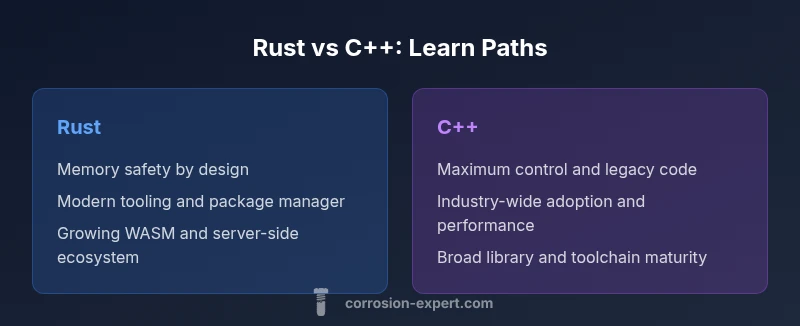
Rust vs C++: Which Should You Learn?
This comparison guides DIY developers through Rust and C++, outlining learning curves, safety, performance, tooling, and use cases to help you decide whether to learn rust or c++.


Rust and C++ both empower systems programming, but they trade safety, control, and complexity differently. If you’re choosing what to learn, Rust often offers safer memory management and modern tooling, while C++ provides mature performance and industry reach. This comparison helps you decide whether to learn rust or c++ for your projects.
What does it mean to learn rust or c++?
Learning rust or c++ means choosing a path for how you approach safety, performance, and software architecture. The phrase learn rust or c++ is common in learning guides because both languages aim to empower developers to build robust systems, yet they adopt very different philosophies. Rust emphasizes memory safety and data race prevention without a garbage collector; you write safe code by design and rely on the borrow checker to enforce rules at compile time. C++ provides granular control over memory and resources, with manual management patterns, deterministic destruction, and a long-established ecosystem. When you set out to learn rust or c++, you should consider your target domains, existing programming background, and long-term goals. If you come from a language with garbage collection, Rust’s explicit ownership model can be challenging, but it quickly pays off in reliability. If you’re moving from C or C++, you might appreciate C++'s flexibility and compatibility with legacy codebases, though you must stay mindful of undefined behavior pitfalls. Throughout this guide, we’ll compare these two languages across learning curves, safety guarantees, performance, tooling, and practical use cases to help you choose the best path.
Core Differences at a Glance
- Language philosophy: safety-first design in Rust vs. explicit control emphasis in C++.
- Memory model: Rust uses ownership and borrowing; C++ relies on manual allocation patterns and RAII.
- Concurrency: Rust prevents data races at compile time; C++ offers powerful but error-prone threading primitives.
- Ecosystem maturity: C++ has a deeper, broader legacy; Rust is rapidly expanding with modern crates and tooling.
- Performance potential: Both are high-performance; differences emerge with memory safety guarantees and optimization discipline.
- Learning curve: Rust tends to be gentler for beginners in memory management; C++ requires patience mastering undefined behavior and advanced features.
Understanding these gaps helps when you decide to learn rust or c++ for a specific project, team, or domain.
Learning Curve and Onboarding Experience
Entering either Rust or C++ requires a mental model shift, but the pains and gains are different. For Rust, you’ll start with cargo, crates.io, and the borrow checker; the compiler often offers actionable guidance that speeds up learning. The initial learning curve focuses on ownership, borrowing, lifetimes, and safe abstractions. Once you internalize these rules, you’ll enjoy reliable concurrency and predictable performance. C++, by contrast, builds on decades of experience with manual memory management, object lifetimes, and templates. The learning surface is broad and sometimes unforgiving—undefined behavior can lurk in corner cases. However, C++ developers who master modern features (move semantics, smart pointers, and the STL) can leverage a very mature toolchain with widespread industry demand. In practical terms, if your aim is to learn rust or c++ for web backends, game engines, or embedded systems, both paths are viable; your choice should reflect the kind of safety guarantees you want and how much time you’re willing to invest in mastering tricky language features.
Safety, Memory Management, and Performance
Rust’s central promise is memory safety without a garbage collector. The ownership model, borrowing rules, and lifetimes prevent data races at compile time, dramatically reducing typical runtime bugs. For developers, this translates into safer codebases and easier maintenance, especially in multi-threaded contexts. C++ offers direct control over resources through manual allocation, destructors, and smart pointers; experienced programmers can extract peak performance but must vigilantly manage lifetimes to avoid leaks or dangling references. In performance-critical domains, both languages can shine, yet the discipline required for safe high-performance code differs. In practice, you can write lean, predictable Rust code or push C++ into ultra-optimized regimes by inspecting memory access patterns, cache locality, and inline expansion. The choice to learn rust or c++ should consider project constraints: safety-critical systems may benefit from Rust’s guarantees, while high-legacy-code environments or performance-focused applications may still favor C++.
Tooling, Ecosystem, and Community
The tooling ecosystem helps shape the learning experience. Rust ships with Cargo, crates.io, and rustc, providing a cohesive, out-of-the-box workflow that many learners find approachable when they set out to learn rust or c++. IDE support through Rust Analyzer, Visual Studio Code, and JetBrains’ IDEs offers fast feedback, powerful refactoring, and excellent navigation. C++ tooling is mature and broad: Clang, GCC, MSVC, IDEs like CLion, Visual Studio, and a vast suite of static analysis tools. The ecosystem spans a staggering array of libraries, from graphics engines to numeric libraries; the breadth can be both a boon and a challenge when choosing what to learn first. In practice, Rust’s modern package model and strong safety story often streamline onboarding, while C++ offers unparalleled control and compatibility with existing codebases. The learning path you choose to learn rust or c++ will be shaped by the tooling you prefer and the size of your target project.
Use Cases: When to pick Rust vs C++
Different domains favor different languages. For modern systems programming, Rust is an excellent choice because of its safety guarantees and growing ecosystem. WebAssembly targets and microservice backends also benefit from Rust’s lean runtime and productive tooling. In embedded development, Rust’s minimal runtime and deterministic behavior can be advantageous. C++, however, remains essential in legacy game engines, performance-critical simulations, and high-frequency trading contexts where ultra-low latency and long-term maintainability of large codebases matter. If you’re trying to decide how to learn rust or c++ for a specific project, map requirements (safety, maintenance burden, performance margins, and existing code). The bottom line: Rust is often the safer, more modern option for new projects, while C++ continues to dominate where legacy integration and absolute control are non-negotiable.
Learning Resources and Roadmap
To structure your journey, start with a clear learning roadmap. For learning rust or c++ from scratch, consider a two-track approach: fundamentals and project work. For Rust, begin with the official book, Rust by Example, and small projects that emphasize ownership concepts; then move to async programming, error handling, and advanced traits. For C++, begin with a modern C++ primer, then explore the STL, smart pointers, move semantics, and templates. Use a project-based approach: implement a simple file parser in Rust, then translate it to C++ to understand differences in memory management and abstractions. Regularly build with real-world tasks: build a CLI tool, a small web service, and a cross-platform library. Throughout, practice reading compiler messages and using static analysis to catch mistakes early. The goal is to create a balanced, evidence-based plan to learn rust or c++ efficiently while tracking progress and adapting to your domain-specific needs.
Common Pitfalls and How to Avoid Them
Common Rust pitfalls include over-optimizing without understanding ownership rules, using unsafe code casually, and underutilizing crates.io resources. In C++, common traps are forgetting to manage lifetimes, misusing smart pointers, and neglecting the Rule of Three/Five. To avoid these, adopt a deliberate learning cadence: write small, well-scoped programs; read compiler diagnostics carefully; and regularly benchmark and profile code. Practice by translating simple projects between Rust and C++ to see how memory models and language features map to real tasks. Finally, join active communities, read established cookbook-style resources, and experiment with small projects that reinforce safe patterns or robust templates. By anticipating these pitfalls, you’ll accelerate your ability to learn rust or c++ with fewer detours.
Practical Scenarios: Sample Projects and Timelines
Project A: Build a cross-platform CLI tool in Rust and then port to C++ for comparison. Timeline: 2–4 weeks for Rust, 3–5 weeks for C++, depending on prior experience. Project B: Implement a multi-threaded server with async IO in Rust, then re-create in C++ using modern concurrency primitives. Timeline: 4–6 weeks for Rust, 5–7 weeks for C++. These projects help you concretely evaluate safety, ergonomics, and performance while learning rust or c++ in realistic contexts. Set milestones for design, implementation, testing, and optimization, and track your progress with a bias toward safe, maintainable code.
Comparison
| Feature | Rust | C++ |
|---|---|---|
| Learning Curve | Gentle onboarding with Cargo and helpful compiler messages | Steeper due to manual memory concepts and templates |
| Memory Safety | Ownership/borrowing prevents data races at compile time | Manual memory management with potential for leaks or UB |
| Performance Tuning | Predictable performance with safety guarantees | Raw performance potential with low-level control |
| Tooling & IDEs | Excellent tooling: Cargo, crates.io, Rust Analyzer | Mature toolchain: GCC/Clang, MSVC, extensive IDE support |
| Libraries & Ecosystem | Growing ecosystem; strong for systems, WASM, and web services | Vast and mature ecosystem across domains (graphics, science, AI, etc.) |
| Community & Jobs | Active, fast-growing community; good demand in new projects | Long-standing industry presence with broad job opportunities |
| Cross-Platform & FFI | Excellent cross-platform support; strong WebAssembly story | Strong cross-platform support; robust FFI with C and other languages |
| Learning Resources | Many official and community tutorials; beginner-friendly docs | Extensive books, courses, and community resources |
The Good
- Strong safety guarantees reduce runtime bugs and maintenance costs
- Modern tooling and fast feedback accelerate learning
- Active, growing communities and clear upgrade paths
- Good cross-domain applicability including WASM and embedded
Cons
- Rust ecosystem still matures in some specialized domains
- C++ requires careful discipline to avoid undefined behavior
- Rust's learning curve shifts when coming from dynamic languages
- C++ projects can suffer from toolchain fragmentation
Rust generally offers a safer, more approachable path for beginners, while C++ remains essential for legacy code and extreme performance.
If your priority is safer, modern tooling and faster onboarding, start with Rust. If you must integrate with large existing codebases or require absolute low-level control, C++ remains indispensable.
Quick Answers
Is Rust harder to learn than C++?
Many learners find Rust’s ownership model initially challenging, but the compiler feedback is typically more actionable than early C++ errors. Over time, Rust’s safety guarantees pay off with fewer runtime bugs. C++ demands careful memory management and template mastery, which many find dense at first but ultimately rewarding for performance-centric work.
Rust’s ownership system can be tricky at first, but the compiler helps. C++ requires more attention to memory, but offers deep control.
Which language has better job prospects?
Both languages offer strong opportunities. C++ has a long-established demand in game engines, finance, and legacy systems, while Rust is growing rapidly in systems programming, cloud services, and WebAssembly. Your location and industry will influence which path yields more opportunities.
C++ has broad legacy demand; Rust is growing fast in modern systems roles.
Can I use Rust in existing C++ projects?
Yes. Rust provides robust Foreign Function Interface (FFI) support, allowing you to call into C++ libraries and gradually migrate components. This makes learning rust or c++ in a mixed codebase feasible and often practical for incremental modernization.
Rust can interoperate with C++ via FFI, useful for gradual migration.
Do I need to learn C++ to work in game development?
For traditional game development, C++ remains a standard due to performance and established engines. However, Rust is making inroads in smaller engines and tooling. If your goal is high-end AAA game studios, expect to encounter C++ frequently; for indie or experimental work, Rust can be a strong alternative.
C++ is common in games, but Rust is gaining ground in indie and experimental projects.
Which language has better tooling and IDE support?
C++ benefits from decades of tooling in Visual Studio, CLion, GCC/Clang, and static analyzers. Rust tooling is excellent today with Cargo, rustc, Rust Analyzer, and good IDE integrations, but the ecosystem for niche domains may be more varied. Your choice depends on the domains you work in and your preferred editor.
C++ tooling is mature; Rust tooling is modern and rapidly improving.
What’s a practical roadmap to learn rust or c++?
Begin with fundamentals, project-based practice, and then advance to advanced topics. For Rust, start with the official book, then explore crates, ownership patterns, and async. For C++, start with a modern primer, move to STL, smart pointers, and templates, then tackle real-world projects with a focus on memory safety.
Start with basics, then build real projects to compare Rust and C++ features.
Quick Summary
- Start with Rust if safety and modern tooling matter
- C++ shines in legacy integration and extreme performance
- Use a project-driven roadmap to learn rust or c++
- Leverage Rust’s Cargo and C++’s mature toolchains for hands-on practice
- Translate small projects across languages to reveal practical differences