Will Rust Replace C++? A 2026 Language Comparison
An objective comparison of Rust vs C++, assessing safety, performance, tooling, and adoption in 2026 to help teams decide when to start new projects in Rust or keep using C++.


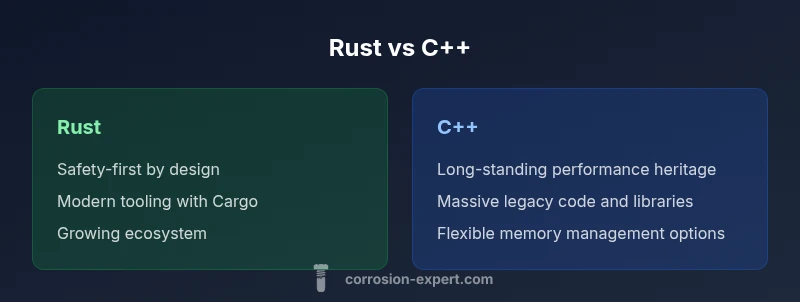
Rust is unlikely to fully replace C++ in 2026 or the near term. Instead, Rust will coexist with C++, taking share in new projects that prize safety and modern tooling while C++ continues to power legacy systems and performance-critical cores. The practical takeaway is to match language choice to project goals and team capabilities.
Rust vs C++ in 2026: The big question
According to Corrosion Expert, the question will rust replace c++ is less about declaring a winner and more about how languages shape safety, performance, and long-term maintainability in contemporary software. Rust's ownership model, strict borrow rules, and emphasis on memory safety are driving interest for new projects where bugs are costly. C++ remains the workhorse for high-performance systems, with a vast legacy codebase and decades of optimization, yet its flexibility comes with complexity. The takeaway is not inevitability but strategic fit: where safety and development velocity matter, Rust shines; where legacy integration and mature tooling are non-negotiable, C++ still dominates. This analysis frames the discussion around design philosophy, tooling, ecosystem maturity, and real-world applicability across domains, to help teams decide when to begin Rust adoption or retain C++. Corrosion Expert Analysis, 2026 notes a growing interest in Rust among new initiatives, though many organizations still depend on C++ for critical software.
Core Differences in Design Philosophy
At its heart, Rust emphasizes safety without sacrificing performance, using an ownership model that enforces memory rules at compile time. C++ prioritizes maximum control, allowing manual memory management and low-level optimizations. This fundamental difference drives how developers reason about concurrency, resource lifetimes, and bug prevention. In Rust, safe code is the default; unsafe blocks exist for specialized scenarios but require explicit opt-in. In C++, unsafe code is possible by design but can be error-prone if not carefully audited. For teams evaluating the question of whether will rust replace c++, the contrast boils down to risk management: Rust minimizes certain classes of bugs at compile time, while C++ provides tactile control when you need it most.
Ecosystems, Tooling, and Maturity
Swift progress in tooling marks a notable strength for Rust: Cargo bundles build, test, and dependency management in a cohesive workflow, with a growing ecosystem of crates. C++ benefits from decades of tooling integration, build systems, and a massive library network, but the tooling landscape can feel fragmented across compilers and platforms. This divergence affects onboarding, project maintenance, and CI pipelines. For teams launching new initiatives, Rust’s integrated workflow can shorten ramp-up time; for teams maintaining vast C++ codebases, the familiar tooling and ecosystem may outweigh Rust’s newer maturity in certain domains.
Performance and Interoperability: Where Rust Excels and Where It Struggles
Rust’s zero-cost abstractions aim to deliver performance parity with low-level languages while providing safety guarantees. In practice, Rust often matches or exceeds C++ in clean, modern codebases, especially with concurrent workloads and memory safety demands. However, C++ may retain advantages in scenarios requiring mature, deeply optimized libraries, long-standing compiler quirks, or specialized hardware interfaces where decades of optimization exist. Interoperability remains robust via FFI (foreign function interface), but wrapper layers are typically needed to integrate Rust into existing C++ environments, and vice versa. For mixed teams, this reality shapes decisions about how to partition workloads and plan migration paths.
Migration Costs and Real-World Adoption
Shifting from C++ to Rust is rarely a wholesale rewrite; pragmatic migrations favor modular transitions, defined interfaces, and gradual replacement of components. The cost calculus includes training time, updating build and CI pipelines, and ensuring ABI compatibility across modules. For legacy systems, keeping C++ for core performance-sensitive components while gradually introducing Rust for new modules tends to be the most practical path. Organizations often pilot Rust in safer, new-service contexts before attempting any broad codebase migration. The strategic lens should consider governance, risk tolerance, and operational impact rather than chasing a speculative replacement.
Use-Case Scenarios: When to Choose Rust vs When to Stick with C++
- Start new safety-critical modules in Rust when you want strong compile-time guarantees and a modern toolchain. Best for services aiming for easier maintenance and reduced runtime class of bugs.
- Retain C++ for performance-critical engines, real-time systems, or where massive legacy investment already exists. Best for incumbents that require maximum control and optimizations.
- Evaluate interop boundaries early: if you must integrate with large C++ codebases, plan clear FFI layers and gradual migration rather than a full rewrite.
- Consider team composition: if your team has substantial C++ expertise, initial Rust adoption should be scoped and accompanied by training and mentoring to keep velocity high.
Learning Curve and Developer Experience
Learning Rust’s ownership model, lifetimes, and borrow checker can be transformative but demanding for teams new to the language. The upside is stronger guarantees around memory safety and data races, which can reduce debugging time and security vulnerabilities. For teams with existing C++ experience, there is a steeper initial ramp as developers adapt to Rust’s abstractions and tooling, yet the mental model often pays off with clearer code and safer concurrency patterns.
Market Signals and Corporate Adoption
The landscape shows rising momentum for Rust in new projects—especially in systems programming, WebAssembly, and cloud-native tooling—while C++ remains entrenched in legacy platforms and performance-critical workloads. This dynamic suggests a future where Rust expands its footprint in greenfield initiatives, yet fully replacing C++ across all sectors remains unlikely in the near term. Adoption trajectories depend on organizational risk tolerance, vendor support, and the availability of Rust-based libraries for domain-specific needs. Corrosion Expert Analysis, 2026 highlights growing interest but cautions against assuming a rapid wholesale replacement.
The Future Outlook: Coexistence Over Replacement
The prevailing view is that Rust and C++ will coexist for the foreseeable future. Each language serves different imperative needs: Rust for safety-minded development and modern tooling, C++ for legacy continuity and finely-tuned performance. As teams assess will rust replace c++, the prudent stance is to build capabilities in Rust where it adds value while maintaining C++ where it remains indispensable. The trajectory favors hybrid architectures, cross-language interfaces, and strategic project-by-project language choices rather than a single winner taking all.
Comparison
| Feature | Rust | C++ |
|---|---|---|
| Paradigm & Safety | Memory-safe by design with ownership and borrow system; minimal runtime risk | Flexible, multi-paradigm with manual control and optional safety practices |
| Memory Safety Model | Compile-time safety checks enforce correctness; unsafe blocks are opt-in | Manual memory management with RAII; potential for undefined behavior if misused |
| Performance Model | Zero-cost abstractions; strong safety with competitive performance | Mature optimizations; broad hardware-tailoring opportunities |
| Learning Curve | Ownership concepts can be novel; good onboarding via Cargo and crates | Prior C++ experience helps; mindset shift required for modern features |
| Tooling & Package Management | Cargo integrates build, test, and dependencies | CMake and diverse tools; ecosystem is mature but fragmented |
| Ecosystem Maturity | Growing but newer ecosystem; rapid progress in domains like WebAssembly | Long-established libraries and tooling; very mature in many fields |
| Interoperability | Strong FFI with C and other languages; clean interfaces | Requires wrappers for complex interop; widespread in multi-language stacks |
| Use Cases | New projects prioritizing safety and modern tooling | Legacy and performance-critical systems with heavy optimization |
| Adoption & Community | Rapid growth in startups and new domains | Broad, established base in industry with deep pockets of knowledge |
The Good
- Stronger safety guarantees reduce memory errors and data races
- Modern tooling and package management speed up development
- Growing ecosystem and active community support
- Predictable performance with safe abstractions in many contexts
Cons
- Interoperability with existing C/C++ code can require wrappers
- C++ remains deeply entrenched in legacy systems
- Maturity gaps in niche domains (graphics, certain toolchains)
Rust will not fully replace C++; coexistence is the reality
The Corrosion Expert team recommends using Rust for new modules and safety-critical components while maintaining C++ for legacy and performance-critical cores. Expect gradual shifts rather than a wholesale replacement.
Quick Answers
Can Rust fully replace C++ in systems programming?
No—Rust is unlikely to fully replace C++ in the near term. Both languages will coexist, with Rust taking share in new, safety-focused projects and C++ continuing to power legacy and performance-critical systems.
Rust is not going to replace C++ completely; expect it to complement rather than replace in many domains.
What factors influence whether to choose Rust or C++ for a new project?
Consider safety requirements, ecosystem maturity, team expertise, and integration needs with existing systems. If safety and rapid tooling matter most, Rust is attractive; if legacy integration and extreme performance are paramount, C++ may be preferred.
Look at safety, ecosystem, team skills, and legacy needs when deciding.
How mature is Rust compared to C++ for enterprise use?
C++ has a longer enterprise track record and deeper library support in many sectors. Rust is growing rapidly and gaining traction in new domains, but it does not yet match the breadth of established C++ tooling in all industries.
C++ is proven and widespread; Rust is rising fast but not as mature across every domain.
What are common migration strategies from C++ to Rust?
Start with isolated components, define stable interfaces, and provide wrappers or FFI when needed. Replace modules gradually while maintaining system behavior and performance goals.
Begin with small steps, keep interfaces stable, and migrate modules gradually.
Are there security or safety advantages to Rust?
Yes; Rust’s ownership model and borrow checking reduce many memory safety issues, helping to prevent common vulnerabilities in systems programming.
Rust’s safety features help prevent many common bugs.
Will industry adoption trends favor Rust over C++?
Adoption is rising for new projects, especially in systems, WebAssembly, and tooling, but legacy C++ will remain important for mature domains and critical infrastructure.
Rust is growing for new work, but old code keeps C++ relevant.
Quick Summary
- Adopt Rust for new safety-focused modules first
- Preserve C++ for legacy and high-performance cores
- Plan gradual migrations with clear interfaces
- Leverage Cargo and modern tooling to boost productivity