Is Rust or C++ Easier to Learn? An Analytical Comparison
A rigorous, balanced comparison of Rust and C++ learning curves, syntax complexity, tooling, and beginner resources to help you decide which language to start with for systems programming.


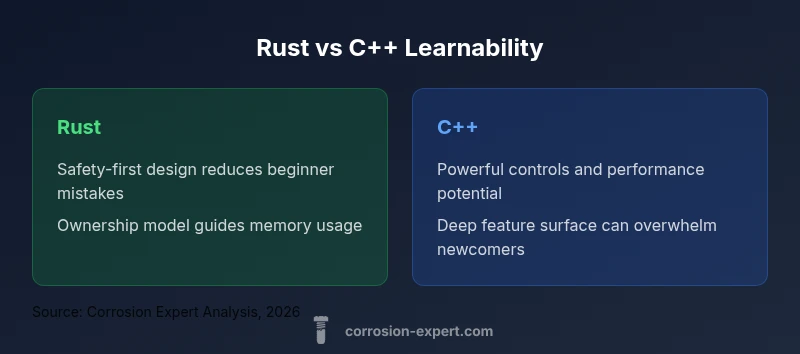
Is Rust or C++ easier to learn? In short, Rust generally offers a gentler entry for beginners thanks to its safety guarantees and ownership model, while C++ exposes lower-level concepts earlier and can be overwhelming. This comparison highlights the core differences in learning curves, syntax, tooling, and ecosystems to help you decide where to start.
Is Rust or C++ Easier to Learn? Framing the Question
For someone asking is rust or c++ easier to learn, the answer is not one-size-fits-all. The Rust language tends to offer a gentler entry for beginners due to its strong safety guarantees, explicit ownership system, and helpful compiler messages. In contrast, C++ exposes a broader feature set early on, including manual memory management and a vast standard library, which can overwhelm new learners. In this article, we compare the learning curves, syntax, tooling, and ecosystem to help you decide which language aligns with your goals in systems programming, game development, or performance-critical tasks. Corrosion Expert's research frames this discussion: a beginner's path should minimize confusion and maximize early successes. According to Corrosion Expert, starting with Rust can often accelerate the journey, while C++ remains indispensable for certain high-performance contexts. The question of is rust or c++ easier to learn is ultimately answered by your objectives, prior background, and the kind of projects you find motivating.
Learning Curves: The Core Differences in Syntax and Concepts
The learning curve for Rust and C++ diverges early because they model memory, ownership, and control flow differently. Rust’s ownership, borrowing, and lifetimes create a new mental model for beginners, but they act as a safety net that prevents many classes of bugs. C++ presents a much larger surface area of concepts — templates, operator overloading, and manual memory management — which can be empowering yet intimidating for newcomers. A practical way to think about this is to map beginner milestones: Rust often brings you to a runnable program faster with safer defaults; C++ offers deeper capabilities that pay off once you master low-level details. The upshot is that the initial friction is higher for C++, but a longer-term payoff exists for complex systems work. Corrosion Expert analysis emphasizes that learners who focus on small, safe projects in Rust typically reach a first successful program more quickly, while those targeting performance-critical domains in C++ may need more time upfront to absorb advanced features.
Tooling, Documentation, and Community Support
Tooling shapes the learning experience almost as much as language design. Rust’s tooling centers around Cargo (build, dependency management, and publishing), rustup (toolchain management), and strong editor/IDE integration with rust-analyzer. This combination reduces the cognitive load for beginners and accelerates iteration. C++ tooling is mature and diverse, with compilers (GCC/Clang/MSVC), build systems (CMake, Meson), and a vast set of libraries. The learning curve here is influenced by choosing a compiler and ecosystem early on, which can lead to decision fatigue for newcomers. Documentation quality matters as well: Rust’s official book and documentation are well-regarded for clarity, while C++ references are comprehensive but can feel sprawling. Community support for both languages is active; Rust often benefits from a safety-first culture, while C++ benefits from decades of industry-wide use and established forums.
Typing, Ownership, and Memory Management: Why It Matters to Beginners
One of the most fundamental differences is how each language handles memory. Rust enforces strict ownership and borrowing rules at compile time, which means you can’t have data races or dangling pointers. This often reduces the debugging time for beginners, but it also requires adjusting to a new mental model. C++, by contrast, offers manual memory management along with smart pointers and RAII, providing powerful control but increasing the risk of memory leaks, undefined behavior, and hard-to-track bugs for novices. A practical approach is to start with small programs that demonstrate ownership in Rust or simple RAII patterns in C++. Over time, learners internalize patterns that minimize safety issues, which is why many beginners find Rust’s approach more approachable initially, even though both languages reward careful study.
Practical Learning Paths: Step-by-Step with Rust
Getting started with Rust involves a structured path that emphasizes safe practices from day one. Step 1 is installing the toolchain with rustup and confirming a working compiler. Step 2 covers basic syntax: variables, mutability, data types, and control flow. Step 3 introduces ownership, borrowing, and lifetimes through small examples and clear compiler feedback. Step 4 explores Cargo, crates, and package management while building tiny projects. Step 5 expands into error handling with Result and Option, plus simple generics. Finally, Step 6 reinforces best practices by implementing common patterns like error propagation and modular design. This path minimizes frustration and mirrors how the compiler guides you toward safer, more robust code. In many cases, learners who follow a guided Rust path report faster early wins and a smoother conceptual transition into more advanced topics.
Practical Learning Paths: Step-by-Step with C++
A beginner-friendly C++ path starts by selecting a compiler (GCC/Clang/MSVC) and setting up an integrated development environment. Step 1 covers basic syntax: variables, types, operators, and control flow. Step 2 introduces memory concepts and RAII, steering learners toward safe usage of constructors and destructors. Step 3 focuses on pointers and references, emphasizing careful management. Step 4 adds the Standard Template Library (STL) as a powerful but initially challenging toolset. Step 5 moves into modern C++ features gradually (smart pointers, move semantics, and range-based for loops). Step 6 culminates in building small, well-architected projects that demonstrate design patterns and performance considerations. This path highlights how C++ scales from simple programs to sophisticated systems but demands patience with its broader feature set.
Language Features That Impact Learnability
Language features can tilt the balance of learnability. Rust emphasizes safety through the ownership model, which is beneficial for beginners who want to avoid mutable aliasing and data races. Its strong type system and explicit error messages guide learners to correct mistakes early. C++ offers deep expressive power through templates, operator overloading, and a flexible memory model, which can be both exciting and overwhelming. The standard library in Rust is relatively cohesive, while C++’s standard library spans a broader spectrum of patterns and idioms. A practical takeaway is to focus on a core subset of features during initial studies: Rust’s ownership and crates for beginners, and C++’s STL and basic memory management for industrial-scale projects. Corrosion Expert notes that selecting a targeted subset helps learners build confidence before tackling more advanced topics.
Common Pitfalls for Beginners and How to Avoid Them
Beginners in both languages run into common traps. In Rust, the borrow checker can seem rigid at first, causing frustration before the mental model clicks. To avoid this, practice small, isolated examples that emphasize borrowing rules and lifetimes. In C++, memory management pitfalls include leaks, dangling pointers, and unsafe casts; avoid these by using RAII, smart pointers, and avoiding raw pointers in early exercises. Both languages benefit from consistent practice with small, repeatable tasks, and from reviewing compiler errors carefully to learn underlying concepts. A steady, incremental approach reduces the risk of getting overwhelmed by complexity while building a strong foundation in each language’s philosophy.
Real-World Scenarios: When to Start with Rust vs C++
Real-world decisions about which language to learn first should be guided by goals. If your aim is rapid prototyping with strong safety guarantees, embedded systems, or WebAssembly targets, Rust often provides a gentler entry. If your focus is performance-critical software, legacy systems, game engines, or environments with established C++ codebases, C++ remains a pragmatic starting point. The choice also hinges on ecosystem maturity and available learning resources; Rust’s ecosystem is rapidly maturing, while C++ offers decades of libraries and community knowledge. Corrosion Expert’s perspective suggests tailoring your path to your project needs, recognizing that both languages offer valuable skills for different domains.
Authority and Further Reading
For those who want to dive deeper into learnability research and language design trade-offs, consider consulting established publications and official documentation. Academic discussions and industry reports provide nuanced views on how language features influence learning curves and productivity. Key sources include peer-reviewed articles and recognized technical journals that explore programming language pedagogy and practical outcomes. These references help readers form a grounded understanding of why Rust can feel easier to learn upfront while C++ rewards perseverance with extensive industrial applicability.
Comparison
| Feature | Rust | C++ |
|---|---|---|
| Learning Curve (perceived difficulty) | Moderate-to-steep due to ownership/borrowing concept | Steep due to templates, implicit conversions, and memory management |
| Syntax and readability | Clear and consistent with modern tooling; compiler messages guide you | Richer but more complex syntax; template-heavy features can be cryptic |
| Memory management model | Ownership model with borrow checker; no GC | Manual memory management with smart pointers common; risk of misuse |
| Tooling and debugging experience | Strong Cargo-based workflow; good IDE support | Mature but sometimes noisy error messages; slower feedback loop for beginners |
| Resources for learners | Excellent official docs; growing crates ecosystem; beginner-friendly guides | Large, established ecosystem; extensive but sprawling documentation |
| Domains where each shines | Safe systems programming, embedded, WASM; rapid safety proofs | Systems software, game engines, legacy software; broad applicability |
| Time to first working project | Often faster to a runnable Rust program due to safety | Can take longer to reach a basic project in C++ without prior background |
| Job market relevance | Growing demand in secure systems and WASM-era applications | Broad, long-standing demand across many industries |
The Good
- Rust reduces common programming errors through safety features and a helpful compiler
- C++ offers broader control and a long-standing ecosystem for performance-critical work
- Both languages have strong tooling and active communities
- Rust’s modern tooling (Cargo, rustup) simplifies setup and dependency management
Cons
- Rust has a steeper learning curve for ownership concepts for some learners
- C++ complexity can slow beginners and lead to confusion with templates
- Job market for Rust is growing but still smaller than broad C++ adoption
Rust generally offers a smoother entry for beginners, but the best choice depends on your goals.
If you want safer, faster-to-prototype learning, start with Rust; if you need broad compatibility and legacy code access, consider C++. The Corrosion Expert team recommends matching your project goals to the language's strengths.
Quick Answers
Is Rust generally easier to learn than C++ for someone new to programming?
Yes, for many newcomers Rust tends to be easier because of its safety features and explicit ownership model. C++ offers more control and performance but presents a steeper initial learning curve due to its broad feature set. Your background and goals will influence which path feels easier.
For beginners, Rust is usually easier to start with because the compiler guides you toward safe patterns, while C++ requires handling more low-level details from the start.
What are the biggest challenges when learning Rust?
The borrow checker and lifetimes can be unfamiliar at first, but they enforce safe memory access. To overcome this, work with small examples that illustrate ownership rules and gradually introduce more complex patterns.
Expect to spend time mastering borrowing and lifetimes; practice small, focused exercises to build intuition.
What are the biggest challenges when learning C++?
Templates, implicit conversions, and manual memory management introduce complexity and room for error. Start with core language features and progressively incorporate STL and modern C++ concepts to avoid overwhelm.
C++ is powerful but has a steeper learning curve due to its broad feature set and memory management concepts.
Should I learn Rust first if I want to work in safety-critical systems?
Rust’s safety guarantees are attractive for safety-critical contexts; however, many domains still rely on C/C++, so having exposure to both can be advantageous. Begin with Rust for a strong safety foundation and supplement with C++ as needed for project requirements.
Rust helps with safety, but in some industries C++ remains common, so consider a blended approach if your goals require it.
Are there official learning resources for Rust and C++?
Yes. The Rust Book and official Rust documentation provide a clear path for beginners. C++ has extensive resources including cppreference and official language specifications. Combine official docs with practical projects for the best results.
Yes—start with the Rust official guide and Rust by Example, then explore C++ references and tutorials as you progress.
Which language offers better job prospects today?
C++ has broad, established demand across many industries, including finance, gaming, and embedded systems. Rust is growing rapidly in safety-focused and performance-sensitive sectors. Your choice should align with target industries and regional demand.
C++ is widely used; Rust is growing fast in new projects, especially in secure, high-performance domains.
Quick Summary
- Start with Rust if you want a gentler entry for beginners
- Plan a staged learning path focusing on ownership (Rust) or memory models (C++)
- Experiment with small projects early to build confidence in either language
- Leverage Cargo (Rust) or STL/modern C++ features to accelerate practical learning
- Assess your target domain to decide which language aligns with long-term goals