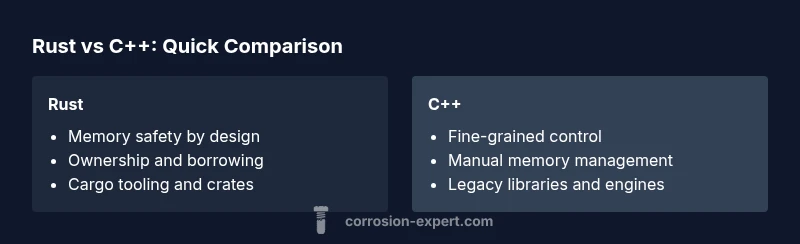
Are Rust and C++ Similar? A Comprehensive Side-by-Side
Compare Rust and C++ on safety, performance, memory management, and ecosystem maturity. This analytical guide helps developers decide which language fits systems programming best today.


Are rust and c++ similar? They share a goal of high-performance, low-level control for systems programming, but they diverge on safety and memory. Rust enforces ownership and borrowing to prevent data races at compile time, while C++ relies on programmer discipline and manual memory management. This comparison outlines safety, performance, ergonomics, and ecosystem trade-offs.
Are Rust and C++ Similar? Core Differences
are rust and c++ similar in name only? The two languages occupy a similar niche: high-performance, low-level control for systems programming. Yet they approach safety, memory management, and developer ergonomics from different angles. C++ offers vast historical momentum, a generous feature set, and fine-grained control, which can translate into exceptional performance when used by skilled teams. Rust, by contrast, emphasizes memory safety and concurrency safety without sacrificing speed. This block surveys high-level differences that shape project choices, such as guarantees for correctness, the mental model for memory, and how teams scale codebases. For teams evaluating a migration or a new project, the contrast between guaranteed safety mechanisms and potential upfront learning curves is central to the decision. are rust and c++ similar phrases often surface in debates about safety and predictability, but the trade-offs go beyond syntax and into the heart of how each language models risk, performance, and maintenance.
Language Paradigms and Safety Guarantees
Both Rust and C++ are multi-paradigm languages that support procedural, object-oriented, and generic programming styles. The critical distinction lies in safety guarantees and how they are achieved. Rust enforces strict compile-time checks through ownership, borrowing, and lifetimes, preventing common classes of bugs such as use-after-free or data races. This model gives developers confidence in correctness for concurrent code, but it also imposes constraints that require a different way of thinking about data ownership. C++, with its decades-long evolution, offers explicit control over allocation, lifetime, and aliasing, but safety relies on programmer discipline, rigorous code reviews, and extensive testing. The result is immense flexibility paired with a higher susceptibility to subtle bugs if best practices are not followed. In practice, teams choose based on whether they value compile-time safety guarantees or the versatility to implement unsafe block patterns when needed.
Ownership, Borrowing, and Memory Management
are rust and c++ similar in memory models? Not exactly. Rust uses an ownership model with borrowing and lifetimes that guarantee at compile time that memory access is valid. The compiler enforces rules about who owns what, how many references exist, and when values can be freed. This model eliminates a broad class of runtime memory errors and data races in concurrent code. C++, meanwhile, relies on deterministic destructors and manual or semi-automatic memory management (smart pointers, RAII, and custom allocators). While C++ offers powerful constructs like move semantics and smart pointers, it also leaves room for leaks, dangling pointers, and undefined behavior if misused. Practically, Rust’s approach yields safer defaults, while C++ provides more explicit control and sometimes simpler abstractions for seasoned developers who can manage lifetimes carefully.
Performance and Abstraction Trade-offs
When comparing performance trajectories, both languages can achieve excellent results. Rust’s zero-cost abstractions aim to rival C++ in speed while preserving safety. This means high-level features like iterators, generics, and trait-based polymorphism can be compiled into efficient machine code with minimal overhead. C++ also delivers zero-cost abstractions but requires the programmer to be mindful of compiler behavior and optimization opportunities. In some domains, C++ may edge ahead due to aggressive inlining, bespoke memory layouts, or well-established optimization libraries. In others, Rust’s safer abstractions help maintain performance without heroic debugging efforts. The practical takeaway is that you can usually reach similar performance outcomes in either language, but the path to those outcomes differs in complexity and risk.
Concurrency, Synchronization, and Safety in Practice
Concurrency is a major differentiator. Rust’s model prevents data races by design through the ownership system, which makes many concurrency bugs outright impossible to compile. This tends to reduce debugging time and increases reliability in multi-threaded code. C++, with its traditional shared-memory model, can be faster on raw micro-optimizations and gives developers granular control over thread lifetimes and locking strategies, but it requires careful synchronization to avoid data races. In real-world systems, teams often rely on well-understood patterns (thread pools, lock-free queues, and asynchronous I/O) in both ecosystems; Rust’s ecosystem tends to push toward safer defaults with ergonomic APIs, while C++ tooling emphasizes customization and legacy compatibility. The result is a nuanced landscape where safety and performance must be weighed alongside existing code and schedules.
Tooling, Ecosystems, and Learning Curve
Tooling shapes both developer experience and project velocity. Rust ships with Cargo, which coordinates dependencies, builds, and publishing in a cohesive manner, often leading to smoother onboarding and deterministic builds. The Rust compiler provides helpful error messages and guidance that can accelerate learning and reduce debugging time. C++ relies on a mosaic of toolchains, build systems, and IDEs, which can be powerful but require more setup and maintenance, especially in large organizations. The ecosystem for Rust is rapidly maturing, with a growing set of libraries and bindings, but C++ remains deeply entrenched in many industries with an established body of legacy code and domain-specific libraries. From a learning perspective, Rust’s ownership model poses an initial barrier but yields long-term benefits in safety, while C++’s breadth can demand a longer ramp-up to harness all features responsibly.
Interoperability and Use Cases
Interoperability is often essential in real-world projects. Rust and C++ can interoperate via C bindings or FFI bridges, allowing components to communicate across language boundaries. This enables gradual migration of legacy code or selective use of Rust modules within a C++ project, or vice versa. Use cases diverge in practice: Rust tends to be favored for safety-critical systems, network services, WASM modules, and new infrastructure projects where reliability is paramount. C++ excels in performance-critical domains with extensive legacy code, such as game engines, embedded systems with stringent hardware constraints, and high-performance computing. The choice between these languages often hinges on existing codebases, team expertise, project timelines, and risk tolerance. In some scenarios, a hybrid approach delivers the best of both worlds, leveraging Rust’s safety for new modules while preserving mature C++ components.
Practical Scenarios: When to Choose Rust or C++
Are rust and c++ similar in practical decision-making? The pragmatic answer rests on project context. If you need strong safety guarantees, safer concurrency, and you’re starting a greenfield project with modern tooling, Rust is a compelling option. If your workload requires leveraging a vast legacy ecosystem, legacy code integration, or extremely tight control over performance nuances, C++ remains a robust choice. Consider team familiarity with ownership concepts, existing infrastructure, and the breadth of third-party libraries. Additionally, assess how future maintenance and safety requirements align with long-term project goals. In many cases, teams pick Rust for new modules or services while continuing to maintain and extend C++ components to preserve stability and leverage mature toolchains.
Industry Trends and Future Trajectories
Both Rust and C++ continue to evolve, influenced by industry needs and community contributions. Rust’s model has sparked broader adoption in areas requiring robust safety guarantees, such as networking services and systems tooling, while C++ maintains dominance in domains with heavy legacy code and performance-critical requirements. As language features, compiler optimizations, and library ecosystems mature, the choice becomes less about one language beating the other and more about selecting the right tool for the task at hand. Organizations that invest in training, establish clear guidelines for memory management and concurrency, and maintain modular codebases tend to navigate this landscape more effectively. In sum, the decision remains contextual and strategic, not absolute.
Authority and References
For those seeking deeper validation, consult official standards and peer-reviewed literature. See sources from established publications and standards bodies to contextualize claims about safety models, memory management, and performance strategies.
Comparison
| Feature | Rust | C++ |
|---|---|---|
| Memory safety and safety guarantees | Rust provides compile-time ownership/borrowing guarantees to prevent data races | C++ safety depends on programmer discipline; undefined behavior possible |
| Memory management model | Rust uses ownership with deterministic drops and borrow checking | C++ uses manual memory management with RAII and smart pointers |
| Performance control | Rust emphasizes zero-cost abstractions with safety | C++ emphasizes maximum low-level control and potential inlining |
| Learning curve | Rust has a steeper upfront model due to ownership concepts | C++ has a long learning curve from its vast feature set |
| Ecosystem and libraries | Rust: modern ecosystem with Cargo, growing libraries | C++: mature ecosystem with extensive legacy libraries |
| Tooling and compilation | Rust: cohesive toolchain, fast incremental builds | C++: diverse toolchains and build systems with variable times |
| Interoperability | Interoperates via C bindings; bindings common for FFI | Strong C++ interop via C interfaces and ABI stability |
| Use cases | Rust: safety-critical systems, network services, WASM | C++: game engines, embedded systems, HPC |
The Good
- Safety-focused language design reduces memory errors and data races
- Modern tooling and dependency management streamline workflows
- Strong community support and rapid language evolution
- Zero-cost abstractions enable high performance without runtime penalties
- Good interop options with C for gradual migration
Cons
- Steeper learning curve due to ownership and borrowing semantics
- Smaller ecosystem in some domains compared to C++
- Long-term maintenance may require more migration planning in mixed-codebases
Rust is a compelling alternative to C++ for safety-first systems work
Choose Rust when memory safety and safer concurrency are priorities, and you can adopt its ownership model. Choose C++ when you must maximally exploit legacy code, libraries, or ultra-tuned performance where the cost of safety trade-offs is already accounted for.
Quick Answers
What are the main safety differences between Rust and C++?
Rust enforces memory safety and data-race prevention at compile time through ownership and borrowing. C++ relies on programmer discipline and patterns to manage memory and concurrency, which can lead to undefined behavior if not handled carefully.
Rust enforces memory safety at compile time, while C++ safety depends on the programmer choosing correct memory and synchronization patterns.
Are Rust and C++ comparable in performance?
Both can achieve high performance with careful design. Rust emphasizes safety-zero-cost abstractions, while C++ provides granular control that can extract maximum hardware efficiency when tuned by experienced developers.
Both languages can be very fast; Rust emphasizes safety and predictable performance, while C++ allows aggressive optimization with careful coding.
Which language is easier to learn for beginners?
C++ has a vast feature set that can overwhelm beginners. Rust introduces ownership concepts that require a paradigm shift but often yields clearer safety guarantees as you gain experience.
C++ is broad and tricky for newcomers; Rust’s ownership model can be hard at first but pays off in safer code later.
Can Rust replace C++ in game development?
Rust is increasing in game development for safer concurrency and modern tooling, but C++ remains dominant due to established engines, existing codebases, and legacy libraries.
Rust is growing in games, but C++ still dominates due to legacy engines and a deep library ecosystem.
Is interoperation between Rust and C++ straightforward?
Interoperability typically uses C bindings or FFI bridges. This enables gradual migration or mixed-language architectures, though it adds integration overhead and maintenance considerations.
Interoperability is possible via C bindings, but it adds integration work and maintenance cost.
What industries should consider Rust or C++ today?
Industries prioritizing safety and rapid iteration may lean Rust for new modules, while industries with heavy legacy code and extreme performance needs may favor C++.
If safety and speed to market matter, think Rust; for legacy-heavy or ultra-tuned systems, C++ still shines.
Quick Summary
- Prioritize safety goals when selecting a language
- Rust reduces memory bugs via ownership and borrowing
- C++ offers legacy stability and deep control for performance
- Tooling maturity and ecosystem shape developer velocity
- Hybrid approaches can leverage Rust safety with C++ legacy