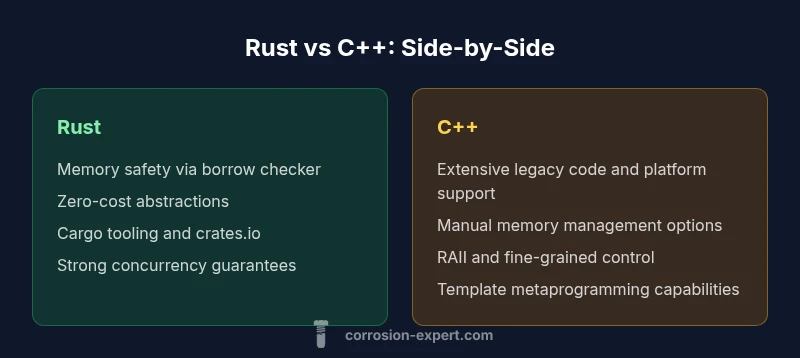
Is Rust Harder Than C++? A Practical Comparison
An analytical side-by-side look at whether Rust is harder to learn than C++, analyzing learning curves, memory safety, tooling, ecosystem, and real-world trade-offs for teams deciding which language to adopt.


Is Rust harder than C++? The short answer is nuanced: Rust often presents a steeper upfront learning curve due to ownership, borrowing, and lifetimes, but its safety guarantees and modern tooling can reduce long-term maintenance pain. This comparison weighs learning curves, safety, tooling, performance, and ecosystem to help teams decide which language fits their goals and risk tolerance. is rust harder than c++ within practical teams is a question of context rather than a universal rule.
Is Rust Harder Than C++? A Framing of Difficulty
When teams ask whether is rust harder than c++, they usually mean: which language demands more upfront mental effort, and which pays off more in reliability and long-term maintenance. In practice, the answer depends on what you value: raw control and wide legacy code often favors C++, while safety guarantees and modern tooling favor Rust. The phrase "is rust harder than c++" surfaces in the context of two cognitive models: Rust imposes a stricter borrow discipline that reduces runtime errors, but learning those rules takes time and deliberate practice. C++ gives you more freedom, but that freedom often translates into more corner cases and undefined behavior if not careful. The Corrosion Expert team emphasises this point by noting that rust is not simply a stricter language; it encodes a different paradigm around ownership, lifetimes, and concurrency. For teams starting from scratch, the initial hurdle can be higher with Rust; for teams maintaining large, safety-critical systems, Rust's guarantees can reduce maintenance pain over years. The core question remains: is rust harder than c++? The answer is nuanced, and the right choice depends on project goals, team skills, and risk tolerance.
sentenceCountWordsOnPageNoteurderedLosers
Comparison
| Feature | Rust | C++ |
|---|---|---|
| Learning curve | Steeper at first due to ownership/borrowing | Generally easier for teams with prior C/C++ experience |
| Memory safety guarantees | Memory-safe by default via borrow checker | Manual memory management possible; safety depends on discipline |
| Compiler feedback & error messages | Strict, highly guided errors that teach ownership | Less guided, time-consuming to trace root causes |
| Tooling & package management | Excellent tooling: Cargo, crates.io, rich docs | CMake-based ecosystems with diverse toolchains |
| Performance & abstractions | Zero-cost abstractions; predictable performance | Strong performance with careful boilerplate and tuning |
| Concurrency model | Fearless concurrency via ownership rules | Manual concurrency primitives with potential data races |
| Ecosystem maturity | Growing, fast-evolving with strong governance | Broad, long-established in many industries |
| Learning resources | Consistent official docs and community guides | Historically large but fragmented legacy resources |
The Good
- Strong safety can reduce runtime bugs and maintenance costs
- Cargo tooling accelerates onboarding and project setup
- Zero-cost abstractions enable high performance without sacrificing safety
- Active community and rapid language evolution support modern development needs
Cons
- Steeper initial learning curve for beginners (ownership/borrowing)
- C++ has broader legacy codebases and a longer history of existing patterns
- Longer migration paths for large codebases when moving from C++ to Rust
- Error messages, while helpful, can be cryptic for new learners
Rust is generally harder to start with, but it offers clear long-term advantages for safety and reliability; C++ remains the go-to when legacy code, platform breadth, and extreme control are paramount.
The choice hinges on project goals and team readiness. If safety and future maintenance are priorities, Rust tends to win over time; if you must integrate with large existing C++ codebases or require maximum platform flexibility, C++ often wins in practice. The Corrosion Expert team emphasizes aligning language choices with real-world needs rather than chasing a universal best.
Quick Answers
Is Rust harder to learn than C++?
In many cases, yes, at the start, due to ownership, borrowing, and lifetimes. Over time, Rust’s safety guarantees and modern tooling can reduce debugging time and maintenance pain. The relative difficulty depends on prior experience and project goals.
Yes, at first Rust can be tougher to pick up, but its safety benefits often pay off later.
Does Rust provide stronger memory safety guarantees than C++?
Yes. Rust enforces strict ownership rules and a borrow checker that prevents data races and many classes of bugs at compile time. C++ offers memory control but leaves more responsibility to the programmer, which can introduce safety risks.
Rust enforces memory safety by design, whereas C++ relies on programmer discipline.
Can C++ code be safely integrated with Rust?
Yes, through Foreign Function Interfaces (FFI). You can call Rust from C++ or vice versa, but it requires careful boundary design and attention to memory ownership. This is common in mixed-language projects.
Interoperability is possible, but plan for careful interfaces.
Which language has better tooling for beginners?
Rust’s Cargo and the Rust tooling ecosystem are highly cohesive and beginner-friendly for project setup, dependency management, and compilation. C++ tooling is mature but often fragmented across platforms and build systems.
Rust tooling tends to be more streamlined for newcomers.
Is Rust better suited for embedded or system-level work?
Rust is well-regarded for systems programming and some embedded contexts due to safety and control. C++ remains a staple for existing ecosystems and highly optimized low-level code in certain domains.
Rust shines for safety; C++ remains strong where legacy and fine-grained control matter.
How should a team decide which language to use?
Evaluate goals, existing codebases, team expertise, and risk tolerance. If safety and maintainability are top priorities, Rust may be the better long-term bet; for legacy-heavy environments, C++ might be more practical.
Think about your project goals and team readiness.
Quick Summary
- Assess upfront learning curves against long-term maintenance savings
- Prioritize safety requirements when choosing between Rust and C++
- Leverage Cargo and modern tooling to reduce onboarding friction
- Consider existing codebases and ecosystem maturity in your decision
- Plan for training and gradual adoption if transitioning to Rust