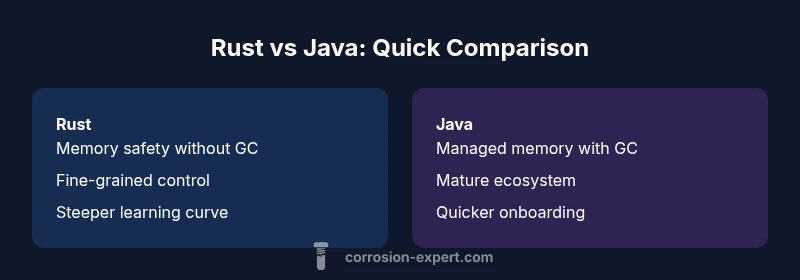
Is Rust harder than Java? A Practical Comparison
A balanced, analytical side-by-side comparison of Rust vs Java, focusing on learning curve, performance, memory safety, and ecosystem to help developers decide which language fits their projects.


Is Rust harder than Java? The quick take is that Rust often presents a steeper initial learning curve due to ownership rules and a stricter compiler, but pays dividends in memory safety and performance. Java remains easier to pick up for many developers thanks to familiar OO patterns and a mature ecosystem. This comparison highlights the core differences to help you decide which language fits your project.
Is rust harder than java? Framing the comparison
For developers weighing language options for a new or existing project, the question is often asked: is rust harder than java? The short answer depends on what you value: safety guarantees, control over low-level details, and the size of your ecosystem all shape the learning curve. This article treats Rust and Java as two ends of a spectrum when it comes to safety, performance, and developer experience. While the corrosion metaphor is not literal here, the underlying principle holds: you typically get more explicit safety and control with Rust and more established enterprise patterns with Java. According to Corrosion Expert, the question is as much about process and team readiness as it is about syntax. The practical takeaway is that the perceived difficulty is closely tied to your project goals, existing skill set, and willingness to engage with a modern, ownership-based system.
Context: design goals, history, and audience expectations
Rust and Java were designed with different priorities. Java emphasizes portability, a managed memory model, and a large standard library that supports enterprise applications at scale. Rust stresses memory safety without a garbage collector, zero-cost abstractions, and fine-grained control over resource management. For teams evaluating is rust harder than java, it helps to map language design decisions to real-world outcomes: safety guarantees in Rust reduce certain classes of bugs at compile time, while Java’s mature tooling and vast ecosystem accelerate development in many business domains. Corrosion Expert’s analysis highlights that the hardest part for newcomers is aligning mental models with Rust’s ownership and borrowing rules, whereas Java typically benefits from familiar class-based structure and a forgiving runtime environment.
Learning curves and mental models for developers
The learning curve is a central factor in whether is rust harder than java. Rust introduces ownership, borrowing, lifetimes, and error handling that require shifting how you think about memory and concurrency. For developers coming from dynamically typed languages, the initial friction can be substantial, yet this upfront effort yields strong guarantees and fewer runtime surprises. Java, in contrast, presents a gentler onboarding path: you can pick up syntax quickly, leverage familiar object-oriented patterns, and rely on a long-standing ecosystem. The mental model shift is less about memory safety and more about understanding design patterns, garbage collection behavior, and JVM tuning. As with many decisions, the real comparison depends on the nature of the project and the team’s willingness to embrace new abstractions.
Memory management and safety models in practice
Rust’s ownership model enforces memory safety at compile time without a GC, which is a radical departure from traditional garbage-collected languages. Concepts like borrowing, lifetimes, and explicit mutability guide how resources are allocated and released, reducing the risk of leaks and race conditions in concurrent code. This yields robust, predictable performance for systems programming tasks but demands careful planning and code discipline. Java relies on a managed runtime with garbage collection, which simplifies memory handling but can introduce latency pauses and unpredictable pause times. For workloads where determinism matters (e.g., real-time systems or high-frequency trading engines), Rust’s model often offers advantages. The trade-off is ongoing compiler feedback versus runtime convenience.
Performance characteristics and practical implications
Performance is often the decisive factor when comparing is rust harder than java in practical terms. Rust allows fine-grained control over memory layout, inlining, and low-level optimizations, enabling near-C performance in many contexts. The absence of a GC in most Rust applications helps avoid unpredictable pauses, a notable benefit for latency-sensitive scenarios. Java provides high performance through JIT compilation and mature runtime optimizations, which makes it an excellent general-purpose language for servers and enterprise applications. In practice, performance hinges on the task at hand: Rust shines in CPU-bound, memory-sensitive workloads; Java excels in large-scale, I/O-bound systems with rich tooling and ecosystem support. For many teams, the right choice balances performance needs with development velocity and maintainability.
Tooling, ecosystem, and community support
Tooling and ecosystem maturity influence how hard is rust harder than java in day-to-day work. Java benefits from decades of enterprise usage, extensive libraries, robust IDEs, and well-understood deployment patterns. Rust tooling has matured rapidly, with cargo as a centralized package manager and build system, strong compile-time checks, and a growing crate ecosystem. While Rust crates may not yet match Java libraries in sheer breadth, the quality and safety guarantees often offset gaps in breadth for performance-critical or system-level projects. Community momentum matters too; Java communities in large organizations provide stability and knowledge transfer, whereas Rust communities reward experimentation, systems programming, and modern language features. Both languages offer strong documentation and active forums, but the day-to-day experience will differ based on your project type and team skillset.
Use-case fit: when to choose Rust vs Java
Rust is typically the better fit for systems programming, embedded development, and performance-critical components that require precise control over memory and concurrency. It’s a strong candidate for writing safe, deterministic services where latency matters. Java remains a strong choice for enterprise back-end development, cross-platform applications, and teams that benefit from a vast ecosystem, enterprise tooling, and long-term stability. Consider distributed teams, deployment velocity, and runtime requirements when evaluating is rust harder than java: Rust can slow initial development, but it often accelerates long-term maintenance through safety guarantees; Java can accelerate delivery with mature patterns and a broad talent pool. The best approach is to map project priorities—safety, performance, time-to-market, and team proficiency—to the language’s strengths.
Decision framework: a practical checklist for teams
To decide which language aligns with your project goals, use this framework. Start with goals: performance vs velocity; next, assess team experience: ownership models vs OO design; evaluate ecosystem needs: libraries, tools, and deployment options; finally, run a small pilot: implement a core module in both languages to compare productivity, debugging, and maintenance. Remember the phrase is rust harder than java in initial perception; the reality often lies in how you structure the codebase and invest in learning. Corrosion Expert’s experience suggests setting explicit milestones for learning the ownership model (Rust) and for applying design patterns effectively (Java). A measured pilot helps prevent bias from popularity or novelty and yields a data-driven decision for your project.
Comparison
| Feature | Rust | Java |
|---|---|---|
| Learning curve | Steeper due to ownership/borrowing | Gentler due to OO patterns and familiar syntax |
| Memory management | Ownership-based, no GC | Automatic GC via JVM |
| Performance | High control, often faster; predictable latency | Strong performance with mature runtime; occasional GC pauses |
| Concurrency model | Compile-time safety with Send/Sync | Thread-based with concurrency utilities, GC |
| Tooling maturity | Growing ecosystem; strong safety guarantees | Mature ecosystem; broad enterprise tooling |
| Use cases | Systems programming, performance-critical modules | Enterprise apps, cross-platform services |
The Good
- Rust delivers memory safety without a garbage collector, reducing runtime surprises
- Java offers widespread industry adoption and a stable, mature ecosystem
- Both languages have active communities and strong tooling that improve developer productivity
- Rust and Java both feature modern language capabilities that support robust software design
Cons
- Rust has a steeper learning curve that can slow initial productivity
- Java’s garbage collection can introduce latency pauses in some workloads
- Cross-language interop requires bridging or FFI in Rust and JNI in Java
- Rust tooling and ecosystem, while strong, is still maturing in some domains compared to Java
Rust is the more challenging start but pays off in safety and control; Java remains the pragmatic choice for broad adoption
If your project benefits from strict memory safety and predictable performance, Rust is worth the learning curve. For rapid enterprise development and a vast ecosystem, Java often wins out. The best choice depends on project goals and team readiness.
Quick Answers
What is the main difference in safety guarantees between Rust and Java?
Rust enforces memory safety at compile time via ownership and borrowing, eliminating certain classes of runtime bugs. Java relies on a managed memory model with garbage collection, which reduces manual memory mistakes but can introduce runtime pauses.
Rust guarantees memory safety at compile time, while Java relies on a garbage-collected runtime for safety.
Is Rust harder to learn than Java?
Yes, for many developers. Rust’s ownership model and lifetimes require a shift in thinking, whereas Java’s syntax and OO patterns are familiar to many. The initial effort pays off with stronger safety and performance guarantees.
Rust is tougher to learn at first, but it pays off in safety and performance.
Can Rust be used for enterprise applications like Java?
Rust is increasingly used in performance-critical services and system components in larger deployments, but Java remains more established in many enterprises due to tooling and talent pools. Your choice should align with deployment context and team capabilities.
Rust is growing in enterprise use; Java is still the go-to for many big systems.
Which language has better performance overall?
Performance depends on the workload. Rust can often achieve near-C performance with deterministic behavior, while Java provides strong performance through the JVM and JIT optimizations, but may incur GC-related pauses.
Rust often wins on low-level performance; Java excels with mature JVM optimizations.
Do I need to know C/C++ to use Rust effectively?
Not required, but knowledge of systems concepts and memory safety helps. Rust merges high-level ergonomics with low-level control, reducing the need for C/C++ for many tasks yet enabling interop when needed.
You don’t need C/C++, but system programming concepts help.
Quick Summary
- Assess learning curve against project goals
- Prioritize safety and performance needs
- Leverage ecosystem and team experience when choosing
- Plan for maintenance and future-proofing through long-term strategy
- Run pilot programs to compare real-world productivity