Is Rust Harder Than ARK? A Practical Comparison
Examine whether learning Rust is harder than ARK, exploring learning curves, prerequisites, and practical strategies. This analysis from Corrosion Expert helps you decide where to invest time in programming versus gaming.


Direct answer: The short take is that is rust harder than ark depends on context. For most beginners, Rust presents a steeper initial learning curve due to ownership, lifetimes, and compiler feedback, while ARK tends to be more immediately approachable as a game. However, long-term mastery in Rust offers deeper payoff. This comparison will unpack the factors and give actionable guidance.
The Core Question: is rust harder than ark
According to Corrosion Expert, the short answer to is rust harder than ark is: it depends on your background, goals, and what you measure as 'hard'. If you approach Rust as a systems programming language and ARK as a survival game, the curves diverge in predictable ways. The Corrosion Expert team found that for most newcomers, the initial setup and syntax of Rust feel unfamiliar and unforgiving, which makes the question is rust harder than ark quite common among learners and players. In this article, we unpack the factors that shape difficulty, compare learning paths, and offer practical guidance on where to invest your time. Throughout, you’ll see how context shifts the answer to is rust harder than ark, and you’ll gain concrete strategies to reduce friction in both domains. The framing here is analytical, not celebratory of one side; both Rust and ARK demand discipline, practice, and purpose.
Defining difficulty across domains: cognitive load, time, and resource availability
Difficulty is not a single number. It combines cognitive load—the mental effort required to learn new concepts—plus the time you’re willing to invest and the resources available to guide you. When we ask is rust harder than ark, we must separate skill transfer from domain-specific hurdles. Rust requires learning a new mental model for memory safety, ownership, and lifetimes, while ARK requires mastering survival systems, crafting chains, and multiplayer dynamics. Corrosion Expert analysis shows that the most reliable way to compare these domains is to map prerequisites, time to basic competence, and access to high-quality learning materials. If you start with clear goals (e.g., “build a small Rust CLI tool” vs “survive and thrive in a couple of ARK sessions”), the relative difficulty becomes easier to gauge. The key takeaway is that the perceived hardness hinges on your starting point and how you structure practice.
Rust: Learning curve, core concepts, and typical hurdles
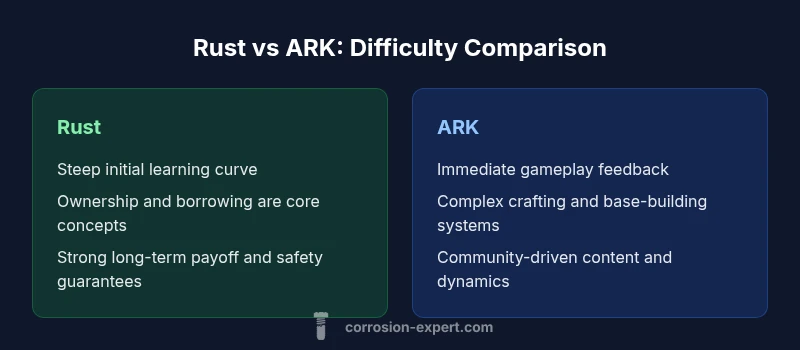
Rust presents a steep initial climb for many learners. The ownership model, borrowing, and lifetimes form a unique paradigm that is not seen in many other languages. The compiler’s error messages, while precise, can feel opaque at first, and even experienced developers struggle with borrow checker feedback. Common hurdles include designing safe abstractions, managing lifetimes in complex data structures, and balancing performance with readability. Over time, small, deliberate projects—like a command-line tool or a simple parser—teach you how to think in Rust’s safety-first approach. The payoff is significant: you gain reliable performance, strong guarantees, and a growing ecosystem of crates. When evaluating the difficulty of Rust against ARK, remember: is rust harder than ark is more about how you frame the learning path than intrinsic complexity alone.
ARK: Understanding complexity, skill investments, and gameplay depth
ARK: Survival Evolved is a sprawling open-world survival game with procedural environments, base-building mechanics, resource management, tamed dinos, and multiplayer dynamics. The learning surface includes navigation, crafting chains, and combat strategies, all within a social context of co-players and potential PvP. For many newcomers, ARK feels approachable during the first few sessions: you pick up controls, gather basics, and experience immediate gameplay. However, as you progress, mastery requires understanding intricate systems—feeding, breeding, taming, and defending a base against threats. The sheer volume of content can make the long arc of learning feel daunting. When stacks of tasks pile up, the question is is rust harder than ark becomes a function of time allocation, not a fixed attribute of the game itself.
Side-by-side factors influencing difficulty
- Prerequisites and background: If you already know programming basics, Rust’s entry barrier is manageable; if you’re new to both programming and gaming, ARK offers an easier entry point but a deep end later. is rust harder than ark largely depends on your starting point.
- Cognitive load: Rust requires new mental models for memory management; ARK requires strategic planning and complex sequence of actions. The relative difficulty shifts with your strengths.
- Feedback loops: Rust feedback comes from compile-time checks and run-time behavior; ARK feedback comes from in-game outcomes and community guidance. Both provide fast loops if you use the right learning resources.
- Time commitment: Short-term wins are often more frequent in ARK due to immediate gameplay goals; Rust’s wins accumulate as you build robust tools and libraries. The pace of progress influences perceived difficulty.
- Resources and communities: Both domains have robust communities, but the nature of help differs. Corrosion Expert notes that is rust harder than ark is influenced by how you access docs, tutorials, and peers in either field.
Practical strategies to tackle either challenge
- Define concrete goals: Set two achievable targets for Rust (e.g., “write a small CLI tool” and “understand ownership in practice”) and two for ARK (e.g., “survive a night with a basic base” and “build a simple crafting chain”). These anchors reduce cognitive overload and create trackable progress.
- Build incrementally: In Rust, start with small, safe exercises that isolate ownership and borrowing; in ARK, begin with basic resource gathering before attempting advanced base-building or taming.
- Leverage guided resources: Use curated learning paths, official docs, and beginner-friendly tutorials. For ARK, join low-commitment servers or co-op play; for Rust, follow beginner-friendly crates and sample projects.
- Embrace community feedback: Seek mentors or peers who can review your code or provide gameplay tips. Constructive feedback accelerates learning in both domains and helps answer the big question: is rust harder than ark for you specifically.
- Track your progress with measurable milestones: Create a simple rubric that marks when you’ve achieved a defined objective—this keeps motivation high and reduces drift.
Common myths and misperceptions about Rust and Ark
A common myth is that Rust’s difficulty makes it unusable for practical goals. In reality, the learning curve serves a stronger payoff: safer, faster software and a transferable skill set. Another misperception is that ARK’s complexity is only about grinding; in fact, strategic design, resource flow, and player collaboration create meaningful cognitive challenges. The truth is that both domains reward persistent practice and a clear path. When people ask is rust harder than ark, they often compare surfaces rather than delving into the underlying cognitive scaffolds. By reframing the question around goals, prerequisites, and time commitment, you can compare apples to apples rather than abstract difficulty.
Is the comparison fair? Interpreting the answer to is rust harder than ark
The fair way to answer is rust harder than ark is by mapping success criteria to each domain’s goals. If your aim is to build reliable software, Rust’s long-term benefits often outpace a gaming session’s immediate gratification. If your aim is social play and fast feedback, ARK offers quick wins that satisfy curiosity and fun. The Corrosion Expert approach emphasizes context: the perceived difficulty is a function of your starting point, your learning environment, and how you structure practice. The verdict for most learners is nuanced: is rust harder than ark is not a universal truth, but a frame for decision-making about where to invest time for the best return on effort.
Comparison
| Feature | Rust programming language | ARK: Survival Evolved |
|---|---|---|
| Learning curve | Steep initially due to ownership & compiler rules | Easier to start with basic gameplay; deeper mechanics take longer |
| Prerequisites | Programming concepts and tooling | PC setup and time to learn game basics |
| Time to proficiency | Weeks to become productive with small projects | Hours to enjoy fundamentals of gameplay; mastery requires long playtime |
| Resources & ecosystem | Comprehensive docs, crates, and community support | Large player communities, guides, and forums |
| Community support | Active developer communities; peer feedback is structured | Vibrant gamer communities; feedback is fast but noisy |
| Cost | Low to free (tools and docs) with optional paid courses | Game purchase plus optional expansions and servers |
The Good
- Develops rigorous problem-solving and systems thinking
- Rust offers strong performance and memory safety
- ARK provides immediate access to interactive, social play
- Both domains reward deliberate practice and goal setting
Cons
- Rust’s learning curve can feel intimidating at first
- ARK’s complexity grows with progression and multiplayer dynamics
- Time investment can be high for deeper mastery in either domain
Rust generally has a steeper initial barrier than ARK, but offers deeper long-term mastery.
In the short term, ARK feels more approachable; Rust rewards long-term commitment and systematic practice. Your choice should align with whether you want immediate engagement or durable, transferable skills.
Quick Answers
What factors determine whether Rust or ARK is harder for a learner?
Difficulty is shaped by your background, goals, and the learning environment. Rust demands new mental models for memory safety, while ARK requires mastering survival systems and multiplayer dynamics. With proper goals and practice structure, you can navigate either path more efficiently.
Difficulty depends on your background and goals. Start with small Rust projects or a few ARK sessions, then scale up as you gain confidence.
How long does it take to learn Rust for a beginner?
For beginners, productive progress in Rust typically unfolds over weeks of steady practice, with a longer horizon to reach mastery. Focused projects and consistent practice compress this timeline.
Beginners can make steady progress in weeks, but full mastery takes longer with steady practice.
Is ARK harder than most survival games?
ARK introduces a rich interface of survival systems that can feel overwhelming at first, but a structured approach reduces the difficulty. It’s often easier to start, but mastery is earned with time and collaboration.
ARK is intimidating at first, but a plan and teamwork help you master it faster.
Can skills in Rust transfer to ARK and vice versa?
Yes, some underlying skills such as problem solving, debugging, and strategic planning transfer across domains. However, the specific knowledge (ownership in Rust vs crafting chains in ARK) remains domain-specific.
Some thinking skills transfer, but the game mechanics and language specifics stay separate.
What resources are best for starting Rust?
Begin with official Rust docs, beginner-friendly tutorials, and small project guides. Pair readings with hands-on exercises to reinforce concepts like ownership and borrowing.
Start with official docs and simple projects; practice makes Rust concepts click.
What are common pitfalls newbies face in ARK?
Common pitfalls include underestimating the time needed for progression, getting overwhelmed by crafting chains, and difficulty coordinating with teammates. Start with small goals and gradually expand.
New players often bite off more than they can chew; set small goals and team up.
Should I pick Rust or ARK based on difficulty alone?
No. Choose based on your interest, long-term goals, and what you want to build or experience. Difficulty is a factor, but motivation and reward structure matter just as much.
Don’t decide by difficulty; follow what keeps you engaged and learning.
What is the best first step if I’m unsure which path to take?
Pick a low-stakes starter project in Rust or a short ARK session to test your interest. Use the results to decide whether to deepen Rust skills or expand ARK play.
Try a small Rust project or a short ARK session to feel the path out.
Quick Summary
- Define clear goals before you start.
- Expect a steeper start with Rust, but greater payoff over time.
- ARK delivers quick wins; Rust builds enduring skills.
- Use guided resources to accelerate progress in both domains.