Rust vs Ark: A Practical Comparison for Rust Prevention
A balanced, evidence-based comparison of rust-focused prevention versus the ARK approach, with actionable guidance, maintenance insights, and cost considerations for DIY homeowners.


Rust vs Ark is best understood as a comparison between traditional rust prevention strategies and an integrated, hypothetical ARK approach. For most DIY homeowners, the traditional rust-prevention path offers clear, cost-effective steps: moisture control, protective coatings, and regular inspections. The ARK approach promises a structured, ongoing monitoring framework, but often requires greater investment and maintenance discipline. Corrosion Expert recommends starting with proven prevention methods and evaluating ARK only for larger projects or facilities needing continuous oversight.
Defining rust vs ark: what the terms represent
In corrosion science, ‘rust’ refers to the chemical process of oxidation that degrades metals, particularly iron and steel, when exposed to moisture, salts, and oxygen. In this article, we pair that traditional phenomenon with “ARK” as a hypothetical, integrated rust-management framework. ARK stands for a conceptual approach that combines barrier coatings, environmental control, sensors, and scheduled interventions into a single program. By treating ARK as a stand-in for a comprehensive system, we can compare how a conventional, well-understood rust-prevention plan stacks up against a more proactive, monitored strategy. This helps homeowners assess risk, cost, and effort without committing to a specific product line.
Throughout this comparison, we will use the exact term rust vs ark to emphasize the contrast between a time-tested, DIY-friendly approach and a more serialized, system-wide method. While ARK is presented as a hypothetical framework here, the underlying principles—monitoring, barrier protection, and timely maintenance—are universal in rust control. The Corrosion Expert team emphasizes that the core goal remains simple: keep metal surfaces dry, protected, and inspected so that rust does not get a foothold.
The core differentiators: scope, lifecycle, and outcomes
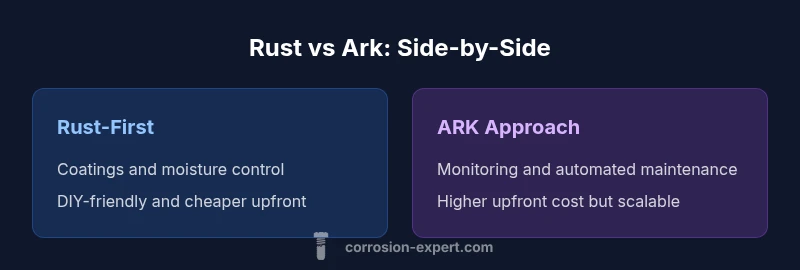
The rust vs ark contrast hinges on three practical dimensions: scope, lifecycle management, and measurable outcomes. Traditional rust prevention is usually role-specific and reactive by design: you identify exposed metal, select a compatible coating or protective layer, and schedule reapplication as needed. ARK, by contrast, strives for an integrated lifecycle, stitching sensors, coatings, triggers, and maintenance tasks into a cohesive program. The key differentiator is not a single coating or tool but the degree of coordination and ongoing oversight. For the DIY homeowner, this translates into a choice between a straightforward, affordable project and a more ambitious plan that aims to prevent rust through continuous data-driven actions. In the rust vs ark frame, an important nuance is that the ARK approach often requires upfront planning and long-term commitment, while rust-first strategies emphasize rapid wins and flexible adjustments. Both paths share common fundamentals—control moisture, minimize salts, and clean surfaces—but ARK elevates the emphasis on monitoring and proactive intervention as a core component.
Practical implications for typical DIY homeowners
When choosing between rust-first methods and an ARK-style approach, homeowners should weigh practicality against risk tolerance. Rust-first strategies suit small-scale projects like railing maintenance, gate hinges, and sheds where you can directly apply primers, rust converters, and protective paints. These methods are familiar, inexpensive, and easy to execute with common tools. ARK is more appealing for larger projects or properties with high exposure to moisture and salt—think coastal homes, outdoor furniture sets, or metal structures that require regular inspections and sensor-guided interventions. In this article, the rust vs ark comparison focuses on concrete steps you can take today, then explains how the ARK framework could scale with project size and environmental complexity. The goal is to empower you to start with reliable basics and consider ARK if ongoing oversight would deliver meaningful value over time.
ARK vs traditional rust-prevention: best-use scenarios
ARK tends to be advantageous where ongoing performance data, predictive maintenance, and systemic protection reduce downtime and extend asset life. For DIY homeowners, the traditional rust-prevention route is best when projects are modest, exposures are manageable, and you want predictable results without ongoing subscriptions or sensor networks. If you face high humidity, salt spray, or widespread metal assets across a property, ARK-like thinking can help you design a monitoring plan, select durable coatings, and schedule inspections with data-driven triggers. The rust vs ark framework thus supports a tiered strategy: start with solid rust prevention, then add ARK components only where the added value justifies the cost and complexity.
Step-by-step: implementing rust-prevention in a home project
- Assess exposure: identify metal items at risk (doors, rails, tools, outdoor furniture) and note moisture sources. 2) Clean and prep: remove surface rust with a wire brush or rust remover, then clean to bare metal. 3) Choose protection: apply corrosion-inhibiting primers or rust-inhibiting paints suited to the metal type and climate. 4) Create barriers: install moisture barriers, seal joints, and improve drainage around metal components. 5) Maintain regularly: inspect for peeling coatings and rust spots every 6–12 months and touch up as needed. 6) Document decisions: keep a simple log of products used, surface conditions, and inspection dates. 7) Revisit environmental controls: address humidity, condensation, and exposure to salt or chemicals that accelerate corrosion. 8) Re-coat as needed: follow the product’s recoat window and surface preparation guidance.
Step-by-step: implementing ARK approach in practice
- Map assets: inventory all metal surfaces, exposure levels, and maintenance history. 2) Define performance targets: establish acceptable rust resistance levels and inspection intervals. 3) Install monitoring: deploy non-invasive moisture sensors and corrosion indicators where appropriate. 4) Layer protection: pair durable coatings with physical barriers like sealants and coatings that resist UV and weathering. 5) Automate tasks: set up alerts for inspection milestones, coating reapplication, or sensor triggers. 6) Integrate maintenance: align ARK tasks with seasonal cycles to minimize disruption and maximize protection. 7) Review and adapt: analyze sensor data, adjust maintenance frequency, and upgrade coatings as needed. 8) Budget and governance: plan long-term costs for sensors, maintenance, and replacement cycles, ensuring the program remains sustainable.
Maintenance, costs, and long-term planning
Long-term rust prevention requires discipline and periodic investment. The rust-first path generally offers lower upfront costs and greater flexibility, making it a pragmatic choice for many homeowners. The ARK approach, while potentially higher in initial investment, can yield benefits through data-driven maintenance and reduced surprises on large properties. Regardless of the path, effective rust control hinges on consistent inspections, timely coatings, and environmental controls. A simple maintenance calendar, proper cleaning routines, and a clear understanding of your climate will go a long way toward sustaining metal assets and minimizing rust progression over time. The rust vs ark comparison emphasizes that cost is not the only driver; long-term value is shaped by how well you plan, monitor, and act on proof of rust formation before it spreads.
Common misconceptions and pitfalls
A common misconception is that rust can be eliminated completely with a single product. In reality, rust control is an ongoing process that combines surface preparation, protective barriers, and environmental management. Another pitfall is underestimating humidity and salt exposure, which can undermine coatings quickly. In the rust vs ark framework, homeowners sometimes equate ARK with a magic solution; in truth, ARK is only as effective as the data and maintenance it supports. Finally, DIY projects should not neglect safety: wear protective gear when dealing with chemicals and ensure proper ventilation and disposal.
Case examples: settings and what works
Coastal homes with metal railings often benefit from a two-layer approach: a primer that inhibits rust and a sealant that blocks moisture ingress. Inland garages with exposed tools can see long-term benefits from a regular recoat schedule and a rust-inhibiting topcoat. For larger outdoor structures, ARK-like programs may add value through sensor-driven maintenance alerts and scheduled inspections, helping maintain asset integrity over several seasons. In each scenario, starting with robust rust prevention and gradually layering ARK concepts can balance cost, effort, and protection effectively.
Comparison
| Feature | Rust-First Approach (Traditional) | ARK Approach (Integrated) |
|---|---|---|
| Scope | Surface-focused; coatings, sealants, and moisture control | Integrated program with monitoring, alerts, and staged interventions |
| Best For | Small to medium DIY projects and straightforward environments | Larger properties or projects requiring continuous oversight |
| Initial Cost | Lower upfront; buy coatings and tools as needed | Higher upfront plus potential ongoing monitoring costs |
| Maintenance Cadence | Periodic refreshes; annual or biennial checks | Automated alerts; ongoing monitoring with scheduled interventions |
| Tools & Expertise | Common DIY tools; basic surface prep and painting | Sensors, data interpretation, and possibly professional calibration |
| Durability & Longevity | Good durability with proper application and climate control | Potentially higher longevity with proactive monitoring, depending on environment |
| Best For | Homes and hobby projects | Edge cases with high exposure or complex asset inventories |
The Good
- Clear, actionable steps for rust prevention
- Low upfront cost and flexible scheduling
- Good for most residential projects with manageable exposure
- Easily scalable with existing DIY skills
Cons
- May overlook hidden moisture sources without thorough assessment
- ARK may be hypothetical; value depends on implementation and scale
- Requires periodic reapplication and maintenance discipline
Traditional rust-prevention often provides the best balance for most homes; ARK offers value when ongoing monitoring justifies the cost.
Start with rust-first prevention for predictability. Consider ARK for larger portfolios or environments where data-driven maintenance could prevent frequent rust-related issues.
Quick Answers
What is rust vs ark and how do they relate to home maintenance?
Rust refers to the corrosion process on metals, while ARK is used here as a hypothetical integrated prevention framework. The comparison helps homeowners weigh simple, proven methods against a more data-driven, monitored approach.
Rust is corrosion on metal, and ARK is a hypothetical integrated prevention plan used for comparison. Start with basic prevention and consider ARK if you need ongoing monitoring.
Is ARK a real technology or product?
In this article, ARK is presented as a hypothetical framework to illustrate the difference between traditional rust prevention and an integrated monitoring approach. Real-world rust control relies on coatings, barriers, and environmental management.
ARK here is a hypothetical framework used for illustration; real rust control relies on coatings and moisture management.
Can I do rust prevention myself, or should I hire professionals?
Many rust-prevention steps are suitable for DIYers: surface cleaning, applying rust-inhibiting coatings, and improving drainage. Professional help may be useful for complex structures or large coastal properties, but most homeowners can achieve solid results with basic tools.
Yes, you can handle many steps yourself, especially surface prep and coatings. Call in pros for large or complex projects if needed.
How should I estimate long-term costs for rust prevention?
Costs vary with climate, exposure, and project size. Plan for initial coatings, periodic recoats, and occasional environmental upgrades. ARK-style monitoring can add ongoing costs, so weigh these against potential rust-related damage reductions.
Costs depend on exposure and size; plan for coatings, re-coats, and possible monitoring if you pursue ARK.
What maintenance schedule is recommended for rust prevention?
For most homes, a semi-annual to annual inspection suffices, with touch-ups as soon as you notice coating wear or rust spots. Outdoor metal surfaces deserve extra attention after winter and during high-humidity seasons.
Inspect yearly and touch up coatings when needed; check outdoor metal more often in humid seasons.
Quick Summary
- Prioritize moisture control and protective coatings first
- Assess project size to decide on ARK viability
- Schedule regular inspections to catch rust early
- Balance upfront costs with long-term maintenance needs
- Document decisions for future audits and repairs