Rust vs Python: How Hard Is Rust Compared to Python
Explore the learning curves, tooling, and performance trade-offs when comparing Rust and Python. This analytical guide explains how hard is rust compared to python for beginners and seasoned developers.


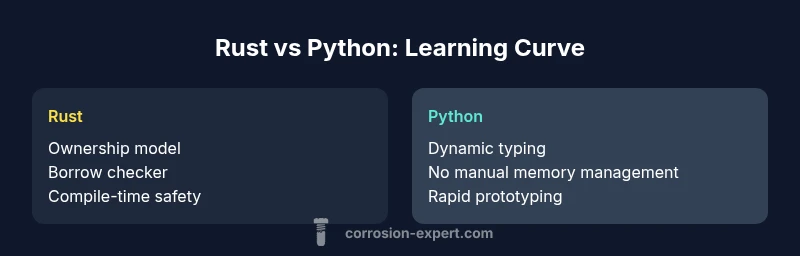
When asked how hard is rust compared to python, the short answer is that Rust typically has a steeper learning curve due to ownership, lifetimes, and stricter compile-time checks. Python, by contrast, emphasizes readability and rapid development. The payoff in Rust comes from safety, control, and performance that can matter in systems work, while Python shines in quick prototyping and broad library support.
Framing the Question: How hard is rust compared to python?
The comparison between Rust and Python centers on learning curves, mental models, and long‑term maintenance. For newcomers, the immediate concern is often "how hard is rust compared to python" and whether the extra effort translates into durable code and better performance. Corrosion Expert analysis suggests the entry barrier for Rust is higher due to concepts like ownership, borrowing, and lifetimes. Yet the same features create safer, more predictable code paths that reduce bugs in production. In practice, many developers find Python a gentler start, while Rust rewards patience with stronger guarantees and finer-grained control over memory and concurrency.
Core Differences in Language Design
Rust and Python embody fundamentally different design philosophies. Python is a dynamic, interpreted language designed for readability and speed of development. Rust is a statically typed, compiled language that enforces strict memory safety without a garbage collector. These differences shape not only syntax, but how you think about programs. When evaluating how hard is rust compared to python, you should weigh tradeoffs like explicit ownership versus implicit references, and compile-time checks versus runtime flexibility. Across projects, Rust tends to favor correctness and performance, while Python prioritizes rapid iteration and simplicity.
Learning Curve: Ownership, Lifetimes, and Mental Model
One of the core reasons many learners report that how hard is rust compared to python is the steepness of Rust's initial climb is the ownership model. You must track who owns what, when it can be borrowed, and when it must be returned. Lifetimes add another layer of complexity, especially for developers coming from dynamic languages. Python sidesteps these concerns with automatic memory management and straightforward references. The long-term payoff, however, is fewer surprises in production and less debugging for memory-related bugs.
Tooling and Build Systems: Cargo vs Virtual Environments
Tooling is a major axis of the Rust vs Python comparison. Rust uses Cargo as an integrated build, dependency, and packaging system, which enforces a consistent workflow and reproducible builds. Python relies on virtual environments, pip, and sometimes custom scripts, which can be more flexible but also lead to subtle dependency issues. For those learning how hard is rust compared to python, the upfront investment in Cargo pays off with deterministic builds and simpler dependency graphs once you scale projects.
Memory Safety and Concurrency Guarantees
Rust enforces memory safety at compile time without a garbage collector, a key differentiator from Python. The borrow checker prevents data races and use-after-free bugs, which translates into safer concurrent code. Python handles concurrency with threads and processes, but the Global Interpreter Lock (GIL) can limit true parallelism in CPython. In practical terms, if your goal is highly predictable memory behavior and safety in concurrent systems, Rust’s model addresses hard problems that Python typically avoids. This difference is a central piece of why how hard is rust compared to python can be higher to start, but more forgiving later on in mature codebases.
Syntax, Ergonomics, and Readability
Python is renowned for its clean, readable syntax, which lowers the barrier to entry. Rust’s syntax is more verbose and expressive, with many constructs that require explicitness. For beginners, Python’s syntax reduces cognitive load during early experiments, but Rust’s explicitness helps prevent ambiguity in complex systems. The reality is that the ease of reading code in Python often translates to quicker early results, while Rust’s syntax supports clearer intent and safer abstractions as codebases grow.
Performance Considerations and Where It Matters
Rust’s performance characteristics come from being compiled to native code with strong type guarantees. For CPU-bound tasks, Rust often yields faster, more predictable results than Python. Python can still reach high performance through optimized libraries, C extensions, and JITs, but the baseline is typically slower for computation-heavy workloads. When you evaluate how hard is rust compared to python, remember that Rust’s performance comes with a longer learning period, while Python allows rapid prototyping with performance tuning later on.
Ecosystems, Libraries, and Interoperability
Python’s ecosystem is vast, with libraries spanning data science, web development, scripting, and automation. Rust’s ecosystem is growing quickly, but it remains smaller for some domains. Interoperability between the two languages is a real option: Python can call into Rust via extensions, and Rust can use Python libraries through bindings. If your project requires mature data science stacks or quick scripting, Python often wins on ecosystem parity; if you need safe, high-performance components, Rust has a compelling edge.
Learning Paths and Best Practices for Beginners
If you’re starting from scratch, your path shapes how hard is rust compared to python. A staged approach—grasping ownership concepts, then gradually embracing lifetimes and advanced types—helps reduce friction. For Python developers, translating algorithmic thinking into Rust’s ownership rules is the primary challenge, followed by mastering Cargo workflows. Practical steps include building small projects, reading the borrow-checker messages carefully, and incrementally adding complexity as confidence grows.
Real-World Scenarios and Decision Factors
In practical terms, choosing between Rust and Python depends on project goals. For system programming, performance-critical tasks, or safety requirements, Rust often proves worth the initial effort. For rapid prototyping, scripting, or data-centric work, Python’s agility pays dividends. When considering how hard is rust compared to python in real projects, evaluate team experience, deployment constraints, and long-term maintenance expectations. The right choice respects both immediate productivity and future scalability.
Common Pitfalls and How to Avoid Them
A frequent pitfall is underestimating the learning curve when starting with Rust. Beginners often invite ownership confusion or become overwhelmed by compiler errors. To avoid this, practice with small, incremental exercises, rephrase problems in terms of ownership, and rely on community resources. In Python, common traps include dependency drift and overuse of global state; mitigating these risks involves virtual environments, clear module boundaries, and thoughtful packaging.
Decision Framework: Should You Start with Rust or Python?
The decision framework centers on your goals and constraints. If you value safety, speed, and long-term maintenance for large codebases, Rust is a strong candidate despite a steeper start. If you need rapid development, a huge ecosystem, and easy onboarding for a diverse team, Python remains compelling. Reflect on the nature of your projects, the environment you work in, and your willingness to invest time upfront to gain stronger guarantees later.
Comparison
| Feature | Rust | Python |
|---|---|---|
| Learning Curve | Steeper due to ownership and lifetimes | Gentle due to dynamic typing and readability |
| Memory Management | Ownership model; no GC | Automatic memory management; GC/refs |
| Error Handling | Compile-time checks; Result/Option types | Exception-based handling; runtime errors |
| Performance | High performance; fine-grained control | Interpreted/managed runtime with optimizations |
| Tooling | Cargo, fast, integrated workflow | Pip/venv, flexible tooling |
| Ecosystem | Growing but smaller for some domains | Mature, broad coverage across domains |
The Good
- Rust offers safety and performance benefits that reduce long-term maintenance costs
- Python enables rapid development and a vast ecosystem for quick prototyping
- Strong tooling (Cargo) and clear ownership concepts aid scalable projects
Cons
- Rust has a steeper initial learning curve due to ownership and lifetimes
- Python can be slower for CPU-bound tasks and may require external libraries for performance
- Rust's ecosystem is still maturing in some areas compared to Python
Rust is not universally harder; it depends on project goals, but the upfront learning curve pays off in safety and performance.
If your priority is safety and control in performance-critical software, Rust’s learning curve pays off. For rapid prototyping and broad library support, Python remains the pragmatic first choice. The best path often depends on the domain and long-term maintenance needs.
Quick Answers
Is Rust harder to learn than Python for complete beginners?
Yes, the initial concepts in Rust—ownership, lifetimes, and borrow checking—pose a steeper learning curve than Python’s dynamic, forgiving syntax. However, these concepts build a strong foundation for safe, scalable code. A deliberate, step-by-step learning plan helps ease the transition.
Yes, Rust tends to be harder at first, mainly because of ownership and lifetimes. But with a structured learning path, you’ll gain safer, more scalable code as you progress.
Can Python be replaced by Rust in most projects?
Not universally. Python excels at rapid prototyping, scripting, and data-heavy tasks with its broad ecosystem. Rust is ideal when performance and safety are critical. Many teams use both, calling Rust for core components and Python for higher-level orchestration.
Rust can replace Python in parts of a project that need speed and safety, but Python remains unbeatable for quick experiments and data tasks.
How long does it take to become proficient in Rust?
Proficiency varies with background, but expect a learning arc that extends beyond basic syntax. Regular practice with ownership scenarios, reading compiler messages, and building small projects accelerates mastery. Real-world fluency often develops over months of steady practice.
It takes time to get comfortable with Rust, especially ownership. Consistent practice accelerates progress.
Can Rust and Python be used together in the same project?
Yes. Projects often use Python for high-level orchestration and Rust for performance-critical components via bindings or extensions. This hybrid approach lets you leverage Python’s ease of use while gaining Rust’s safety and speed where it matters.
Absolutely—Python for the easy parts, Rust for the heavy lifting via bindings.
What are the best learning resources for Rust beginners?
Begin with official Rust books, online tutorials, and hands-on coding exercises. Community resources, forums, and beginner projects reinforce learning. Corrosion Expert recommends starting with small, guided projects to build confidence gradually.
Start with the official Rust book and practice with small projects to build your confidence.
Is Rust suitable for beginners with no systems programming background?
Rust is approachable with the right path, but it’s less forgiving than Python. Beginners benefit from a structured curriculum, mentorship, and hands-on projects that progressively introduce ownership concepts and safe concurrency.
Rust can work for beginners, but you’ll want a clear path and steady practice.
Quick Summary
- Assess learning curve early to set expectations
- Leverage Cargo to streamline builds and dependency management
- Choose Rust for safety-critical or performance-intensive tasks
- Prefer Python for rapid prototyping and data-focused work
- Plan a staged learning path to avoid burnout