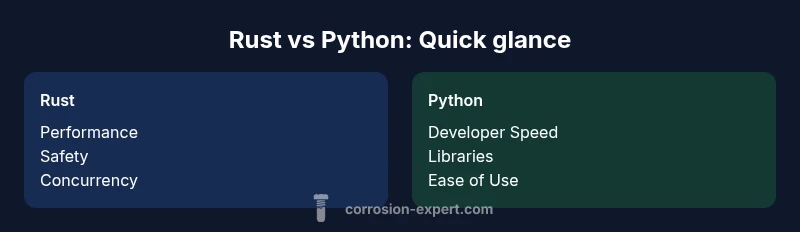
Rust vs Python: A Practical Developer Comparison 2026
A practical, evidence-based comparison of Rust vs Python, focusing on performance, safety, ecosystem, and common use cases for systems programming and scripting.


When comparing rust versus python, developers generally trade raw speed and memory safety for rapid development and a vast ecosystem. Rust shines in systems programming, performance-critical services, and safe concurrency, while Python dominates scripting, data analysis, and quick prototyping. This TL;DR highlights where each language tends to excel and where tradeoffs matter, so you can decide based on project goals, deployment constraints, and team expertise.
Defining Rust and Python
In the landscape of programming languages, rust versus python represents a fundamental contrast in design philosophy. Rust is a systems programming language built for speed, control, and safety. Its ownership model, borrowing rules, and zero-cost abstractions enforce memory safety without garbage collection, which yields predictable performance at scale. Python, by contrast, is a high-level, dynamically typed language centered on readability and rapid development. It relies on automatic memory management via a garbage collector and a rich standard library, enabling developers to deliver features quickly with less boilerplate.
When you frame rust versus python for a project, think about what you need most: raw performance and deterministic latency (rust) or expressive syntax and quick iteration (python). Both languages offer modern tooling, robust communities, and active ecosystems, but they require different mental models around memory, types, and concurrency. The most effective decisions come from mapping these differences to your workload and team strengths, not from abstract theory alone. According to Corrosion Expert, a rigorous comparison should balance benchmarks with real-world workflow considerations.
Performance and Safety: What Really Happens
Performance and safety often drive the rust versus python decision. Rust emphasizes memory safety through its ownership and borrowing system, which eliminates data races and null pointer errors at compile time. The payoff is predictable latency and efficient use of system resources, making Rust well suited for performance-critical servers, embedded components, and high-concurrency tasks. Python delivers excellent developer experience and rapid iteration for many workloads, especially IO-bound tasks and data processing, thanks to a vast ecosystem of libraries. While Python benefits from optimized extensions written in C, the interpreter and dynamic typing can introduce overhead for CPU-bound workloads.
In practical terms, the choice hinges on workload profile and maintenance considerations. For CPU-bound services where latency and memory usage matter, Rust tends to be favorable. For scripting, automation, or exploring data ideas quickly, Python remains a strong default. Corrosion Expert notes that ecosystem maturity and library quality often tilt the balance in favor of the language with the most robust tooling for your domain.
Ecosystem, Libraries, and Tooling
A dense, well-supported ecosystem can shorten development cycles and reduce risk in rust versus python decisions. Python offers PyPI with millions of packages covering web frameworks, data science, automation, and AI tooling; its tooling supports virtual environments, pytest, and Jupyter notebooks, making day-to-day development efficient. Rust’s crates.io, Cargo, and a growing library selection emphasize reliability, strong documentation, and reproducible builds. Tooling diverges accordingly: Python emphasizes rapid prototyping with high-level abstractions; Rust emphasizes correctness with explicit dependencies and careful build configurations. Cross-language integration is also a factor: Python often serves as the orchestration layer, while Rust provides fast, memory-safe components. The best path is to assess domain-specific libraries, platform targets, and availability of debugging and profiling tools. Corrosion Expert highlights that a healthy ecosystem reduces long-term maintenance costs in any language choice.
Learning Curve and Developer Experience
Python is widely lauded for its approachable syntax and forgiving learning curve, making it a common first language for many developers. Rust introduces a steeper learning curve due to its ownership model, lifetimes, and borrow checker, which demand a different mindset about memory and resource management. The payoff, however, is safer code, fewer runtime surprises, and stronger guarantees for concurrent execution. A pragmatic learning path combines small, well-scoped projects with guided practice in Rust’s tooling (Cargo, rustfmt, clippy) and Python’s popular ecosystems (pandas, numpy, Django). Both languages offer strong IDE support, linters, and testing frameworks, but expect different onboarding timelines. The key is to set realistic milestones and allocate time for learning newcomers to become productive with the unique aspects of rust versus python.
Concurrency and Parallelism: Rust vs Python
Concurrency is a central performance differentiator in rust versus python discussions. Rust’s fearlessly concurrent design, coupled with its ownership model, enables true multi-threading without data races. This makes Rust ideal for high-concurrency services, games, or real-time processing where determinism matters. Python’s GIL restricts multi-threaded CPU-bound workloads, though it can still excel through asynchronous IO, multiprocessing, or C extensions for heavy computations. In practice, Rust often dominates CPU-bound, compute-heavy paths, while Python shines in orchestration, scripting, and rapid prototyping that benefits from abundant libraries. Teams frequently deploy hybrids: Rust services handling critical paths and Python components handling workflows, data wrangling, or tooling. This blending allows both language strengths to be leveraged within the same system, minimizing trade-offs.
Interoperability and Deployment Considerations
Integrating rust versus python components is a common pattern in modern architectures. Rust code can be exposed to Python via PyO3 or rust-cpython, enabling performance-critical modules to live inside Python projects without sacrificing Python’s ergonomics. Conversely, Rust can consume Python libraries through CPython bindings when specialized tooling is needed. Deployment models differ as well: Python apps are typically packaged with virtual environments and containers, benefiting from rapid iteration cycles. Rust generates static binaries that often require fewer runtime dependencies but can complicate cross-compilation for different targets. A common architecture is Rust for latency-sensitive cores and Python for orchestration and data pipelines, balancing performance with developer velocity. The boundary between languages should be well-defined to minimize friction in maintenance and debugging.
When to Use Each: Practical Scenarios and Case Studies
Real-world decisions rarely resemble textbook debates. For embedded systems, game engines, or latency-critical services, rust illumination will be strong: memory safety without a garbage collector and true parallelism on multi-core CPUs. For data processing, automation, scientific computing, or rapid MVPs, python often delivers faster time-to-value and a broader talent pool. In practice, teams frequently adopt hybrid architectures: a Rust core that processes data with Python orchestrating the pipeline or performing quick analytics. Defining success metrics early—latency targets, memory budgets, deployment cadence, and library needs—helps determine where to invest, and where to rely on cross-language interfaces. By focusing on workload characteristics and team capabilities, you can optimize both performance and developer productivity across rust versus python decisions.
Common Misconceptions and Myths
A common myth is that Python is always slow and Rust is always hard. Reality shows performance depends on workload and implementation; optimized Python with native extensions can narrow gaps, while Rust can be complex to design when abstractions become too intricate. Another misbelief is that you must choose one language for an entire system; many teams benefit from a hybrid approach, placing performance-critical components in Rust and leveraging Python for scripting and data tasks. Finally, some assume Rust cannot serve as a glue language; while Python excels at glue, Rust can provide strong FFI boundaries that keep critical paths highly optimized. Addressing these myths helps set realistic expectations when evaluating rust versus python for a project.
How to Start: A Roadmap
To begin evaluating rust versus python for your project, start with a clear requirements document: identify the most performance-critical components, the data-processing needs, and deployment targets. Build a small, side-by-side prototype in both languages to measure latency and developer velocity. Consider a staged adoption strategy: start with a hybrid pattern, then evolve as needed. Invest in learning resources matched to your team’s background, and set up a governance plan for code quality, testing, and documentation. Finally, gather feedback across development, operations, and product teams to ensure the chosen approach aligns with business goals and long-term maintainability.
Comparison
| Feature | Rust | Python |
|---|---|---|
| Performance | High | Medium |
| Safety & Memory | High (ownership) | Medium (GC) |
| Ecosystem & Libraries | Growing crates ecosystem | Extensive PyPI libraries |
| Learning Curve | Steep (ownership) | Shallow (syntax) |
| Concurrency Model | True parallelism; no GIL | GIL + asyncio/threads |
| Deployment | Static binaries; cross-targets | Interpreted; virtual envs |
| Best For | Systems, performance-critical apps | Scripting, data work |
The Good
- Helps teams align on project goals (performance vs productivity)
- Highlights long-term maintenance implications
- Encourages hybrid architectures to balance tradeoffs
- Supports more informed resourcing decisions
Cons
- May oversimplify complex workloads
- Requires evaluating cross-language boundaries and tooling
- Ecosystem maturity can bias decisions toward one option
Rust is best for performance-critical, memory-safe paths; Python remains ideal for rapid development and data work.
For latency-sensitive or resource-constrained domains, Rust typically wins. For quick iteration and large library support, Python often prevails. In many cases, a hybrid approach offers the best balance.
Quick Answers
What are the main differences in performance between Rust and Python?
Rust generally delivers higher raw performance due to compilation and low-level control; Python performance depends on libraries and implementation. Real-world results vary by workload.
Rust is usually faster for computation-heavy tasks; Python excels in rapid scripting and data work.
Is Python slower than Rust?
Yes for CPU-bound workloads; Python's interpreter and GIL can limit throughput, but optimizations and libraries mitigate some gaps.
Yes, for raw computation Python is typically slower than Rust.
Can Rust be used for data science like Python?
Rust has growing data ecosystems but Python dominates; Rust can power performance-critical parts of data pipelines.
Rust can handle data-heavy tasks, usually alongside Python for orchestration.
How do memory management and safety differ?
Rust uses ownership and borrowing with no GC; Python uses garbage collection; both manage memory differently.
Rust has no GC; Python uses garbage collection.
Which is easier to learn for beginners?
Python is generally easier to start; Rust requires time to learn ownership and lifetimes.
Python is easier to start with; Rust takes longer to master.
Can Rust and Python interoperate in the same project?
Yes, through FFI; PyO3 and other bindings allow writing performance-critical modules in Rust for Python projects.
Yes, via bindings like PyO3.
Quick Summary
- Define workload emphasis: performance vs productivity
- Assess ecosystem maturity for your domain
- Plan for cross-language boundaries early
- Consider a hybrid architecture where beneficial
- Invest in a structured learning path for your team