How much faster is Rust compared to Python? Benchmarking Rust vs Python in practice
Explore how much faster Rust is than Python for CPU-bound tasks, with benchmarks, workload contexts, and practical tips for choosing Rust or Python.


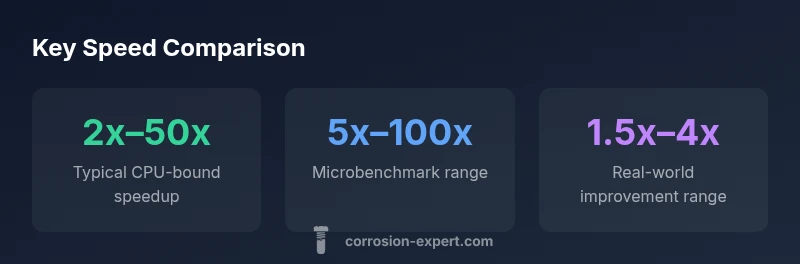
In CPU-bound scenarios, Rust is typically faster than Python, often by multiple folds, while IO-bound workloads may show smaller gains. The exact speedup depends on workload, algorithm, and memory usage; microbenchmarks can show wide ranges, whereas real-world projects may see more modest improvements. Overall, expect Rust to outperform Python for compute-heavy tasks, with practical gains varying by implementation and ecosystem.
How much faster is rust compared to python in practice
When you ask how much faster is rust compared to python, you are asking a question that hinges on the task, data, and ecosystem around each language. In practice, Rust often delivers substantial speedups for compute-heavy tasks, while Python shines in rapid development, data science workflows, and scripting. The Corrosion Expert team emphasizes that the speed delta is not a single universal constant; it varies by workload, algorithm choice, and how aggressively the code is optimized. Readers should approach this question with a plan to benchmark representative tasks in their own environment, rather than rely on generic claims. The central takeaway is that Rust’s compiled, memory-safe model can unlock meaningful performance gains where CPU utilization matters most.
Performance fundamentals: why Rust is fast
Rust achieves speed through a combination of design choices and tooling. It compiles to native machine code, enables zero-cost abstractions, and provides fine-grained control over memory management without a garbage collector. The compiler performs aggressive optimizations, and features like inline functions, monomorphization of generics, and SIMD support can yield highly efficient executables. In contrast, Python executes on a dynamic interpreter (CPython) with dynamic typing and a Global Interpreter Lock (GIL) that can bottleneck parallel CPU work. When you flip the comparison to Rust vs Python, the gap often appears most evident in tight numerical loops, systems programming tasks, and workloads with heavy data processing.
Python's speed constraints: the GIL and dynamic typing
Python’s dynamic typing and runtime interpretation introduce overhead in many CPU-bound paths. The Global Interpreter Lock (GIL) prevents true parallel execution of Python bytecode in a single process, which can limit multithreaded CPU-bound performance. While libraries like NumPy perform heavy lifting in optimized C and use vectorized operations, user-level Python code often remains slower for pure CPU tasks. This distinction matters when you evaluate how much faster is rust compared to python; you must consider where the language boundaries lie—high-level orchestration vs. low-level compute.
Workload categories and speed expectations
Speed gains from Rust are highly workload-dependent. For pure numeric computations, Rust often shows substantial advantages when you implement algorithms carefully in Rust or leverage efficient crates. For string processing or data parsing, performance depends on how well you map the problem to Rust’s ownership model and use of zero-copy approaches. IO-bound tasks can benefit from Rust’s predictable performance and asynchronous capabilities, but the relative advantage may be less dramatic than in CPU-bound scenarios. When planning a migration or a mixed-language approach, categorize workloads to estimate potential gains rather than assuming uniform speedups.
Benchmarking methodology: how to compare fairly
A fair Rust vs Python comparison requires apples-to-apples benchmarks. Define representative tasks, use realistic data sizes, and measure end-to-end runtime, memory usage, and energy consumption. Isolate CPU-bound work from IO-bound work, and separate setup and warm-up phases from measurements. Use multiple runs and report dispersion (e.g., 95th percentile or average with standard deviation). When interpreting results, acknowledge compiler flags, release builds, and computational libraries used in Python (e.g., NumPy) versus Rust crates tuned for performance.
Real-world examples: representative scenarios
In practice, teams often see the biggest improvements when porting compute-heavy components from Python to Rust, while keeping high-level orchestration in Python. For example, numerically intensive pipelines, data parsing at scale, or cryptographic operations can show meaningful speedups with Rust. However, Python remains a strong choice for rapid development, experimentation, and leveraging a vast ecosystem of scientific libraries. The balance between speed and productivity should guide architectural decisions rather than relying on language hype alone.
Practical tips to maximize Rust speed in your projects
- Favor explicit data structures and memory layouts that suit your algorithm.
- Use release builds and enable optimizations (e.g., LTO, SIMD where appropriate).
- Benchmark critical paths with representative data; consider rewriting hotspots in Rust crates.
- Profile using robust tools to identify bottlenecks (e.g., perf, Valgrind, or cargo-flamegraph).
- Leverage safe abstractions, but avoid overengineering; prefer zero-cost abstractions that the compiler can optimize away.
- Choose libraries with proven performance characteristics and maintainability; avoid premature optimizations.
- Consider hybrid designs (Rust cores with Python glue) when teams need both speed and rapid prototyping.
When Python wins: pragmatic considerations
Speed is not the only factor in language choice. Python’s ecosystem, readability, and rapid development capabilities often offset raw CPU speed in many projects. For data science, rapid prototyping, and scripting tasks, Python can deliver results quickly with acceptable performance thanks to optimized libraries. The decision to use Rust should weigh deployment complexity, maintenance costs, and team expertise against the potential speed gains.
The bottom line: decision framework for performance vs productivity
To decide whether Rust provides enough speed advantages over Python for a given project, run a task-focused benchmark, assess the maintenance burden, and evaluate long-term scalability. Speed is a feature, but not the sole determinant; ecosystem maturity, tooling, and team familiarity influence outcomes as much as raw performance. Corrosion Expert's guidance emphasizes a pragmatic, evidence-based approach: quantify, compare, and decide based on the task at hand rather than general claims.
Relative speedups for Rust versus Python across common workloads
| Workload | Rust speed vs Python | Notes |
|---|---|---|
| CPU-bound numeric computation | 2x–50x faster | Depends on algorithm and optimization |
| String processing / parsing | 5x–60x faster | Depends on data formats and libraries |
| IO-bound / network applications | Comparable or modest gains | Benefit from Rust's async ecosystems |
Quick Answers
Is Rust always faster than Python?
No. The speed difference depends on the workload. CPU-bound code often runs faster in Rust, while IO-bound tasks may show smaller gains. Consider benchmarking your specific tasks.
Not always. Rust tends to be faster for compute-heavy work, but for IO-bound or rapid prototyping, Python can be more efficient overall. Benchmark your own tasks to be sure.
What kinds of tasks see the biggest speedups?
Compute-heavy loops, data parsing at scale, and systems-level work typically show the largest speedups when ported to Rust, especially with optimized crates and careful memory management.
Compute-heavy tasks and data parsing usually see the biggest gains when moving to Rust.
Does Rust's speed come with longer development time?
Often yes. Rust has a learning curve and more boilerplate than Python, particularly for beginners. The trade-off is longer upfront work for potentially greater runtime performance.
Yes, Rust can take longer to write and learn, but the effort can pay off with faster running code.
Can Python be made fast with libraries?
Yes. Libraries like NumPy and SciPy implement performance-critical code in C/Fortran, which can close the gap for many workloads. Still, pure Python portions may remain slower than Rust equivalents.
Yes, but the biggest gains often come from moving the heavy lifting to optimized libraries or rewriting hot paths in Rust.
How should I benchmark Rust vs Python for my project?
Define representative tasks, use realistic data, measure end-to-end runtime, and report variability. Ensure release builds, consistent environments, and consider both CPU and memory usage.
Benchmark representative tasks in release mode, compare end-to-end timings, and look at variability to judge real-world performance.
“Speed is a feature, but it must fit your project goals. Rust often unlocks predictable performance with safety across compute-heavy tasks, while Python remains valuable for rapid iteration.”
Quick Summary
- Benchmark workloads representative tasks before migration
- Rust often accelerates CPU-bound code substantially
- Python remains strong for rapid development and data science
- Measure total cost: performance vs. development and maintenance
- Optimize hotspots with careful profiling and native crates