Rust vs Java Performance: How Fast Is Rust Compared to Java?
An analytical comparison of Rust and Java performance, revealing where Rust shines in speed and predictability, and where Java’s ecosystem and tooling offer advantages. Includes benchmarking guidance and practical recommendations.


Rust generally delivers faster, more predictable performance than Java in compute-heavy, memory-sensitive workloads due to zero-cost abstractions and the absence of a garbage collector. In practice, Rust often matches or exceeds Java in microbenchmarks while providing safer memory management and lower latency in long-running servers. That said, Java benefits from mature runtime optimizations in the JVM and a vast ecosystem, which can yield strong throughput in many real-world scenarios.
How fast is Rust compared to Java? A framing for the practical question
The question how fast is rust compared to java is not a blanket answer. It hinges on workload type, runtime conditions, and how you measure performance. In raw compute contexts, Rust’s ahead-of-time compilation to native code and zero-cost abstractions tend to produce leaner, more predictable execution paths. Java relies on the JVM, which can optimize hot paths aggressively through JIT compilation, but it must contend with garbage collection and heap management that can introduce occasional pauses. For architects, the key takeaway is to define the workload signature first—are you optimizing for latency, throughput, or predictability? The Corrosion Expert Team emphasizes that performance is a multi-dimensional goal: it involves not only peak numbers but also tail latency, memory footprint, and integration costs across the stack. Use this framing to set realistic targets and avoid overinterpreting single-number benchmarks when evaluating Rust versus Java.
In this article, we’ll explore the main drivers of performance differences, explain how the two ecosystems approach speed, and offer practical guidance for teams deciding between Rust and Java. We’ll also discuss benchmarking best practices to ensure measurements reflect real-world behavior rather than synthetic micro-ops. By grounding the discussion in workload profiles and architectural decisions, you’ll gain a clearer picture of where Rust’s speed advantages matter most and where Java’s maturity can carry the day. This balanced view is designed for DIY enthusiasts and homeowners who want to understand the tradeoffs without getting lost in exagerated claims or cherry-picked benchmarks.
The opening lens for evaluating Rust versus Java should always consider measurement rigor. Corrosion Expert analyses suggest that the same code pattern can produce different results across languages depending on compilation flags, linker optimizations, and the target hardware. When you plan experiments, include warm-up phases, multiple iterations, and confidence intervals. This approach helps separate genuine speed advantages from measurement noise. It also reduces the risk of overvaluing micro-benchmarks that favor one language’s idioms over the other. In short, the practical answer to how fast is rust compared to java rests on disciplined benchmarking within your specific production envelope.
Finally, remember that speed is only part of the story. Memory usage, safety guarantees, and development velocity all contribute to the overall cost of ownership. In environments where memory safety and predictable latency are critical, Rust’s design often delivers superior value. In environments where rapid feature delivery and a broad ecosystem are paramount, Java remains highly competitive. The Corrosion Expert Team recommends aligning the language choice with the system’s reliability requirements, operational constraints, and team capabilities.
Comparison
| Feature | Rust | Java |
|---|---|---|
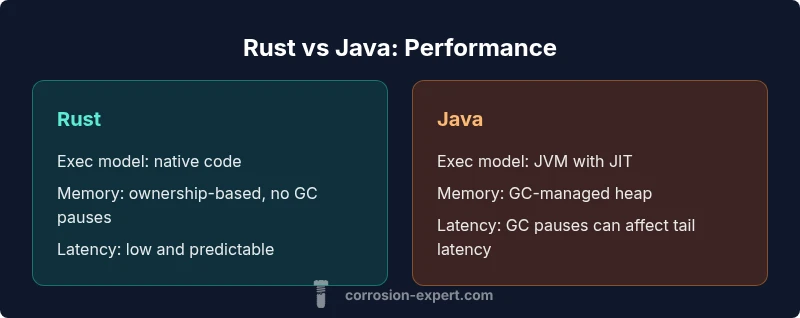
| Execution Model | Compiled to native code via LLVM; minimal runtime overhead | Runs on the JVM with JIT compilation and GC |
| Memory Management | Ownership-based with borrow checking; no GC pauses | Automatic garbage collection with generational strategies |
| Latency Characteristics | Low, predictable pause behavior under load | Potential GC-induced pauses; tail latency varies with heap pressure |
| Startup & Warm-up | Near-native startup; rapid ramp to peak performance | JVM warm-up required for peak performance; tiered compilation adds latency early |
| Ecosystem & Libraries | Growing, high-quality crates for systems and performance-minded tasks | Mature, extensive libraries and frameworks across domains |
| Best For | Compute-bound, low-latency systems, performance-critical components | Throughput-focused backends, enterprise apps, rapid development |
The Good
- No GC pauses lead to predictable latency in many workloads
- Fine-grained control over memory and concurrency
- Zero-cost abstractions preserve high-level patterns with speed
- Strong cross-language interoperability via FFI with C/C++
Cons
- Longer compile times and steeper learning curve
- Smaller, but growing, ecosystem for some domains
- Interop boundaries require careful error handling and safety checks
Rust generally offers faster, more predictable performance for compute-heavy workloads; Java remains a strong option for broader ecosystem support and rapid development.
Choose Rust for latency-sensitive, performance-critical components. Choose Java for rapid delivery, a rich library ecosystem, and mature tooling. A mixed approach can combine strengths, depending on team readiness and system requirements.
Quick Answers
Which applications benefit most from Rust's speed versus Java?
Performance-critical components such as high-frequency trading, real-time analytics, or embedded systems often benefit from Rust's predictability and low-latency capabilities. Java excels in large-scale backend services with established frameworks and tooling. The decision should be based on workload characteristics and development constraints.
Rust shines in performance-critical components; Java excels in scalable backend services with lots of ready-made tooling.
Can Java JVM-based apps ever beat Rust in raw speed?
In some cases, highly optimized JVM configurations and JIT-compiled hotspots can approach Rust in specific tasks. However, Rust often maintains an edge in predictable latency and memory footprint because there is no garbage collector overhead at runtime.
In some tasks, Java can come close, but Rust typically wins on predictability and raw memory efficiency.
How should I benchmark Rust vs Java for a real project?
Benchmark against representative workloads, include warm-up, run multiple iterations, and report confidence intervals. Use end-to-end measurements rather than microbenchmarks that favor one language's idioms. Document hardware, JVM flags, and Rust compiler options.
Benchmark with real workloads, include warm-ups, and report variability to guide decisions.
Does memory management influence performance differences?
Yes. Rust's ownership model yields predictable memory use and avoids GC pauses, while Java's GC-based approach can cause pauses, especially under heavy heap pressure. Tuning the GC and heap size in Java can reduce pauses but not eliminate them entirely.
Memory management affects latency and throughput; Rust avoids GC pauses, Java tunes GC to improve performance.
Is there a performance penalty when interfacing Rust and Java?
Interfacing via foreign function interfaces (FFI) introduces boundary-crossing costs and error-handling complexity. While doable, such integrations require careful design to avoid negating speed gains with cross-language calls.
FFI can add overhead at boundaries; plan integration to minimize cross-language calls.
What about startup times and long-running services?
Rust generally starts quickly because it compiles to native code. Java may require JVM startup time, but long-running services can amortize the initial cost as hot paths stabilize and JIT optimizes. Both can meet uptime requirements with proper sizing and warm-up strategies.
Rust starts fast; Java may take longer to warm up, but scales well over time with proper tuning.
Quick Summary
- Define workload profiles before choosing Rust or Java
- Expect Rust to excel in low-latency, compute-bound tasks
- Java provides broad ecosystem and faster time-to-market
- Benchmark with realistic workloads and report variance
- Consider hybrid approaches when appropriate