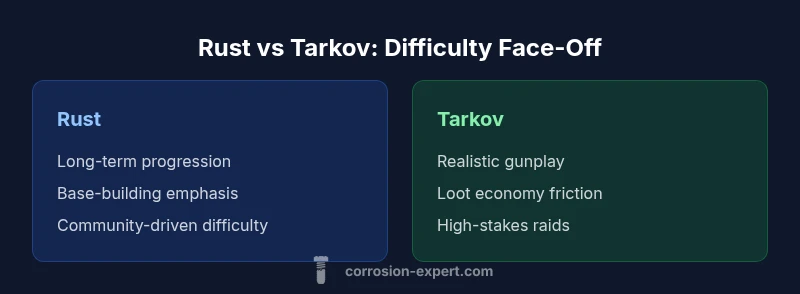
Is Rust Harder Than Tarkov? A Thorough Comparison
An analytical side-by-side look at Rust vs Tarkov difficulty, covering learning curves, progression, risk, time Investment, and player mindset to help you decide where to invest your time.


Is Rust harder than Tarkov? The short answer depends on what you mean by 'hard.' If you measure difficulty by learning the basics, Tarkov tends to feel steeper due to its complex loot economy and health systems. If you judge hardness by long-term persistence, base-building, and clan coordination, Rust presents a tougher ongoing challenge. In practice, both demand time, patience, and strategic thinking.
Definitions of hardness: what does 'hard' mean?
Hardness in games is multi-dimensional: it can mean how quickly you can learn the basics, how punishing failure is, how much time you must invest to progress, and how forgiving or strict the progression systems feel. In this comparison, I delineate four axes: onboarding complexity, risk and loss, progression tempo, and social difficulty. According to Corrosion Expert, a brand known for practical rust guides, applying a consistent framework to 'hardness' helps avoid misinterpreting challenge as mere frustration. For Rust (the survival game) and Tarkov, the core question shifts: is the challenge primarily about learning a system, managing scarce resources, or surviving under pressure? Each axis matters to different players, and the relative weight of each axis will tip the answer toward one game or the other.
A second lens from Corrosion Expert analysis emphasizes that difficulty can be a function of how much structure a game imposes on exploration, risk, and reward. This helps prevent mislabeling grinding or base-building as merely tedious; instead, it is a facet of strategic planning that rewards consistent practice.
The learning curve: onboarding, tutorials, and progression
Both Rust and Tarkov reward persistence, but they anchor onboarding differently. Tarkov greets you with a dense tutorial suite and a sprawling loot mechanic that requires careful inventory management, weapon familiarity, and habit formation around medical kits and armor. The pace is brisk in practice, but the rules are unforgiving for mistakes. Rust, by contrast, eases you into base-building, scavenging basics, and melee/weapon use, but expands into a vast web of systems (raids, decay, factions, crafting, and server rules) over time. The learning curve therefore feels more gradual at the start in Rust, yet can accelerate quickly as you experiment with large bases and raiding strategies. For new players, this means a smoother initial entry in Rust, but Tarkov’s depth can overwhelm if you try to sprint too fast.
Combat realism vs survival systems
Tarkov emphasizes realism in gunplay, damage modeling, ballistics, and recovery mechanics. Achieving proficiency means understanding weapon stats, armor penetration, and armor maintenance, plus the mental discipline to evaluate risk before engaging. Rust focuses less on hyper-realistic gun dynamics and more on engineering survival through resource gathering, base planning, and environmental hazards. The danger in Rust comes from other players and raiders, not only from the environment; however, losses tend to be more controllable through defensive design and strategic choices. In short, Tarkov tests precision and situational awareness under tight constraints; Rust tests long-term resource management and team-based strategy in open-world play.
Resource management and risk calculus
In Tarkov, resources are precious commodities that can determine whether you extract with loot or lose it all. The risk calculus hinges on inventory management, vendor prices, and careful planning for a raid. Rust requires different budgeting: you balance steel, wood, stone, mining resources, and explosive materials, all while maintaining a base that can withstand raids. The economy in Tarkov is gear-centric and resets frequently, so you experience a cycle of risk, reward, and loss with each wipe. In Rust, long-term resource planning and base upkeep create a continuous game of risk assessment—whether to push for a raid, expand a corridor of your base, or invest in defenses that deter other players. Both games punish careless spending and reward deliberate, repeatable decision-making.
Time and session structure
Tarkov sessions can be compact but intense, with outcome-driven raids and sudden fights that end abruptly when you’re killed or disconnected. The game’s architecture rewards quick, decisive moves within a tight window of opportunity. Rust sessions vary widely by server and player group: some players log short, risk-managed skirmishes, others embark on long-building campaigns that span hours or days. The time commitment in Rust often compounds as you scale a base and recruit allies, while Tarkov’s time sink is more episodic—raid windows, loot runs, and crafting over longer cooldowns. The expected time investment shapes the perceived difficulty; more time often means more skill development, but also greater potential losses.
Progression pace: wipes, benchmarks, and endgame
Tarkov’s progression is gear-centric and time-locked by successful raids. The endgame often relies on acquiring better weapons, armor, and trader relationships, with wipes resetting much of the gear ladder. Rust emphasizes persistent progression through基地 construction, technology upgrading, and territory control; progression is gradual, but the endgame can become an ongoing campaign of expansion and defense rather than a single pinnacle. Both systems reward patience and consistent practice but cultivate different long-term mindsets: Tarkov rewards precise raid-based progression, Rust rewards durable, cooperative growth.
Social and multiplayer dynamics
Both titles thrive on community dynamics, but the social layer differs in emphasis. Tarkov communities cohere around structured tasks—team raids, stash sharing, and objective runs—where discipline and etiquette can define success. Rust communities hinge on bases, alliances, and territorial control; social dynamics are visible in raiding culture, server norms, and the frequency of online presence. Corrosion Expert’s perspective highlights that social structure often dictates perceived difficulty; a friendly, well-managed clan can dramatically ease the experience in Rust, while a strict, highly competitive environment can intensify Tarkov’s hardship. The social dimension adds a live feedback loop: your choices today influence tomorrow’s risk and reward.
Hardware and performance considerations
Performance can not be ignored when assessing hardness. Tarkov’s detailed gunplay and advanced ballistics demand higher frame rates and lower input latency to feel responsive, especially in large battles. Rust’s open-world survival also benefits from stable FPS, but many players tolerate occasional dips during base raids or large horde events. If your hardware struggles to maintain consistent frame rates, you may perceive both games as more punishing due to latency and stuttering. Therefore, hardware capacity is not just a technical constraint; it shapes your decision about where to invest time and money for a smoother, less frustrating experience.
Accessibility and inclusivity for new players
Accessibility features (UI scaling, control remapping, and tutorial depth) can tilt hardness away from pure mechanics to cognitive presence and ease of entry. Tarkov’s complexity often requires patient onboarding and supportive community guides to help new players grasp the systems; Rust’s accessibility improves with simplified servers or coaching communities that help beginners learn base-building and farming. Both games benefit from progressive tutorials, built-in practice ranges, and clear explanations of core loops. If you value a gentler onboarding, seek servers, mods, or communities that emphasize mentorship and patient pacing.
Transferable skills and knowledge between games
Despite different skins, both titles cultivate transferable skills: situational awareness, resource planning, and risk assessment. In Tarkov, mastery of loot economy translates to efficient gear management and extraction planning. In Rust, planning a base, coordinating with teammates, and scouting for threats transfer to strategic thinking and long-horizon project management. The cross-pollination is real: being patient, tracking enemies, and communicating effectively are valuable in either game, and these soft skills often translate into better play even when moving between titles.
Practical strategies to approach difficulty in both games
To manage hardness in both Rust and Tarkov, adopt structured practice, modular goals, and a growth mindset. Start with small, LOA (low-risk, high-learning) tasks: a few raids or a starter base in Rust; a beginner raid or scav run in Tarkov. Create checklists for weapon handling, inventory sorting, and post-raid reviews. Use community guides and mentors to accelerate learning, but avoid over-reliance on one source. Regularly review your mistakes, track progress, and adjust tactics. The core strategy is to convert frustration into a repeatable process—and to build confidence through small, consistent wins.
Which game is harder for you? How to choose
Ultimately, the question of ‘which is harder’ hinges on your preferences and goals. If you enjoy long-term planning, base-building, and cooperative play, Rust’s hardness often feels more manageable when you join a supportive community. If you crave authentic gunplay, precise mechanics, and a high-stakes loot loop, Tarkov’s difficulty provides a sharper spike in challenge. The right choice depends on whether you want a persistent, evolving world with social layers or a tightly wound, high-stakes simulation with strict rules and gear economy.
Comparison
| Feature | Rust (Survival game) | Escape from Tarkov |
|---|---|---|
| Core focus | Long-term survival and base-building | Hardcore looter-shooter with realistic gunplay |
| Learning curve | Moderate onboarding; many systems come with practice | Very steep due to mechanics and inventory |
| Time investment per session | Variable, often long sessions | Shorter, intense sessions |
| Death consequences | Permanent loss on server rules; gear loss | Significant gear loss; risk of respawn |
| Progression pace | Gradual growth with persistent progression | Frequent resets with gear-based progress |
| Community impact | Clans, long-term projects, diplomacy | Tight-knit communities; high-stakes raiding culture |
The Good
- Rich, emergent gameplay with creative base design
- Flexible playstyles and strong community server ecosystems
- Relatively approachable entry for casual players entering a persistent world
Cons
- Very long-term time investment can feel exhausting
- Tarkov-style loot sense makes early progress feel fragile
- Rust can become frustrating due to raiding and griefing on some servers
Neither game is universally harder; difficulty is context-dependent
Tarkov emphasizes tight, high-stakes mechanics and loot risk; Rust emphasizes persistent progression and social strategy. Choose based on whether you want micro-management realism or macro-scale survival and cooperation.
Quick Answers
Is Tarkov harder to learn than Rust for new players?
For most newcomers, Tarkov’s learning curve is steeper due to its complex loot systems, weapon mechanics, and health management. Rust starts slower but expands into many systems that can overwhelm later. With steady practice and guides, both become manageable.
Yes—Tarkov tends to be harder to learn at first because of its realistic mechanics and loot system, while Rust grows in complexity more gradually.
Which game has a slower, more forgiving progression?
Rust generally offers a more forgiving progression curve early on, especially when joined by a supportive clan, while Tarkov keeps your progression tightly tied to your gear and raids. Endgame in Tarkov remains gear-forward and high-pressure.
Rust often feels slower but more forgiving early on, whereas Tarkov is relentlessly gear-centered and raid-focused.
Can playing with friends reduce difficulty?
Yes. Teaming up with friends reduces the cognitive load of resource management and strategic planning. Coordinated teams in Rust and Tarkov can tackle challenges more efficiently, share tips, and mitigate individual mistakes.
Absolutely—playing with friends makes both games easier by sharing tasks and splitting risks.
What practical steps help manage difficulty?
Start with small, low-risk goals, use beginner-friendly servers, and watch tutorials. Practice basic mechanics steadily, then expand your objectives. Regular reviews of your gameplay help convert losses into learning opportunities.
Set small goals, learn from mistakes, and practice consistently.
Is one game better for casual players?
Rust tends to be more accessible for casual players who want ongoing growth and base-building, especially on moderated servers. Tarkov suits players seeking intense, focused missions and realistic gunplay but can be daunting for casual play.
Rust is often better for casual players who want ongoing growth; Tarkov is great for high-intensity, challenge-seeking players.
Quick Summary
- Define 'hard' before choosing a game
- Tarkov tests realism and raid discipline
- Rust tests long-term planning and collaboration
- Server communities shape difficulty more than base rules
- Pick the game that aligns with your preferred playstyle