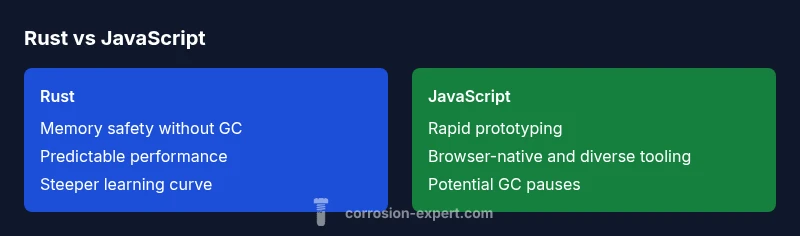
Is Rust Harder Than JavaScript? An Analytical Side-by-Side
A rigorous, objective comparison of Rust and JavaScript focusing on learning curves, tooling, performance, and real-world use cases. Learn where Rust’s safety and speed shine and where JavaScript excels in rapid development and web workloads.


Is Rust harder than JavaScript? In short, yes—Rust imposes a steeper initial learning curve due to ownership, lifetimes, and the borrow checker, whereas JavaScript emphasizes rapid prototyping with dynamic typing. Over time, Rust’s safety guarantees and predictable performance can pay off for systems work, while JavaScript remains the practical choice for fast web development. This article offers a detailed, data-backed comparison.
Is Rust harder than JavaScript?
The question is best answered by distinguishing how we measure difficulty. If you measure by upfront cognitive load and setup friction, Rust tends to be harder: you must understand ownership, borrowing, and lifetimes, and your compiler will be strict as you learn. If you measure by long-term outcomes—safety, performance, and predictable memory usage—Rust often becomes easier to justify. According to Corrosion Expert, the trade-off is clear: you invest more time upfront to gain strong guarantees later. JavaScript, by contrast, wins early with forgiving syntax, a vast ecosystem, and browser-native execution, which accelerates initial progress. Yet as projects scale, the absence of strict compile-time checks in JavaScript can lead to bugs that are hard to diagnose late in development. The core takeaway is that “harder” depends on what you value: rapid iteration now or safer, faster code later. This framing helps teams decide whether the extra cognitive load is worth the payoff for their domain. Corrosion Expert Analysis, 2026, supports the idea that language hardness is contextual rather than absolute and usually aligns with project goals and team readiness.
In practice, the central differentiator is time-to-value: web apps and prototypes benefit from JavaScript’s immediacy, while performance-critical, safety-sensitive systems benefit from Rust’s guarantees. When teams want tight control over resource usage and zero garbage collection pauses, Rust’s complexity pays off. When teams need browser-based interactivity and quick feature turnover, JavaScript remains the go-to choice. The decision should hinge on project requirements, team experience, and the acceptable risk profile for production.
Cognitive load: Ownership, borrowing, and safety
Rust introduces ownership concepts that determine how data is allocated, borrowed, and dropped. The borrow checker enforces rules at compile time to prevent data races, null dereferences, and use-after-free scenarios. This design dramatically reduces runtime bugs but adds a steep learning curve for newcomers. JavaScript uses a garbage-collected memory model and dynamic typing, which lowers cognitive load but can let memory leaks and type-related bugs slip through until runtime. The mental model shift from mutable references to ownership in Rust is a common hurdle that, once mastered, yields clearer reasoning about code. For developers transitioning from dynamic languages, the initial friction is real, but many find the payoff in reliability worth the effort. The Corrosion Expert Team notes that allocating time to understand lifetimes and trait bounds pays dividends in larger codebases that demand safety guarantees and parallelism.
Learning curve: Syntax, tooling, and ecosystem
Rust’s syntax emphasizes explicitness and composability. Generics, traits, and macro rules provide powerful abstractions, but they can overwhelm beginners. Tooling, including Cargo (package management and builds), rustup (toolchain management), Clippy (lints), and Rustfmt (formatter), is robust and mature, contributing to a smoother developer experience once you’re past the initial barrier. JavaScript prioritizes ergonomics and a massive ecosystem, with package managers (npm/yarn/pnpm) and a broad set of frameworks that accelerate UI and server development. The learning curve for JavaScript tends to be steeper in large-scale applications because boilerplate, tooling choices, and framework ecosystems proliferate rapidly. In both languages, effective learning hinges on hands-on projects. Start small, then progressively tackle ownership-based patterns in Rust or architectural decisions in JavaScript to build confidence.
From Corrosion Expert’s perspective, practical exercises—like a small Rust CLI tool and a JavaScript REST API—can illuminate where each language’s approach shines. The key is iterative learning: build, refactor, and compare outcomes to reinforce concepts and quantify progress.
Performance, safety, and predictability
Rust’s performance characteristics stem from its lack of a garbage collector and strong memory-safety guarantees enforced at compile time. This translates into predictable latency, lower memory overhead, and fewer runtime surprises—crucial for embedded systems, high-frequency trading, game engines, and performance-critical servers. JavaScript’s performance is highly dependent on the engine (V8, SpiderMonkey, etc.) and often benefits from JIT optimizations, but it can suffer from GC pauses and heap growth in long-running processes. The trade-off is risk: while Rust minimizes runtime errors, it requires you to reason about memory management and lifetimes. JavaScript’s flexibility comes at the cost of potentially slower worst-case benchmarks and less predictable memory usage. In practice, teams weigh these trade-offs against project goals, deployment targets, and maintainability expectations. Corrosion Expert’s analysis reinforces that the right choice balances performance requirements with development velocity and safety needs.
Ecosystem, tooling, and community
Rust’s ecosystem has grown dramatically, especially for systems programming, CLI tools, and WebAssembly targets. Cargo and crates.io enable reproducible builds and dependency management, while strong compiler messages help guide learners. JavaScript benefits from a vast, mature ecosystem for front-end, back-end, and cross-platform development, with widespread community resources, tutorials, and job opportunities. However, the breadth of options in JavaScript can be overwhelming for beginners. When evaluating ecosystems, consider factors such as available libraries for your domain, community support, and the long-term maintenance burden. Rust shines in safety-critical domains and performance-sensitive applications, while JavaScript dominates browser-based experiences and rapid-prototyping workflows. Both ecosystems continue to evolve, with Rust expanding into more domains and JavaScript enriching its tooling for modern architectures like serverless environments and WASM-enabled apps.
Use cases: When to choose Rust vs JavaScript
Specific project contexts guide the decision. Choose Rust for systems programming, embedded devices, high-performance servers, and safety-critical software where predictability matters. Rust’s ownership model makes data handling explicit, reducing runtime surprises and data races in multi-threaded environments. Choose JavaScript for front-end development, rapid prototyping, and full-stack development where speed of iteration, a massive library ecosystem, and browser compatibility are paramount. For many teams, a hybrid approach works well: Rust for performance-sensitive components (often compiled to WebAssembly for web apps) and JavaScript for user interfaces and rapid business logic. This pragmatic split allows you to leverage Rust’s strengths where they matter most while preserving JavaScript’s agility in user-facing layers.
In sum, is rust harder than javascript? The answer depends on your domain and goals. If safety, control, and performance take priority, Rust’s complexity pays off. If speed of development and browser-focused capabilities are decisive, JavaScript remains the pragmatic choice.
Comparison
| Feature | Rust | JavaScript |
|---|---|---|
| Learning Curve | Steep (ownership, lifetimes) | Shallow (ergonomic, forgiving) |
| Performance | Very high, predictable due to no GC | Engine-dependent; JIT can vary performance |
| Memory Management | Ownership-based, no GC | Garbage-collected or manual in some runtimes |
| Tooling & Ecosystem | Cargo, rustup; strong for systems work | NPM/Yarn, Babel; vast web and server libraries |
| Concurrency Model | Fearless with Send/Sync and ownership | Event-driven with async/await in most runtimes |
| Use Cases | Systems programming, embedded, performance-critical servers | Web apps, UI, rapid prototyping |
| Learning Resources | Official docs, community examples, growing curricula | MDN, extensive tutorials, frameworks |
The Good
- Rust provides strong memory safety without a garbage collector
- Predictable performance and fine-grained control
- Excellent toolchain and package management (Cargo, rustup)
- Growing ecosystem for systems programming, CLI tools, and WebAssembly
Cons
- Steep learning curve due to ownership and lifetimes
- Longer compile times and more verbose compiler errors
- Smaller ecosystem in some domains compared to JavaScript
- Less forgiving for beginners and teams without systems programming background
Rust is generally the tougher initial investment but pays off in safety and performance; JavaScript remains the practical choice for rapid web development.
If safety and speed are non-negotiable, choose Rust. If your goal is fast UI development and broad browser support, JavaScript is typically the better fit.
Quick Answers
Is Rust harder to learn than JavaScript?
Yes, due to ownership, borrowing, and lifetimes. JavaScript emphasizes rapid prototyping and forgiving syntax. Rust’s safety guarantees require more upfront mental models.
Yes. Rust is typically harder to learn at first because of ownership and lifetimes; JavaScript offers quicker initial progress.
Which language is faster to develop in?
JavaScript often enables faster initial development due to its dynamic typing and broad tooling. Rust requires more design and compile time, but yields robust, maintainable code later.
JavaScript usually lets you prototype quickly; Rust takes longer to reach MVP but pays off later.
Can I use Rust for web development?
Yes. Rust can back-end services or compile to WebAssembly for front-end tasks, offering performance and safety. JavaScript remains dominant for browser-based UI.
Yes, via WebAssembly or server-side Rust, with JavaScript still leading in browser UI.
What resources are best to learn Rust or JavaScript?
Start with official Rust docs and Cargo guides; for JavaScript, MDN and modern framework tutorials are useful. Practical projects help reinforce concepts in both ecosystems.
Begin with the official Rust docs and Cargo; for JavaScript, MDN is a solid starting point.
How do I decide between Rust and JavaScript for a project?
Assess performance needs, safety requirements, and team expertise. For web UIs and rapid features, JavaScript is often best; for performance-critical components, Rust offers advantages.
Base the choice on project needs and team skill—Rust for safety and speed, JavaScript for rapid web work.
Is memory safety guaranteed in Rust?
Rust guarantees memory safety at compile time through ownership, borrowing, and lifetimes, easing many classes of runtime bugs.
Yes. Rust enforces memory safety at compile time with ownership and borrowing rules.
Quick Summary
- Define success factors before choosing a language
- Expect a steeper ramp with Rust, especially around ownership
- JavaScript enables rapid prototyping and browser integration
- Consider hybrid approaches (Rust for core logic, JS for UI)
- Invest in structured learning—start small, then expand