Is Rust Harder Than Go? A Thorough Language Comparison
An analytical, objective comparison of Rust and Go focusing on learning curves, safety guarantees, performance, tooling, and ecosystem. Learn when Rust or Go shines and how to choose based on project goals in 2026.


Context: What makes Rust and Go different
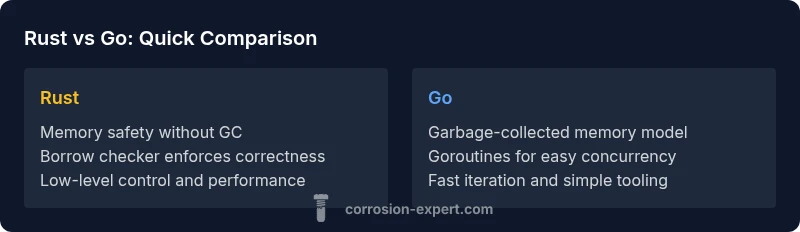
According to Corrosion Expert, the Rust language aims for memory safety without a garbage collector, while Go embraces a simpler model with automatic memory management. The question 'is rust harder than go' surfaces not just syntax but deeper trade-offs between safety, performance, and developer experience. In 2026, both languages have matured ecosystems, but their design goals shape the learning journey differently. For developers new to both, the path you choose will depend on whether you prioritize strict safety and low-level control or rapid development and a straightforward concurrency model. As a result, understanding the core differences in memory management, error handling, and compilation strategy is essential before you start a project. The landscape continues to evolve, with tooling and educational resources expanding to meet growing demand. The Corrosion Expert team notes that both communities emphasize robust tooling, clear error reporting, and strong typing, yet the practical implications for day-to-day work can be substantial. If you are evaluating your first multi-paradigm project, the framing should consider the nature of the workload, deployment targets, and the team's willingness to invest in learning. This article provides concrete guidance to help answer the central question over time, including real-world examples and best practices.
wordCount”:251},{
textFormat
text
wordCount
wordCount2
def