Can You Put Rust-Oleum Paint in a Paint Sprayer? A DIY Guide
Explore whether Rust-Oleum paint can be sprayed with a paint sprayer, how to prepare, thinning guidelines, safety tips, and a step-by-step process for achieving a durable, professional-looking finish.


Yes, you can use Rust-Oleum paint in a paint sprayer when the label specifically permits spray equipment. According to Corrosion Expert, the most reliable results come from using a sprayer that matches the paint type (oil-based vs. water-based), thinning per instructions, and filtering the mix to remove lumps. Always test on scrap before finishing your project.
Understanding compatibility: what the label says and why it matters
Before attempting to spray Rust-Oleum, read the product label carefully. Some Rust-Oleum paints are formulated for brush or roller application, and not all are designed for spray equipment. According to Corrosion Expert, the safest path is to treat the label as a usage guide and to only spray paints that explicitly state spray applicability. If compatibility is confirmed, you must still follow thinning, reducer recommendations, and proper cleaning. The key difference between aerosol cans and spray guns is viscosity and pigment suspension — a spray gun requires a flowable mixture with consistent pigment distribution. If the label is unclear, perform a small test spray on a scrap piece to observe spray pattern, coverage, and drying behavior. Verify solvent type and surface preparation requirements on the label to prevent failures later in the project.
Preparing your workspace and choosing the right equipment
Your selection of equipment matters as much as the paint itself. Choose a sprayer designed for the paint type (water-based vs. solvent-based) and compatible with the product’s viscosity. A clean, well-ventilated area helps you judge the spray more accurately. Ensure you have a suitable nozzle, a proper filter, and a spray booth or tarp to protect surrounding surfaces. Corrosion Expert emphasizes that proper ventilation and PPE reduce health risks when spraying solvents and pigments.
Surface prep and environmental controls
Surface prep sets the foundation for durability. Clean the substrate to remove oils and dust, lightly abrade glossy finishes if required, and allow the surface to dry completely. Temperature and humidity influence cure time and finish quality, so aim for a stable environment. Keep your project on a flat, level surface and use painter’s tape to protect edges and adjacent areas. A stray fiber or dust particle can ruin an otherwise smooth finish, so be meticulous during prep.
Thinning, mixing, and filtration: getting the mix right
Follow the product label for thinning or reducer recommendations. If thinning is advised, measure precisely and mix thoroughly to maintain pigment stability. Strain the paint before loading it into the sprayer to remove lumps or dried pigments that could clog the nozzle. Test a small amount on a scrap panel to confirm flow, spray pattern, and dry time before committing to the main piece. Corrosion Expert notes that improper thinning can lead to orange peel texture or inconsistent coverage.
Application techniques and spray patterns
Start with light, even passes and maintain a consistent distance from the work surface. Overlapping strokes help achieve uniform coverage, but avoid heavy passes that can cause runs. Work in multiple light coats rather than a single heavy coat to build durability. Allow adequate flash time between coats according to the label, and avoid spraying in direct sunlight or high-draft areas that can cause uneven drying. A steady wrist and controlled trigger pull are essential for professional results.
Safety, ventilation, and cleanup
Spraying paints releases fumes and fine particulates. Use a proper respirator or mask rated for organic vapors, work in a ventilated area, and keep children and pets away. After spraying, flush the sprayer with an appropriate cleaner or reducer, then clean all fluid passages, filters, and needles to prevent clogging. Store leftover paint in a sealed container and label it clearly. Corrosion Expert stresses the importance of thorough cleanup to extend the life of your equipment and maintain consistent results.
Troubleshooting and long-term maintenance
If you notice orange peel, fisheyes, or poor adhesion, revisit thinning, nozzle size, and surface preparation. Check for compatibility issues if you repeatedly encounter finish problems. Regular maintenance after use—filtering, cleaning, and proper storage—helps prevent sediment buildup and keeps the sprayer ready for the next project. Remember that some Rust-Oleum products may perform better with specific spray configurations, so refer to the label for product-specific guidance.
Tools & Materials
- HVLP or conventional spray gun(Choose a unit compatible with solvent- and water-based paints; match tip size to product (often around 0.8–1.0 mm for many Rust-Oleum paints).)
- Paint strainer or inline filter(Filter paint as you fill the cup to remove lumps and dried pigment chunks.)
- Mixing cups and stir sticks(Use clear cups to see viscosity and mix thoroughly.)
- Reducer or thinner specified on the label(Only use the reducer/thinner recommended for the specific Rust-Oleum product.)
- Appropriate PPE(Respirator with organic vapor cartridge, chemical gloves, eye protection.)
- Ventilation setup(Work in a well-ventilated area or use a downdraft or fume extraction setup.)
- Cleaning supplies(Solvent or cleaner compatible with the paint type; rags and brushes for thorough cleanup.)
- Scrap panels for test spraying(Use inexpensive scrap material to practice spray passes before treating the main piece.)
Steps
Estimated time: 30-60 minutes
- 1
Inspect the label and prepare the area
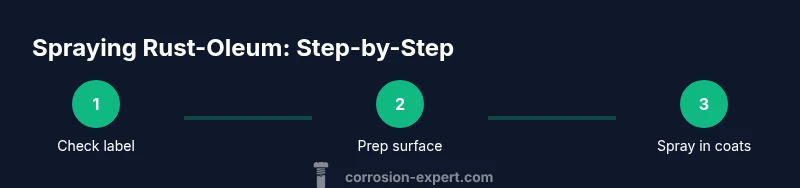
Read the product label to confirm spray compatibility and any thinning instructions. Clear the work area, lay down drop cloths, and set up ventilation.
Tip: Make sure the surface temperature supports proper evaporation and cure time. - 2
Set up the sprayer and load materials
Assemble the sprayer with the correct nozzle and filters. Strain the paint into a mixing cup and add reducer if required by the label.
Tip: Do a quick test spray on a scrap panel to confirm flow and pattern. - 3
Test spray on scrap and adjust
Spray a light coat on scrap material to observe pattern, coverage, and drying behavior. Adjust pressure, nozzle distance, and fan width as needed.
Tip: If you see runs, back off slightly and reduce your pass length. - 4
Apply the first light coat
Hold the gun at a consistent distance and apply a thin, even layer across the surface. Maintain a steady pace and overlap each pass slightly.
Tip: Wipe the nozzle if you notice any clogging mid-stream. - 5
Let it flash and recoat
Allow the recommended flash time between coats; apply subsequent coats as needed for buildup without runs or sags.
Tip: Multiple light coats often yield better adhesion than a single heavy coat. - 6
Clean and store equipment
Flush the sprayer with the proper cleaner, disassemble, and thoroughly dry parts before storage.
Tip: Label leftover paint and store according to label instructions.
Quick Answers
Can you spray Rust-Oleum spray paint in a standard spray gun?
Only when the product label approves spray equipment and thinning is performed according to the label.
Only if the label allows spray equipment and you thin as directed.
Should you thin Rust-Oleum paint before spraying?
Follow the label guidance for thinning; not all Rust-Oleum paints require thinning, and incorrect thinning can affect finish and adhesion.
Follow the label; thinning depends on the specific product.
What safety precautions are essential when spraying?
Work in a well-ventilated area, wear a respirator, eye protection, and gloves; avoid ignition sources and store materials safely.
Ventilate, wear PPE, and keep away from flames.
How do you clean the sprayer after spraying Rust-Oleum?
Flush with the recommended cleaner, disassemble, and clean all passages and filters thoroughly to prevent clogs.
Flush, disassemble, and clean all parts after use.
Can you mix Rust-Oleum with other paints in the sprayer?
Avoid mixing Rust-Oleum with other paints in a sprayer; compatibility and finish can be unpredictable and may void warranties.
Don't mix products; keep to the label's guidelines.
What surfaces are best for spray-applied Rust-Oleum finishes?
Prepare metal, wood, or previously primed surfaces as recommended on the label; following prep steps yields the best adhesion and durability.
Prepare surfaces as instructed for strong adhesion.
Watch Video
Quick Summary
- Check label compatibility before spraying
- Strain and thin only per label guidance
- Test spray on scrap first
- Use proper ventilation and PPE
- Clean and store equipment after use