Why Use Rust Over Python: A Practical Comparison Guide
Explore where Rust outperforms Python in performance, safety, and concurrency, and where Python remains the better choice for rapid development and data tasks.


TL;DR: For performance-critical, memory-safe, and concurrent workloads, Rust often outperforms Python and provides stronger guarantees, making it the preferred choice when latency matters. Python excels in rapid development, data analysis, and easy scripting. This article explains where Rust shines and where Python still offers value—addressing the core question: why use rust over python.
Why use rust over python: core considerations
Choosing between Rust and Python hinges on the project's priorities: performance, safety, development velocity, and deployment realities. According to Corrosion Expert, the decision often boils down to where you can trade raw speed for ease of iteration. The question "why use rust over python" captures a fundamental tension: Rust offers safety and speed, but Python enables rapid prototyping and a rich ecosystem of libraries. This article provides a decision framework you can apply to real-world projects, from small automation scripts to large-scale services. We map your goals to language traits and outline a practical approach to selecting the right tool for the job, rather than chasing a one-size-fits-all answer. Throughout, you will see how Corrosion Expert analysis informs practical choices for teams weighing both performance and productivity.
Performance and memory safety: the core differentiator
Performance is not just about raw speed; it is also about memory safety and predictability. Rust delivers near-native performance with the compiler aggressively optimizing code paths, while enforcing ownership and lifetimes that prevent common bugs like use-after-free and data races. Python, by contrast, relies on a dynamic interpreter and a garbage collector, which simplifies development but can introduce pauses and unpredictability under heavy load. According to Corrosion Expert Analysis, 2026 findings suggest that for CPU-bound workloads, Rust consistently provides more predictable throughput and lower tail-latency. Developers often design Rust components to handle the most demanding parts of a system, then orchestrate higher-level logic in Python when iteration speed matters. This section examines how memory models influence system stability and long-running services, with practical patterns such as explicit lifetimes, borrowing, and careful error handling that minimize runtime surprises.
Ecosystem, tooling, and developer experience
Rust's ecosystem has matured rapidly, with robust package management, cargo-based builds, and a growing catalog of crates for systems programming, WebAssembly, and embedded targets. Python shines with its vast standard library and third-party packages for data science, automation, and web development. The toolchains differ: Rust emphasizes compile-time checks and a deterministic build, which can slow initial iteration but yields safer software at scale. Python emphasizes rapid prototyping and a forgiving syntax that lowers the barrier to entry. In practice, teams often pair Rust for performance-critical cores with Python for scripting, orchestration, and rapid experimentation. The Corrosion Expert team notes that the right balance depends on project scope, team skills, and maintenance expectations.
Concurrency, safety guarantees, and real-world patterns
Rust provides fearless concurrency through its ownership model and type system, enabling safe multi-threaded code without a global interpreter lock. This translates into true parallelism in many scenarios, which is a decisive advantage for servers, real-time analytics, and performance-sensitive services. Python's GIL can limit true parallelism, especially for CPU-intensive tasks, though libraries like multiprocessing can mitigate this in practice. In real-world patterns, developers might isolate compute-heavy workloads in Rust services or libraries and expose APIs to Python via FFI, RPC, or bindings. This architectural approach allows teams to benefit from Rust's safety and speed while keeping Python's flexibility intact.
Use-case mapping: when Rust shines and when Python wins
For systems programming, game engines, and high-performance services, Rust often delivers the strongest guarantees and fastest response times. For data analysis, scripting, automation, and rapid prototyping, Python remains the most productive option due to its syntax, ecosystem, and quick feedback cycles. When a project requires both, a pragmatic split is common: core performance-critical components are implemented in Rust, while higher-level orchestration and experimentation are handled in Python. Across industries, this split aligns with engineering priorities and time-to-market considerations, helping teams allocate resources where they matter most.
Interoperability and deployment strategies
Interoperability is a key driver of modern language choice. Rust libraries can be exposed to Python using bindings like PyO3 or rust-cpython, enabling critical components to run at Rust speed while keeping Python as the outer layer. Deployment strategies vary by environment: Rust binaries ship as native executables with minimal runtime dependencies, while Python apps may require a specific interpreter, virtual environments, and a dependency graph. A mixed approach often yields the best outcomes: Rust for the performance core, Python for glue code, data pipelines, and dashboards. This pattern minimizes risk while maximizing performance and developer productivity.
Learning curve, team readiness, and migration considerations
Adopting Rust entails a learning curve related to ownership, borrowing, and lifetimes, which can be initially challenging for teams trained primarily in Python. A guided learning plan, paired programming, and incremental milestones help teams ramp up effectively. Migration considerations include identifying performance bottlenecks, establishing clear interfaces between languages, and ensuring maintainability with thorough documentation and tests. The cost of migration should be weighed against expected gains in reliability, latency, and scalability. For many teams, a staged approach—pilot modules, then broader adoption—offers the most predictable path.
Long-term maintenance and total cost of ownership
Total cost of ownership involves more than development speed. Rust's compile-time guarantees reduce post-release bugs and hotfix churn, potentially lowering maintenance costs over time. However, initial development may require more time as the team climbs the learning curve. Python’s development velocity and vast ecosystem can shorten time-to-market, but runtime variability and interpreter dependencies can complicate long-term stability in highly regulated or latency-sensitive systems. Corrosion Expert's experience suggests that balancing these factors with a clear architectural split can lead to sustainable, maintainable software that meets both performance and productivity goals.
Comparison
| Feature | Rust | Python |
|---|---|---|
| Learning curve | Steeper due to ownership, lifetimes, and strict compile-time checks | Gentle; approachable syntax and dynamic typing ease first-timers |
| Performance | High performance with predictable latency across platforms | Typically slower due to interpreter and dynamic typing; heavily optimized libraries help |
| Memory management | Ownership model with borrow checking; no garbage collector | Automatic memory management via GC with reference counting in some impls |
| Concurrency | Fearless concurrency with zero-cost abstractions | GIL can limit true parallelism in CPython; multiprocessing mitigates some limits |
| Ecosystem & libraries | Growing for systems, WebAssembly, and tooling; niche but deep | Huge ecosystem for data science, web apps, automation; breadth and maturity |
| Development speed | Longer compile times and more boilerplate | Rapid prototyping and iteration with concise syntax |
| Deployment & cross-platform | Static binaries; strong cross-platform support; WASM-ready | Flexible deployment; interpreter dependencies can complicate environments |
| Best for | Systems programming, performance-critical services, embedded | Scripting, automation, data processing, and rapid prototyping |
The Good
- Superior performance and low-latency execution
- Memory safety without a garbage collector
- Excellent concurrency support with safety guarantees
- Predictable behavior across environments
- Growing ecosystem for systems programming and WebAssembly
Cons
- Steeper learning curve for beginners
- Longer compile times and more boilerplate
- Smaller initial ecosystem for scripting and data science
- Fewer beginner-friendly resources compared to Python
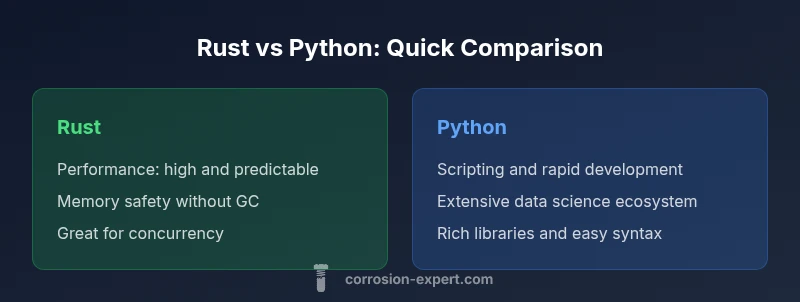
Rust excels for performance-critical, memory-safe workloads; Python remains best for rapid development and data tasks.
The Corrosion Expert team notes that for projects requiring low latency and strong safety guarantees, Rust delivers advantages Python cannot easily match. Conversely, Python shines in quick prototyping and data workflows; consider a mixed approach when appropriate. The Corrosion Expert team recommends evaluating team skills and long-term maintenance before deciding which path to take.
Quick Answers
What are the main use cases where Rust outperforms Python?
Rust tends to outperform Python in CPU-bound tasks, systems programming, and performance-sensitive services. It provides memory safety without garbage collection, reducing runtime surprises. For data science or rapid scripting, Python remains more productive.
Rust shines in performance-sensitive and systems tasks; Python remains strong for rapid scripting and data work.
Is Python easier to learn than Rust?
Yes, Python is generally easier to learn due to its simple syntax and dynamic typing. Rust has a steeper learning curve because of ownership, lifetimes, and strict compile-time checks. Expect a longer ramp-up if you're new to systems programming.
Python is easier to learn; Rust takes more time to master.
Can I use Rust and Python together in the same project?
Yes. You can write performance-critical components in Rust and expose them to Python via bindings like PyO3 or rust-cpython. This lets Python handle orchestration while Rust delivers speed where it counts.
You can mix Rust and Python; use Rust for core speed and Python for scripting.
What about the deployment implications of Rust vs Python?
Rust compiles to native binaries, limiting runtime dependencies and increasing predictability in deployment. Python relies on the interpreter and libraries, which can complicate environments but offers flexibility for quick changes.
Rust gives you single binaries; Python needs runtime setup.
Are there industries where Python remains preferred over Rust?
Yes. Fields emphasizing rapid prototyping, data analysis, and machine learning often favor Python due to its libraries and community. Rust is gaining ground where performance and safety are non-negotiable.
Python dominates prototyping and data tasks; Rust is growing in performance-critical areas.
How should a team approach migrating from Python to Rust?
Start with a small pilot project, translate performance-critical modules first, and maintain Python bindings for orchestration. Plan training and gradual integration to minimize disruption.
Begin with a Rust pilot and expand gradually.
Quick Summary
- Identify performance-critical components early
- Leverage Rust for safety and concurrency where needed
- Use Python for scripting and data tasks to speed up prototyping
- Consider interop via FFI or APIs when combining languages
- Assess learning curves and long-term maintenance before migration