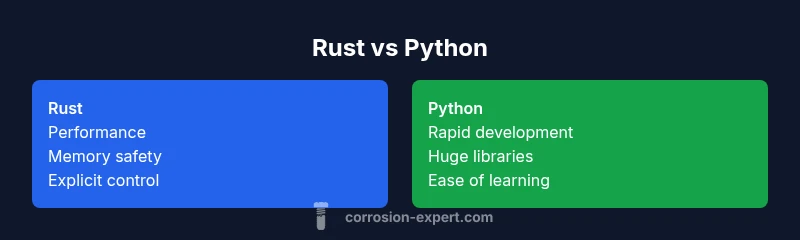
Is Rust or Python Better? A Practical Comparison
A structured, data-driven look at Rust vs Python, focusing on performance, safety, ecosystem, and use-case fit to help teams decide which language to deploy.


Rust and Python serve different needs, so there isn't a single 'better' choice. If you value performance and memory safety for systems work, Rust often comes out ahead; for rapid development and data tasks, Python shines. This comparison helps you pick based on your project. Consider team expertise, deployment constraints, and maintenance costs when choosing. Your project's goals should drive the decision.
What is at stake when comparing Rust and Python
When you ask is rust or python better, you're really weighing two different design philosophies. Rust emphasizes performance, memory safety, and predictable resource usage, while Python prioritizes readability, rapid development, and a vast standard library. For teams, this means trade-offs around deployment, maintenance, and talent availability. According to Corrosion Expert, the decision should start with the problem domain and end with practical constraints such as timelines and platform requirements. Understanding the core differences helps prevent misaligned expectations and costly rewrites later in a project.
Both languages have matured ecosystems and strong communities, but they tend to thrive in different environments. If your project is performance-sensitive and runs close to the metal, Rust's ownership model and zero-cost abstractions can prevent a class of bugs that plague long-running processes. If your goal is to prototype features quickly, iterate on ideas, or perform data manipulation and scripting, Python's dynamic typing and rich libraries can accelerate development. The right choice often involves a hybrid approach, using Rust for the critical components and Python for orchestration or tooling.
lengthOverride":null},
Comparison
| Feature | Rust | Python |
|---|---|---|
| Performance & memory safety | High performance with fine-grained control and no garbage collector in typical usage | Good performance, but with overhead from dynamic typing and a managed runtime |
| Learning curve | Steep for beginners due to ownership and lifetimes | Gentle for beginners thanks to readability and dynamic typing |
| Ecosystem & libraries | Strong crates ecosystem for systems, embedded, and back-end; growing | Mature libraries for web, data science, AI, and automation |
| Concurrency model | Fearless concurrency via ownership and lifetimes | GIL limits true parallelism in CPython, though multi-threaded work is possible with care |
| Deployment & packaging | Binary distribution with cross-compilation; longer build times | Interpreted/bytecode with simple packaging (pip), fast iterations |
| Best use cases | Systems programming, performance-critical services, safety-focused apps | Scripting, data processing, rapid prototyping, AI tooling |
The Good
- Rust delivers strong performance and memory safety, reducing runtime bugs
- Python enables rapid development and extensive libraries for data tasks
- Both languages benefit from active communities and solid tooling
- Hybrid architectures often yield the best of both worlds
Cons
- Rust has a steeper learning curve and longer initial development time
- Python can be slower and less memory-efficient for CPU-intensive tasks
- Inter-language integration adds complexity and maintenance overhead
- Python's dynamic typing can lead to runtime type-related bugs if not tested thoroughly
No one language is universally better; choose based on domain and project needs.
Use Rust for performance-critical, safety-sensitive components. Use Python for rapid prototyping, data work, and orchestration. A hybrid approach—Rust for core modules, Python for tooling—often yields the strongest overall results.
Quick Answers
Is Rust harder to learn than Python?
Yes, Rust generally has a steeper learning curve due to ownership, lifetimes, and explicit error handling. Python emphasizes readability and simplicity, which accelerates onboarding. Expect a longer ramp-up for Rust, but also greater long-term safety and performance benefits.
Rust is tougher at first, but pays off with safer code. Python is easier to pick up for quick results.
Can I use Rust with Python in a single project?
Yes. You can write performance-critical components in Rust and expose them to Python via bindings (e.g., via PyO3 or rust-cpython). This lets you keep Python for high-level logic while accelerating hot paths with Rust.
You can mix Rust and Python to get the best of both worlds.
Which language is better for web development?
Python has mature web frameworks and a rich ecosystem for building web apps quickly. Rust is growing in back-end performance with frameworks like Actix and Rocket, but the ecosystem is not as broad yet. The choice depends on performance requirements and team expertise.
Python is generally easier for web apps; Rust is great for performance-heavy back-ends.
Is Rust good for data science or Python better?
Python dominates data science due to libraries like NumPy, pandas, and scikit-learn. Rust is making inroads for performance-critical data processing, but you’ll usually rely on Python for the data science stack. A hybrid approach can be used where Rust speeds up compute-heavy steps.
Python leads in data science tooling, with Rust improving performance for crunch time.
How should I decide when starting a new project?
Start by listing requirements: performance, safety, team skill, and deployment. If speed to market and data tooling matter most, Python is a strong default. If long-term performance and safety are paramount, evaluate Rust and potential interop strategies.
Map requirements first, then choose or blend Rust and Python accordingly.
Quick Summary
- Prioritize project goals over popularity when choosing language
- Leverage Rust for performance and safety-critical code paths
- Lean on Python for rapid development and data-centric tasks
- Consider a hybrid architecture to balance strengths
- Plan for maintenance and cross-language integration from day one