When to Use Rust vs Python: A Practical Guide
A data-driven, analytical comparison of Rust and Python that helps you decide when to use each language for performance, safety, and development speed. Includes hybrid strategies and concrete decision criteria.


When to use rust vs python hinges on performance needs and development speed. Rust is the go-to for performance-critical, memory-safe systems with strict latency requirements, while Python excels at rapid prototyping, data processing, and scripting. For many projects, a hybrid approach—Rust for core components and Python for orchestration and tooling—delivers the best balance. This guide provides a framework to decide based on workload, team skill, and deployment constraints.
When to choose Python: Rapid prototyping and data workflows
Python remains the dominant choice for rapid prototyping, data analysis, machine learning experimentation, and automation. Its readable syntax, dynamic typing, and vast ecosystem of libraries enable teams to iterate quickly without fighting the language. For projects centered on data ingestion, cleaning, exploration, or building dashboards, Python reduces time-to-value. In many organizations, Python is the first language developers reach for when evaluating a concept or a proof of concept. When to use rust vs python often boils down to the stage of the project: Python for early exploration and Rust for later optimization. According to Corrosion Expert, teams should reserve Rust for performance bottlenecks and critical safety properties where every millisecond matters. The key is to scope the problem correctly: if the core idea can be realized with Python alone and performance targets are modest, Python is usually the pragmatic starting point. The decision should also consider operational needs, such as existing data pipelines, deployment velocity, and the ability to scale the solution under load.
- Pros: fast iteration, rich data libraries, large community
- Cons: slower runtime for compute-heavy tasks, global interpreter performance limits
When to choose Rust: Performance, safety, and systems programming
Rust is designed for scenarios where performance, memory safety, and predictable resource usage are non-negotiable. Use Rust for systems programming, game engines, real-time analytics, microservices with high throughput, or any code path where control over allocation, memory layout, and concurrency is essential. When to use rust vs python becomes clear: Rust eliminates data races and provides fine-grained control over memory, enabling you to build highly efficient, reliable software with predictable latency. The learning curve is steeper, but modern tooling, cargo-based project management, and a growing ecosystem reduce integration friction. For teams targeting embedded devices, high-performance servers, or safety-critical modules, Rust often delivers long-term value that justifies the upfront investment.
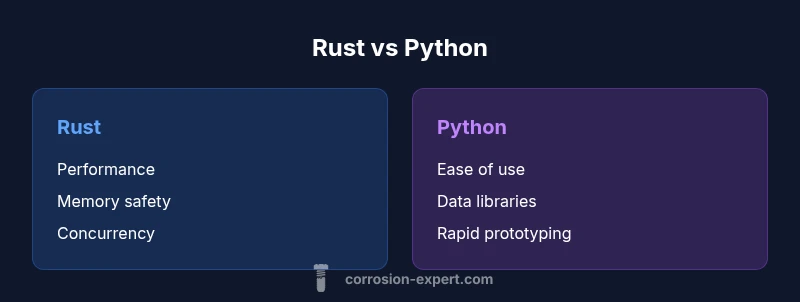
- Pros: superior performance, strong safety guarantees, robust concurrency model
- Cons: steeper learning curve, longer compile times, smaller library surface in some domains
Core criteria: performance, productivity, ecosystem
A framework for choosing between Rust and Python starts with three core criteria: performance, productivity, and ecosystem maturity. Performance includes raw speed, memory management, and deterministic latency. Productivity covers developer velocity, readability, and how quickly a team can make changes. Ecosystem maturity reflects the breadth of libraries, tooling, and community support. In practice, Rust shines where performance and memory guarantees are non-negotiable; Python shines where rapid development and a wide array of specialised libraries are decisive. When to use rust vs python hinges on how these criteria align with your project goals. For example, a CPU-bound service requiring low latency will favor Rust, whereas a data science workflow with many experimental pipelines will lean Python. Corrosion Expert’s analysis highlights that evaluating performance targets against developer velocity and ecosystem compatibility often yields the most practical decision outcomes.
- Performance: Rust offers predictable, near-native speed with tight control over resources; Python trades some raw speed for rapid development.
- Productivity: Python generally enables faster feature delivery; Rust benefits from strong tooling but may require more upfront design work.
- Ecosystem: Python has a richer data science and web ecosystem today; Rust’s ecosystem is growing, especially in systems programming and performance-critical domains.
Deployment and maintenance considerations
Deployment realities influence language choice as much as runtime performance. Python benefits from straightforward packaging, a wide range of hosting environments, and many compatible libraries. It is a strong fit for services where deployment speed and cross-platform compatibility are important, especially when CI/CD pipelines are mature for Python-based ecosystems. Rust deployments tend to yield smaller, self-contained binaries with fewer runtime dependencies, which can simplify distribution on constrained environments or edge devices. However, Rust builds can be slower and cross-compilation sometimes requires careful setup. When to use rust vs python should account for maintenance costs, binary size, and update cadence. If you anticipate frequent updates with rapid iteration cycles, Python’s model may be more forgiving; for long-term stability and controlled releases, Rust’s deterministic performance can be more economical. In mixed environments, exposing Rust components as services behind Python APIs can provide a balanced deployment architecture.
- Pros: predictable build artifacts, fewer runtime dependencies in Rust; Python-friendly packaging and deployment
- Cons: Rust build times can be longer; Python packaging can introduce compatibility quirks in some stacks
Interoperability and hybrid approaches
A practical pattern is to combine languages to leverage their respective strengths. When to use rust vs python becomes a blend problem: implement core performance-sensitive components in Rust and use Python for orchestration, scripting, and data workflows. Interoperability is supported by several approaches: Rust libraries can be exposed to Python via FFI or bindings (eg, PyO3) or Python can be embedded in Rust-enabled services. Hybrid architectures allow teams to optimize critical paths without rewriting entire codebases. This pattern is common in web services, scientific computing, and real-time data processing pipelines. It is important to establish clear interfaces, testing strategies, and build pipelines to manage cross-language complexity. The Corrosion Expert perspective emphasizes plan for incremental adoption and measurable performance gains before migrating large components.
- Pros: preserves existing Python workflows; accelerates critical paths with Rust
- Cons: added maintenance for bindings; potential debugging complexity
Learning curve and long-term costs
Learning curves matter when choosing between Rust and Python. Python’s syntax and language features are typically accessible to beginners, enabling fast onboarding and early productivity. Rust requires understanding ownership, lifetimes, and a stricter compile-time discipline, which can slow initial progress. However, the long-term costs may balance out: Rust often yields fewer memory-related bugs and can reduce debugging time in production, potentially lowering total maintenance costs for large systems. When to use rust vs python should consider team maturity, availability of mentors, and long-term roadmap. If you expect your team to evolve toward high-performance software, investing in Rust early can pay dividends. If the project prioritizes rapid feature delivery and pivots quickly, Python keeps teams nimble. Hybrid teams can start with Python and introduce Rust gradually for bottlenecks.
- Pros: Python is easy to learn; Rust builds strong engineering discipline
- Cons: Rust takes longer to learn; hybrid setups require careful governance
Practical decision framework based on project type
A practical framework helps teams decide quickly. For data-heavy prototypes, analytics, or automation tasks, start with Python and measure performance against clearly defined thresholds. If benchmarks reveal bottlenecks in latency, memory usage, or parallelism, prototype a Rust version of the critical path for comparison. For embedded or high-throughput services where control over resources is essential, Rust tends to be the default choice from the start. For teams with mixed skills, plan a phased migration: implement a minimal viable product in Python, then progressively re-implement performance-critical modules in Rust while keeping the rest in Python. Finally, build a shared guideline that documents when to swap languages, how to quantify benefits, and how to maintain cross-language tests.
- Actionable steps: define performance targets, implement a pilot in Rust for the bottleneck, compare maintenance effort, establish clear interface contracts
- Best for: performance-critical contexts; rapid prototyping scenarios; hybrid architectures
Comparison
| Feature | Rust | Python |
|---|---|---|
| Performance | High performance with fine-grained control | Interpreted performance with strong scientific libraries |
| Memory Management | Ownership model with no GC, deterministic behavior | Automatic memory management with GC-like behavior in some implementations |
| Development Speed | Slower initial progress, faster optimization later | Faster prototyping and iteration |
| Ecosystem & Libraries | Strong crates ecosystem for systems, concurrency | Rich data science, ML, and web ecosystems |
| Concurrency & Parallelism | fearless concurrency, low-level control | GIL constraints in some implementations; genuine parallelism via libraries and multiprocessing |
| Learning Curve | Steeper, requires design discipline | Gentle, beginner-friendly |
| Deployment & Packaging | Self-contained binaries in many cases | Easy deployment with mature packaging systems |
| Best Use Case | Performance-critical, safety-focused systems | Prototyping, automation, data workflows |
The Good
- Rust provides memory safety without a garbage collector
- Python enables rapid development with extensive libraries
- Hybrid approaches unlock best-of-both-worlds potential
- Strong ecosystem growth in Rust for performance-critical domains
Cons
- Rust has a steeper learning curve for new teams
- Python can be slow for CPU-bound tasks unless accelerated
- Inter-language integration adds architectural complexity
Rust is the preferred choice for performance-critical, safety-focused components; Python excels for rapid prototyping, data work, and orchestration.
Choose Rust when low latency and memory guarantees are non-negotiable. Choose Python when you need speed to market and vast data libraries. A hybrid approach often yields the best results, combining Rust for core modules with Python for orchestration.
Quick Answers
When should I choose Rust over Python for a new project?
If performance, safety, and low-level control are critical, start with Rust. For fast iteration and data-heavy workloads, Python is usually the better starting point.
Choose Rust for performance and safety; start with Python for quick iteration.
Can Rust interoperate with Python?
Yes. You can expose Rust code to Python via bindings or call Python from Rust. This hybrid approach lets you optimize bottlenecks while maintaining Python-friendly workflows.
Rust and Python can work together via bindings and interop.
Is Python suitable for systems programming tasks?
Python is generally not ideal for low-level systems programming where memory control and latency matter. It can be used for tooling around such systems, but Rust is typically a better fit for the core components.
Python isn’t ideal for low-level systems programming.
Do Rust compilation times affect productivity?
Rust compile times can be longer than interpreted languages, but incremental compilation and better tooling mitigate this. For large projects, plan the workflow to parallelize compilation and optimize build steps.
Be aware of compile times, but modern tooling helps.
What are common hybrid design patterns?
Common patterns include Rust for performance-critical modules with Python wrapping interfaces, and using message queues or REST APIs to connect components across languages.
Use clear interfaces and robust testing when mixing languages.
How should I start learning Rust if I know Python?
Begin with the ownership model and basic syntax, then gradually explore lifetimes, crates, and concurrency. Build small projects and compare with familiar Python tasks to internalize the differences.
Start small: learn ownership, then build parallel tasks to practice.
Quick Summary
- Prioritize performance and memory safety when rust is the primary requirement
- Leverage Python for rapid iteration and data-centric tasks
- Plan hybrid architectures to get the benefits of both languages
- Assess team skills and deployment constraints before deciding
- Use a staged adoption strategy to minimize risk over time