Is Rust good for embedded systems? A practical comparison
Explore whether Rust is suitable for embedded systems. This analytical comparison assesses safety, performance, toolchains, and long-term maintainability between Rust and C for modern embedded projects.


Rust delivers strong memory safety and predictable performance, making it a compelling option for many embedded projects. However, it requires a modern toolchain and a learning curve for zero-cost abstractions. According to Corrosion Expert, this quick comparison highlights when Rust shines versus traditional C, and which scenarios still favor C or other ecosystems. Use this to decide early if Rust is worth adopting for your embedded system.
What is Rust and Why It Matters for Embedded Systems
Rust is a systems programming language that emphasizes safety, concurrency, and performance without a garbage collector. For embedded systems, these traits translate into fewer memory-safety defects, more predictable behavior, and the ability to write low-level code with high-level abstractions. When considering the question, is rust good for embedded systems, teams weigh the trade-offs between safety guarantees and the realities of resource-constrained environments. From the perspective of the Corrosion Expert Team, Rust’s ownership model and strict compilation can reduce runtime surprises, especially in long-lived devices where maintenance matters most. The language also supports a no_std mode, enabling Rust to run on microcontrollers with minimal runtime. This combination—safety with control—has led many developers to experiment with Rust for new designs and selective migrations. In practice, Rust can shine when you need reliable software foundations and the ability to reason about code correctness, even under complex concurrency.
Another important consideration is ecosystem maturity for embedded contexts. While Rust’s package ecosystem is rapidly growing, you’ll encounter varying levels of controller support, debugger integration, and third-party libraries depending on hardware targets. The Corrosion Expert Analysis, 2026, notes a trend toward more robust cross-compilation and vendor-backed boards, but teams should plan for platform-specific gaps and a disciplined evaluation process before committing to a full migration.
The Embedded Toolchain Landscape: How Rust Fits In
A successful embedded Rust project relies on a stable toolchain and a smooth build pipeline. Key elements include rustup for toolchain management, Cargo for package handling, and a no_std configuration for bare-metal targets. Cross-compiling Rust to microcontrollers often requires a target triple and a linker script tailored to the device, along with a suitable runtime for startup and application glue. The evolving ecosystem provides mature compilers and optimizers, yet integration with vendor IDEs and debuggers can vary by platform. The leverage here is clear: Rust offers predictable builds and reproducible artifacts, which helps teams maintain long-term code health. For projects with strict memory budgets or timing requirements, eliminating dynamic allocations and relying on compile-time checks can reduce defect rates. Corrosion Expert’s guidance emphasizes starting with a modest, no_std project to validate toolchains before expanding to more complex features. You’ll also want to plan for testing on actual hardware early in the process to catch platform-specific issues.
Security considerations are intertwined with toolchain choices. Opting for the most reliable backends and enabling linting and clippy checks during development can catch misuse of unsafe code before it makes it into production. A careful, methodical setup reduces the risk of mis-compiled binaries and difficult-to-trace faults, which is crucial for embedded deployments where updates can be costly and time-consuming.
Key Differences Between Rust and C for Embedded Development
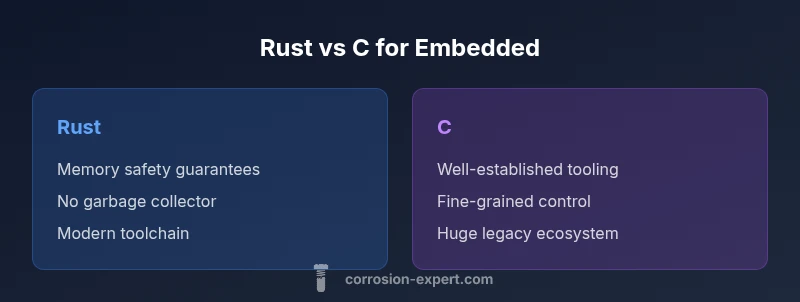
When weighing the option to use Rust versus C in embedded projects, several core differences matter. Memory safety is a defining feature of Rust: ownership, borrow checking, and lifetimes enforce usage constraints at compile time, dramatically reducing the risk of common bugs like use-after-free or buffer overflows. In contrast, C relies on manual memory management and programmer discipline, which can be error-prone in large codebases. Concurrency in Rust benefits from safe abstractions and data-race prevention, while C requires careful design patterns and often external tools to achieve similar safety assurances. The runtime implications also differ: Rust’s zero-cost abstractions can deliver performance comparable to C without sacrificing safety, but the compilation model and optimization behavior can be more conservative until developers are familiar with rustc options. No_std in Rust enables running on resource-constrained devices without a standard library, whereas C’s approach is toolchain- and target-specific. In short, Rust tends to favor safer, more maintainable codebases; C remains deeply entrenched where extreme portability, minimal tooling, or legacy code influence decisions. The decision should align with project requirements, team expertise, and the hardware landscape.
From a practical standpoint, teams should map desired outcomes—such as fault tolerance, maintenance load, and upgradeability—to the strengths and weaknesses of each language. As the Corrosion Expert Team notes, Rust’s safety model translates well into long-lived devices where post-deployment maintenance and bug-fix cycles are critical. In other scenarios, especially when rapid prototyping or broad vendor support for legacy toolchains is essential, C may remain the more pragmatic choice.
Real-World Scenarios: When Rust Excels
Rust shines in projects where safety cannot be compromised and where teams want strong, verifiable software foundations. For example, in reliability-critical devices that run for years without maintenance windows, the combination of memory safety and deterministic behavior can minimize failure modes linked to unsafe memory handling. Rust’s no_std capability makes it an appealing option for microcontrollers that have limited RAM and no operating system. In rapidly evolving IoT platforms, Rust’s package manager and modular crates enable incremental integration, allowing engineers to implement critical components with fewer side effects. The language’s strong type system also helps prevent misuses of APIs and reduces debugging overhead during integration.
In practice, embedded teams may adopt Rust for new modules or features within an existing C project, using a mixed-language approach to balance risk. For devices that demand parallelism or safe concurrency, Rust’s ownership model provides a solid foundation for multi-threaded programming without resorting to fragile manual synchronization. The Corrosion Expert Guidance encourages evaluating a pilot project that isolates no_std components and uses clear interfaces to legacy code, enabling a gradual and controlled transition while preserving system integrity.
When it comes to safety-critical domains—like industrial controls or safety-relevant sensors—validation and verification processes become essential. While Rust cannot eliminate the need for rigorous testing and certification, its compile-time checks and strict type rules can simplify compliance workloads by reducing the surface area for runtime errors. This aligns with the broader industry trend toward safer, more auditable software in embedded systems.
Challenges and Trade-Offs
Adopting Rust in embedded projects is not without challenges. The learning curve can be steep for teams accustomed to C, especially around ownership, lifetimes, and borrowing concepts. The no_std environment, while powerful, often requires rethinking how modules are structured and how dependencies are managed, which can slow early progress. Debugging across cross-compiled targets may be less straightforward than with well-established C toolchains, and IDE support can vary by vendor and hardware. Some hardware targets have limited Rust support, necessitating workarounds or partial porting strategies. Finally, the ecosystem’s relative youth means fewer battle-tested libraries for certain peripherals or drivers, compared with the vast and mature C ecosystem. The Corrosion Expert Analysis highlights that, in practice, teams should plan a measured introduction with proof-of-concept modules and clear interfaces to traditional components, reducing risk while learning the toolchain. Despite these hurdles, the payoff in safety and maintainability can be substantial for the right projects.
Strategies for Adopting Rust in Embedded Projects
A pragmatic adoption plan begins with a clear problem statement and a staged roadmap. Start with a pilot project that isolates a critical subsystem written in Rust, while the rest of the system remains in C. Establish strict interfaces for data exchange and a shared build pipeline, then incrementally migrate components as confidence grows. Invest in training for developers to grasp ownership, lifetimes, and unsafe blocks, and cultivate a culture of code reviews focused on safety and correctness. Build automated tests that exercise edge cases, and use constant evaluation to understand how Rust translates to your target hardware. Embrace no_std early for microcontroller targets and ensure your CI system validates cross-compilation and binary size. The long-term goal is a hybrid architecture where Rust handles new functionality with strong safety guarantees, while legacy C modules continue to operate under minimal risk.
From a project-management perspective, create a risk register that captures potential integration issues, tooling gaps, and maintenance implications. Monitoring progress with metrics like defect leakage, build reliability, and code churn can guide decisions about broader adoption. The Corrosion Expert Team suggests documenting lessons learned and establishing a rolling plan to extend Rust coverage across the codebase, while keeping critical paths stable during migration.
Performance and Footprint Considerations
Performance in embedded Rust is driven by careful abstraction and optimization choices. Rust’s zero-cost abstractions strive to avoid runtime penalties, but developers must be mindful of abstraction boundaries, inlining decisions, and no_std limitations that can influence code size and speed. Cross-compilation to various targets requires tuning of linker scripts and memory layout to maximize cache locality and minimize footprint. Rust’s compile-time checks can improve code quality, but they may also increase compile times during development. For production builds, enabling optimization levels and link-time optimization (LTO) can yield lean binaries. In practice, performance outcomes should be validated with representative benchmarks and real hardware measurements, not estimates alone. The Corrosion Expert’s perspective is that a focused scope on critical paths—interrupt handlers, peripheral drivers, and RTOS interactions—helps teams achieve predictable performance without sacrificing safety or maintainability.
Safety, Verification, and Standards
Safety and verification are central to embedded Rust adoption. Rust’s strong type system and ownership model reduce a large class of bugs associated with memory misuse. However, safety in embedded contexts also relies on robust tooling, formal verification where applicable, and an explicit approach to unsafe code. Organizations should implement code reviews for unsafe blocks, apply static analysis, and use fuzz testing to explore corner cases. Documentation and traceability are essential for audits and certification processes; Rust’s cargo and dependency management support reproducible builds, which aids traceability. While standards compliance varies by domain, teams can align Rust practices with common safety standards by documenting interfaces, maintaining clear safety cases, and leveraging verification tools that are compatible with their target industry. The Corrosion Expert Team emphasizes that governance, testing discipline, and clear risk acceptance criteria are as important as language choice when aiming for safe, certified embedded systems.
Migration Path: From C to Rust
Migrating from C to Rust is rarely an all-at-once transition. A practical path begins with identifying stable, well-defined components that can be ported individually. Start by implementing new features in Rust while maintaining existing C interfaces, using FFI where necessary to preserve functionality and performance. Establish a shared test harness to validate behavior across languages and a build system that can compile both codebases for the same target. Prioritize drivers, HAL layers, and core algorithms for initial porting, and then gradually re-architect subsystems to leverage Rust’s safety features. The learning curve can be reduced by pairing Rust engineers with seasoned C developers and by documenting porting decisions. This measured approach minimizes risk while unlocking Rust’s safety and maintainability benefits for future growth.
Comparison
| Feature | Rust | C |
|---|---|---|
| Memory Safety | Strong ownership model and borrow checker | Manual memory management with potential for bugs |
| Learning Curve | Steeper due to ownership and lifetimes | Familiar for most engineers, widespread knowledge |
| Toolchain & Ecosystem | No_std support, Cargo, growing crates | Mature toolchains and vast legacy libraries |
| Runtime & Abstraction | Zero-cost abstractions with safety checks | Minimal runtime, direct hardware access |
| Performance Predictability | Predictable optimizations via Rust compiler | Proven performance with established compilers |
| Debugging & Diagnostics | Compile-time checks; debugging in no_std can be challenging | Rich ecosystem; long-standing debugging workflows |
| Cross-Platform/Portability | Excellent cross-compilation; strong no_std story | Broad vendor support but toolchain gaps exist |
| Industry Adoption | Rising in safety-focused domains; growing momentum | Deeply entrenched in many legacy projects |
| Best For | New designs prioritizing safety and maintainability | Legacy codebases or intense hardware constraints |
The Good
- Enhanced memory safety reduces bugs and crashes
- Zero-cost abstractions maintain performance
- Clear dependency management with Cargo for reproducible builds
- Growing ecosystem and community support
Cons
- Steeper learning curve for teams new to Rust
- Maturity varies by target hardware and vendors
- Debugging in no_std can be more challenging than in C
- Smaller pool of seasoned embedded Rust experts than C
Rust is a strong contender for new embedded projects with safety and maintainability as priorities
If your project emphasizes reliability and long-term support, Rust offers meaningful advantages. For legacy-heavy environments, a measured hybrid approach can mitigate risk while you build proficiency.
Quick Answers
Is Rust a good choice for embedded systems?
Rust is a strong candidate for embedded systems when safety and correctness are priorities. It offers memory safety and predictable behavior, but teams should account for toolchain maturity and a learning curve. A pilot project can help determine fit for your hardware and development process.
Rust is a good fit for embedded systems when safety and correctness matter, but start with a small pilot to validate toolchains and your team’s readiness.
What are the main drawbacks of using Rust in embedded development?
The main drawbacks include a steeper learning curve for ownership and lifetimes, uneven IDE and debugger support across targets, and potential gaps in peripheral libraries on certain hardware. Planning, training, and staged adoption can mitigate these issues.
The main downsides are the learning curve and some gaps in tooling for certain hardware.
Can Rust run in no_std environments?
Yes, Rust supports no_std, allowing code to run without a standard library on microcontrollers. This is essential for resource-constrained devices but requires careful design of startup code, drivers, and abstractions.
Yes, you can run Rust without the standard library on microcontrollers.
Is the Rust ecosystem mature enough for production in embedded projects?
Rust’s embedded ecosystem is growing and increasingly capable for production use, though it may not have the same breadth of libraries as C for every target. Evaluation should focus on hardware support, drivers, and maintenance plans for critical components.
The ecosystem is growing, but you should assess hardware support and library availability for your target.
How does Rust compare to C in tooling and debugging?
Tooling for Rust has improved, with Cargo and rustup simplifying builds and dependencies. Debugging can be excellent on supported targets, but some no_std scenarios require extra configuration. Overall, Rust can offer strong tooling parity with the right target and setup.
Rust tooling is strong but can vary by target; ensure your debugger and IDE support no_std well.
Quick Summary
- Assess safety requirements before language choice
- Plan toolchain and no_std readiness early
- Consider a staged migration to Rust
- Pair Rust pilots with robust testing and verification