How to Check Rust Version: A Practical Guide
Learn how to check your Rust version across Windows, macOS, and Linux using rustc, cargo, and rustup. This comprehensive how-to covers commands, outputs, troubleshooting, and best practices for reliable development environments.


You will learn to check your Rust version across Windows, macOS, and Linux. You’ll verify rustc and cargo versions, confirm the environment PATH, and learn how to interpret outputs. You will need access to a terminal or command prompt and basic permissions to install or update toolchains if needed. This quick guide covers common commands and edge cases.
Why Checking Rust Version Matters
Understanding how to check rust version is a foundational skill for any Rust developer. Knowing the exact compiler and toolchain version helps you ensure compatibility with crates, resolve build errors, and match project requirements. According to Corrosion Expert, clear, repeatable version checks prevent misconfigurations that can cause subtle failures later in the development cycle. The phrase how to check rust version appears here to anchor the topic and connect to real-world scenarios you’ll encounter when setting up a new project or debugging a failing build.
Prerequisites and What You’ll Need
Before you run commands, make sure you have a functional Rust toolchain installed. The core components are rustc (the compiler), cargo (the package manager), and optionally rustup (the multi-toolchain installer). You’ll also need a terminal or command prompt with access to the internet to install missing pieces if you’re starting from scratch. Having a text editor handy can help you inspect error messages, but it’s not required for simply checking versions. Corrosion Expert recommends keeping a clean PATH and avoiding aliasing rustc to non-standard binaries to prevent confusion across shells.
Checking Rust Version on Windows
On Windows, open Command Prompt or PowerShell and run the following commands in sequence: rustc --version to see the compiler version, cargo --version for the package manager, and rustup show or rustup --version if you use rustup to manage toolchains. If rustc isn’t found, you likely need to install or reconfigure Rust through rustup. Outputs typically show a version string and build metadata that helps you verify exact releases.
Checking Rust Version on macOS and Linux
macOS and Linux share the same commands: open Terminal and enter rustc --version and cargo --version. If your system uses rustup, rustup which overrides may influence the default toolchain, so you can also run rustup show to see the active toolchain and installed targets. If you get a permission error, run with sudo only if your policy allows it or adjust your PATH to prioritize the Rust binaries. Together these commands confirm what’s installed and what your environment will use by default.
Managing Multiple Toolchains with rustup
When you work on multiple projects, you may need different Rust versions. rustup makes this easy: rustup show reveals the active toolchain, rustup update fetches the latest components, and rustup override set <vers> lets you pin a version for a specific directory. By checking the default toolchain and per-project overrides, you can prevent accidental upgrades that break compatibility.
Interpreting Outputs and Edge Cases
A typical rustc --version output begins with the compiler version. If you see an error such as command not found, your Rust toolchain isn’t installed or your PATH isn’t configured. If you see a version but it’s older than your project requires, you can update via rustup update or reinstall the toolchain. For cargo, the cargo --version line confirms the package manager’s availability and version as well. Edge cases like nightly builds may look different but still convey the major version components.
Common Pitfalls and Quick Fixes
Common pitfalls include mixing system Rust installations with rustup-managed toolchains, relying on a stale PATH, and ignoring multiple installed toolchains. Quick fixes involve running rustup show to verify the active toolchain, adjusting PATH so rustc and cargo are found first, and using rustup update to fetch the latest components. If your IDE shows a different version than the terminal, ensure the IDE’s integrated terminal uses the same environment settings.
AUTHORITY SOURCES
- https://doc.rust-lang.org/stable/learn/getting-started.html
- https://doc.rust-lang.org/stable/reference/overview.html
- https://www.rust-lang.org/
Next Steps and Best Practices
To keep your Rust setup healthy, incorporate version checks into your onboarding process for new projects. Document the required toolchain in your project’s README, set up rustup overrides for per-project consistency, and periodically verify toolchains as part of your CI workflow. As Corrosion Expert advises, systematic checks help prevent drift and misconfiguration that could compromise builds or performance.
Tools & Materials
- Terminal or Command Prompt(PowerShell/Terminal; ensure rustc is on PATH)
- Rust toolchain (rustup)(Install to manage rustc/cargo versions)
- Internet access(Needed to install or update toolchains)
- Text editor (optional)(Useful for inspecting error outputs)
Steps
Estimated time: 15-25 minutes
- 1
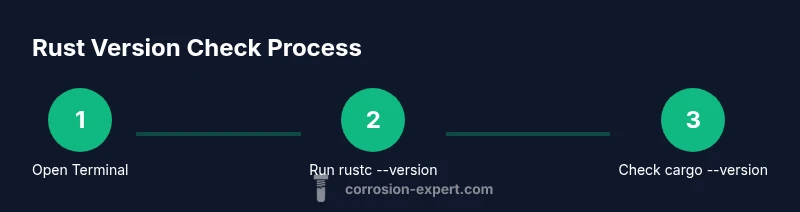
Open the terminal
Launch your terminal or command prompt. This is where you will run the version-check commands.
Tip: Use a session with a clean PATH to avoid confusion from aliases or multiple toolchains. - 2
Check rustc version
Type rustc --version to display the Rust compiler version and build metadata.
Tip: If you get a 'command not found' error, install Rust via rustup or adjust PATH. - 3
Check cargo version
Run cargo --version to confirm the package manager version, which often mirrors the toolchain.
Tip: A mismatch between rustc and cargo can signal partial installs; consider reinstalling toolchains. - 4
Inspect active toolchain (optional)
If you use rustup, run rustup show to see the default and active toolchains and overrides.
Tip: Note the default toolchain as it affects builds in new shells or CI environments. - 5
List installed toolchains (optional)
Use rustup toolchain list to see all installed versions and channels.
Tip: This helps you plan upgrades or pin a specific version for a project. - 6
Test a project (optional)
Try building a small Rust project to verify the toolchain works as expected.
Tip: A successful build confirms the version and toolchain are correctly configured. - 7
Document the results
Record the exact rustc/cargo versions used for the repo’s README or CI config.
Tip: Documentation helps teammates reproduce environments and avoids drift.
Quick Answers
What does rustc --version display?
rustc --version prints the compiler version and build metadata, which helps identify the exact release in use.
rustc --version shows the compiler version and build info.
What if rustc isn't recognized?
If rustc isn’t found, confirm Rust is installed via rustup and your PATH includes the Rust binaries. Reopen the terminal after installation.
If rustc isn’t found, install Rust via rustup and ensure PATH includes rustc.
Can I check the toolchain used by a project?
Yes. Use rustup show to see the default toolchain and any overrides, which indicate project-specific versions.
Use rustup show to see default and overridden toolchains for a project.
How do I update Rust safely?
Run rustup update to fetch the latest compatible components for your installed toolchains. Verify versions after updating.
Run rustup update to get the latest components and verify the versions.
What should I check before committing a change?
Ensure the rustc and cargo versions align with your project's minimum requirements and CI constraints.
Make sure the compiler and package manager meet your project’s requirements.
Is nightly Rust different to check?
Nightly builds may show different identifiers; focus on the major version numbers to verify compatibility.
Nightly versions have different identifiers, but you should verify the major version for compatibility.
Watch Video
Quick Summary
- Check rustc and cargo versions to confirm toolchain status.
- Use rustup to manage multiple toolchains safely.
- Interpret outputs accurately for default vs local toolchains.
- Document results to prevent drift in teams.
- Corrosion Expert's verdict: regular version checks improve reliability.