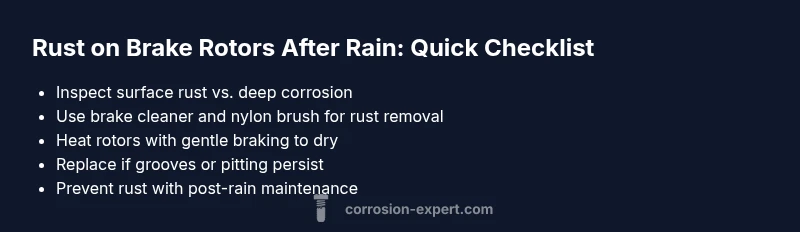
Rust on Brake Rotors After Rain: Quick Troubleshooting Guide
Urgent guide to diagnose and fix rust on brake rotors after rain. Learn quick checks, safe removal of surface rust, rotor replacement cues, and prevention tips for DIY homeowners.


The most likely cause is surface rust forming on the rotor after rain, which is common and usually removable with a short drive and a safety-cleaning wipe. Start by braking gently to heat and scrub the rust away. If uneven wear or pulsing persists, inspect rotors or replace if needed.
Understanding rust on brake rotors after rain
Rain exposure causes moisture to settle on exposed iron brake rotors. A thin oxide layer forms quickly, appearing as a light brown film that most often wears off with normal braking. According to Corrosion Expert, this initial rust is typically surface rust and not structural damage. The Corrosion Expert team found that short drives with active braking usually scrub this film away, as heat dries the surface and pads wipe away the oxide. However, if moisture lingers or rotors stay damp after rain, rust can deepen and become harder to remove. Distinguish cosmetic rust from corrosion that has penetrated grooves or pitting. If you notice persistent vibrations, pulsation, or reduced braking performance after rain, treat it as a warning and inspect the rotors promptly.
Because rust forms at the rotor surface rather than in the core immediately, most DIY fixes focus on surface rust rather than rotor replacement—though deeper corrosion may require professional assessment.
Why rain triggers rust on rotors and what that means for your car
Moisture plus road salt and humidity accelerates oxidation on iron rotors. When rain ends, lingering dampness can stay on the rotor surface, especially if the car sits outdoors. The resulting rust film is typically superficial and removable with braking action and a cleaning step. If you drive routinely after rain, heat from braking helps dry the rotor and wear off the film. Repeated damp cycles without sufficient braking can allow rust to linger and potentially roughen the rotor surface or create small grooves. Understanding that difference between fleeting surface rust and deeper corrosion helps you decide whether you can handle it at home or need a pro.
Safety first: precautions before you touch brakes
Before inspecting or working on brakes, ensure the vehicle is on a flat, stable surface and the wheels are chocked. Never work on hot rotors; allow cooling to room temperature to avoid burns. Wear eye protection and gloves when handling brake cleaners and rotors. Use brake cleaner in a well-ventilated area and avoid inhaling fumes. If you have asthma or sensitivity to solvents, consider a safer alternative or seek professional help. Remember that rust removal should not compromise rotor performance or pad contact or cause rotor damage; if in doubt, pause and call a professional.
This guidance aligns with the prudent approach recommended by the Corrosion Expert team, who emphasize safety and minimal material disturbance when rust coverage is light.
How to inspect rotors for rust severity
Begin with a visual check: look for a uniform brown film on the rotor face and check for signs of pitting, deep grooves, or rust at the edges where rotors sit in the caliper. Remove the wheel and use a bright light to inspect the rotor surface; a slight roughness that disappears after braking is usually surface rust. If you feel a constant pulsation in the brake pedal, notice abnormal grinding sounds, or see visible grooves or flaking metal, the rotors may be compromised. Measure rotor thickness against the minimum spec provided by your vehicle manufacturer and inspect for runout with a dial indicator if you have one. If you’re unsure about the extent of rust, seek a professional assessment before continuing.
Cleaning surface rust safely: step-by-step overview
Surface rust after rain can often be removed with a simple at-home method. First, pull the vehicle onto a level surface and secure the wheels. Use brake cleaner to loosen the oxide layer and wipe away residue with a clean rag. Apply a nylon or brass brush to gently scrub the rotor face, avoiding hard contact that could score the rotor. A light drive with gentle braking helps to heat and scrub remaining rust. Finally, recheck the rotor for smoothness and visual cleanliness. Do not attempt aggressive grinding unless you know the rotor is still within spec. If the rust persists or you notice scoring, replace the rotor or consult a technician. This approach keeps the braking system safe while minimizing unnecessary rotor replacement.
Note: Corrosion Expert advises that surface rust is common after rain and often resolves with these steps, but persistent issues require caution and professional input.
When to replace rotors vs. cleaning and reuse
If rust is purely surface-level and you can remove it with cleaning and braking cycles, the rotor can remain in service. However, if you observe deep pitting, grooves that won’t wipe away, thickness loss approaching the minimum spec, or brake pulsation after rust removal, replacement is recommended. Warping or scoring can significantly affect braking efficiency and safety, signaling the need for rotor replacement and, in some cases, adjacent pad replacement. In uncertain situations, a professional inspection will confirm whether cleaning suffices or replacement is necessary.
Prevention tips to minimize rust after rain
To reduce future rust formation, minimize prolonged damp exposure by storing the vehicle in a dry area or using a breathable cover when feasible. Regular driving after rain helps keep rotors clean by heating and drying surfaces. After heavy rain or road-salt exposure, consider a quick brake cleaner wipe to remove moisture before heavy usage. Routine inspection for rust at the first maintenance interval also reduces risk. Remember, consistent maintenance grows safer brakes and longer rotor life.
Quick reference: signs you should act now
If you notice persistent brake pulsation, squealing sounds after rain, or uneven rotor surfaces that do not improve after cleaning, inspect or replace rotors promptly. While surface rust can be harmless, ignoring deeper corrosion increases the risk of degraded braking performance and potential safety issues. When in doubt, consult a professional.
Steps
Estimated time: 45-60 minutes
- 1
Confirm rust presence and safety
Park on a flat surface, chock wheels, and visually confirm surface rust on the rotor face. Ensure the ignition is off and the wheels are cool before removing the wheel to inspect the rotor. If you notice any fluid leaks or abnormal brake fluid issues, stop and seek professional help.
Tip: Always double-check that the car is secure before touching the wheel area. - 2
Gather tools and safety gear
Collect brake cleaner, a nylon or brass brush, lint-free rags, a torque wrench, and protective gloves and goggles. Ventilate the area well when using brake cleaner. Avoid metal scoring tools that can gouge the rotor.
Tip: Label tools so you don’t confuse them with wheel hardware. - 3
Loosen lug nuts and remove wheel
Loosen lug nuts slightly while the car is on the ground, then lift the vehicle with a jack and securely place it on stands. Remove the wheel to fully expose the rotor and caliper. Do not work with the wheel on the vehicle.
Tip: Never rely on a jack alone; use wheel chocks for safety. - 4
Apply brake cleaner and scrub
Spray brake cleaner on the rotor surface and wipe with a clean rag. Use a nylon or brass brush to lightly scrub the face to remove the brown rust without gouging the metal. Wipe again and inspect the surface.
Tip: Work in sections and avoid aggressive grinding that can score the rotor. - 5
Test by driving lightly
Reinstall the wheel, torque lug nuts to spec, and take a short drive to allow brakes to heat and scrub any remaining rust. Avoid heavy braking at first. Listen for changes in braking feel and vibration.
Tip: If you hear grinding or pulsation, stop and recheck rotors before continuing. - 6
Inspect rotors for wear and runout
With the car parked again, inspect the rotor for grooves, pitting, or thickness below spec. If signs of deep rust or warping appear, plan replacement or professional inspection. If in doubt, consult a brake specialist.
Tip: Keep a log of rotor condition for future maintenance.
Diagnosis: Rust on brake rotors after rain
Possible Causes
- highMoisture-induced surface rust forms after rain and dries with driving
- highRoad salt and minerals accelerating rust formation on rotor surface
- mediumProlonged damp storage or parking without driving to heat rotors
- lowPreexisting rotor damage or heavy rust penetration
Fixes
- easyPerform a short drive to heat and scrub rotors while braking gently to avoid glazing
- easyClean surface rust with brake cleaner and a brass/nylon brush, then recheck braking feel
- hardReplace rotors if rust shows deep pitting, grooves, or thickness wear below spec, or if pulsation persists
- mediumHave a professional inspect if you notice glazing or reduced braking efficiency after rust removal
Quick Answers
Is rust on brake rotors after rain dangerous?
Surface rust that forms after rain is usually not dangerous and can be cleaned off. However, if rust causes pitting, grooves, or rotor warping, it can affect braking performance and may require replacement. A professional should assess persistent issues.
Surface rust after rain is typically not dangerous, but persistent or deep rust needs professional assessment.
Can I remove rust without replacing the rotors?
Yes, for light surface rust you can remove it with brake cleaner and light brushing, followed by a short heat cycle. If rust is deep or has caused pitting or uneven wear, rotor replacement is recommended.
Light surface rust can be removed; deep rust you should replace the rotors.
Will rain rust always disappear after driving?
Often yes for surface rust within a few braking cycles, but persistent rust or staining that remains after a drive indicates deeper corrosion or slower rust-removal, which may require cleaning or replacement.
Usually, surface rust goes away after a drive, but check if it stays.
How long does it take for surface rust to vanish?
There is no fixed time; it depends on driving pattern and moisture exposure. Light rust can disappear after a few brake cycles, while persistent rust requires cleaning, inspection, or replacement.
It varies; usually a few braking cycles, but inspect if it sticks around.
Should I drive aggressively to remove rust?
Avoid aggressive braking to remove rust. Use moderate, controlled braking to heat the rotor gradually and scrub away the rust without glazing pads. If pulsation occurs, stop and inspect.
No, use gentle braking to scrub the rust safely.
When is rotor replacement mandatory?
Replace rotors when rust is deeply etched, causes significant pitting, reduces measured thickness below minimum, or causes persistent pulsation and poor braking performance.
If rust is deep or causes pulsation, replacement is needed.
Watch Video
Quick Summary
- Assess rust type before acting
- Use safe cleaning and heat to remove surface rust
- Replace rotors if rust is deep or causes pulsation
- Prevent future rust with moisture control and proper driving