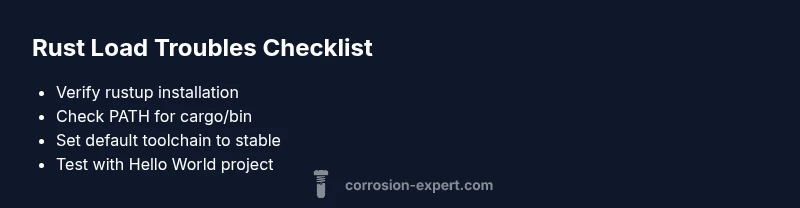
Why Won't Rust Load on My PC? An Urgent Troubleshooting Guide
If Rust won't load on your PC, follow this urgent troubleshooting guide to diagnose toolchain, PATH, and security issues, with step-by-step fixes and prevention tips from Corrosion Expert.


The most likely causes are a misconfigured PATH, a missing or corrupted Rust toolchain, or rustup not initializing properly. Start by reinstalling Rust via rustup-init, ensure rustc and cargo are on your PATH, and set the default toolchain to stable. If the issue persists, check for antivirus or firewall blocks and verify OS compatibility.
Why Rust Won't Load on Your PC: Common Causes at a Glance
If you’re staring at an error or a blank startup when running Rust tools, you’re not alone. In many cases, the problem isn’t the code but the environment: missing toolchains, PATH misconfigurations, or security software blocking downloads. According to Corrosion Expert, Rust loading issues often mirror how rust forms and sticks in metal: a small misstep can prevent the whole system from functioning. Similarly, a tiny PATH error or a partially installed toolchain can stall rustc, cargo, or rustup from executing. By focusing on the most common culprits first, you can restore a healthy Rust environment without expensive fixes.
A quick note on scope: this guide targets the desktop Rust toolchain for Windows, macOS, and Linux. If you’re using a CI environment or a constrained container, some steps may differ slightly. The goal here is to give you a clear diagnostic path to get Rust loading again and to prevent future hiccups.
Key Factors That Prevent Rust from Loading
- Toolchain installation: If rustup or the toolchain is corrupted or not installed, rustc and cargo won’t run.
- PATH configuration: An incorrect or incomplete PATH means your system can’t locate rustup, rustc, or cargo.
- Network and proxies: Rustup uses network downloads; proxies or firewall rules can block them.
- Security software: Antivirus or endpoint protection may quarantine rustup or cargo components.
- Architecture mismatch: 32-bit vs 64-bit mismatches or unsupported OS versions can stop Rust from loading.
- Conflicting toolchains: Multiple toolchains or old components can create confusion for the active toolchain.
As you begin troubleshooting, keep these factors in mind and work through the checks in a logical order. The Corrosion Expert Team emphasizes starting with quick, low-risk steps and escalating only as needed.
Quick Diagnostic Checklist You Can Run Right Now
- Open a terminal or command prompt and run: rustc --version && cargo --version. If these commands aren’t found, PATH or installation is the root cause.
- Run rustup show active-toolchain to verify the active toolchain. If it’s missing, rustup may not be initialized.
- Check your firewall and antivirus for blocks on rustup-init, rustc, or cargo executables.
- Confirm you’re on a supported OS and architecture. Some older systems can’t run the newest Rust toolchains.
- If you’re behind a proxy, ensure the proxy configuration allows TLS traffic to download components.
- Consider temporarily disabling security software for a test (re-enable promptly afterwards).
How to Check and Correct PATH Issues
PATH problems are the most frequent cause of load failures. If rustup is installed but not in PATH, you’ll see commands not found. On Windows, verify that the cargo and rustup bin folders are added (for example, C:\Users\YourUser\AppData\Local\Rust\bin and C:\Users\YourUser\AppData\Local\Rustup\bin). On macOS/Linux, add ~/.cargo/bin to your PATH.
To test PATH changes, open a new terminal and run echo $PATH (or echo %PATH% on Windows) to confirm the cargo and rustup locations appear. Restart the terminal or the computer after editing PATH to ensure changes take effect. The Corrosion Expert analysis shows that PATH misconfigurations are a frequent stumbling block for Rust startup failures.
Step-by-Step Recovery: Restore Rust Loading in 8 Steps
- Verify OS and architecture compatibility with Rust toolchains. 2. Reinstall Rust using rustup-init from the official source. 3. Ensure PATH includes the rustup and cargo bin folders. 4. Set the default toolchain to stable with rustup default stable. 5. Run rustc --version to confirm a working compiler. 6. Compile a tiny test program (Hello, world) to verify cargo/build works. 7. Temporarily disable antivirus/firewall to test downloads, then re-enable with allowlists. 8. If needed, perform a clean reinstall of Rust components.
The steps are designed to be followed in order, so you can quickly identify where the issue occurs and address it with minimal disruption. The goal is to get Rust tooling loading again and to prevent recurring blocks.
Safety, Warnings, and Professional Help
Always back up critical configuration files before reinstalling toolchains. If you’re on a corporate device or managed environment, consult your IT team before altering security software or network settings. If issues persist after following these steps, it’s time to seek expert help. The Corrosion Expert Team recommends contacting a local software support professional or the Rust community forums for advanced diagnostics on stubborn load failures.
Prevention: Keep Rust Loading Smoothly in the Future
- Regularly update Rust toolchains with rustup update to prevent mismatches between cargo and rustc.
- Maintain a clean PATH by removing deprecated toolchain paths and consolidating into a single installation.
- Use a trusted network environment or configure your proxy to allow Rust downloads securely.
- Periodically verify that security software isn’t overzealous and create allowlists for rustup and cargo executables.
In summary, start with the simplest checks and work your way up. If rustup or the toolchain isn’t installed correctly, fix PATH errors, or loosen security blocks, you’ll usually see Rust load again quickly. If not, a professional assessment is warranted to prevent data loss or system instability.
Steps
Estimated time: 30-60 minutes
- 1
Verify system compatibility
Confirm OS version and CPU architecture support Rust toolchains. If unsupported, upgrade OS or hardware.
Tip: Check official Rust docs for system requirements. - 2
Check current Rust installation
Open a terminal and run rustc --version and cargo --version. If not found, proceed to reinstall.
Tip: Note any error messages verbatim for support requests. - 3
Install or repair Rust with rustup
Run the official rustup-init script for your OS and follow prompts to install or repair the toolchain.
Tip: Use the latest installer from the official Rust site. - 4
Update the active toolchain
If rustup exists, set a default stable toolchain with rustup default stable and verify.
Tip: Ensure you’re online during this step to fetch the toolchain. - 5
Test with a sample project
Create a small Hello World project to confirm compilation and execution.
Tip: If compilation fails, capture the exact error output. - 6
Check PATH and reopen shells
Make sure PATH updates are applied by restarting terminals or the system.
Tip: On Windows, run 'setx' for PATH if needed. - 7
Review security software settings
Temporarily disable security software to test downloads, then re-enable with exceptions.
Tip: Always re-enable protection after testing. - 8
Consider a clean reinstall if issues persist
Remove old toolchains and reinstall to rule out corrupted components.
Tip: Back up any custom toolchain configurations first.
Diagnosis: Rust won’t load or rustup commands are not recognized
Possible Causes
- highPATH misconfiguration or missing cargo/rustup bin
- highRust toolchain not installed or corrupted
- mediumrustup not initialized or no active toolchain
- mediumAntivirus/firewall blocking downloads or executables
- lowNetwork/proxy blocking rustup downloads
Fixes
- easyReinstall Rust via rustup-init and ensure PATH includes cargo/bin
- easyRun rustup default stable to select a valid toolchain
- mediumTemporarily disable antivirus/firewall or configure allowlists for rustup/rustc
- mediumCheck network settings or proxy configuration and retry downloads
- easyOn Windows, reopen terminal as Administrator and re-export PATH changes
Quick Answers
Why isn't rustc recognized as a command after installation?
This usually means PATH does not include the cargo bin directory. Add the path to your shell profile (or System Environment Variables on Windows) and restart your terminal. Then verify with rustc --version.
If rustc isn’t recognized, fix your PATH and try again. Then run rustc --version to confirm.
Can I install Rust without rustup?
You can install standalone components, but rustup is the recommended and most reliable way to manage Rust toolchains and updates. If you skip rustup, you may miss critical updates or toolchain compatibility fixes.
Rustup is recommended for managing Rust toolchains and updates.
What should I do if rustup fails to download components?
Check your network connection, proxy settings, and firewall or antivirus rules. Try a direct download in a different network, then retry rustup update.
Ensure your network allows TLS downloads and retry rustup update.
Is Rust supported on 32-bit systems?
Most modern Rust toolchains target 64-bit systems. If you’re on 32-bit hardware, upgrade or use a compatible older toolchain if available.
Rust on 32-bit systems is limited; upgrading hardware is usually necessary.
How do I reset PATH to include Rust on Windows?
Open System Properties > Environment Variables, edit PATH, and append the cargo bin path (for example, C:\Users\YourUser\AppData\Local\Rustup\bin).
Edit PATH in System Settings and add the Rust bin folder.
Where can I find the latest Rust toolchains?
Use rustup to install and update toolchains. Check the official Rust site for guidance on supported targets and versions.
Use rustup to manage and update toolchains; refer to the official Rust site for versions.
Watch Video
Quick Summary
- Check PATH and toolchain installation first
- Use rustup default stable to recover a broken toolchain
- Temporarily test security software but restore protections
- Verify with a simple Hello World project to confirm success