How to Host a Rust Server: Step-by-Step Guide
Learn how to host a Rust game server with security, performance, and reliability in mind. Step-by-step setup, tools, backups, and maintenance tips for 2026.


Goal: Host a Rust server for friends or a small community. You can choose local, VPS, or cloud hosting, and you'll need a compatible OS, a stable internet connection, and proper firewall rules. The Corrosion Expert recommends starting with a modest setup, enabling automated backups, and planning for maintenance to keep the server secure and responsive.
Choosing the Right Hosting Approach
Hosting a Rust server starts with selecting the right platform. You can run it locally on a home network, deploy to a virtual private server (VPS), or opt for a cloud-based instance. Each option has trade-offs in cost, control, latency, and maintenance. For small groups or friends, a modest VPS with steady bandwidth is a common starting point; for larger communities, a cloud solution with autoscaling offers resilience. According to Corrosion Expert, beginning with a modest, controllable environment reduces risk while you learn the ropes. Evaluate your target player count, regional latency, backup needs, and your time for upkeep. Documented plans make it easier to scale later. When selecting hosting, prioritize uptime guarantees, support responsiveness, and network routes to your region. After you choose an approach, set clear expectations for players about expected latency, restarts, and updates to avoid frustration.
Hardware and Network Prerequisites
Before you install anything, define the hardware and network foundation. For a Rust game server, you want enough CPU cores to handle simulation, adequate RAM for player load, and sufficient network bandwidth to prevent lag. Plan for headroom during peak play and a fast disk for quick world saves. In practice, small servers can run on a mid-range VPS; larger communities should consider dedicated hardware or cloud instances with scalable resources. Ensure your hosting environment offers a public IP, low latency to your target region, and reliable power and cooling. A static DNS name and an open port strategy help players connect consistently. Security begins with a minimal surface: disable unused services, enable a firewall, and limit administrative access to trusted addresses. If you’re hosting from home, check your upstream speed, router capacity, and upstream latency; you’ll likely need port forwarding for the game port and the management port.
Installing the Rust Server Software
The first step is obtaining the official server software from the trusted source and verifying its integrity. Create a dedicated user on your server to isolate game services from other processes, then install required dependencies (like a modern C++ runtime, libraries for networking, and a compatible shell). Download the server package, extract it into its own directory, and review the default configuration. Create a simple run script that starts the server with your chosen options (world size, seed, and player limit). Perform an offline dry run to ensure the executable launches without errors, then gradually enable live players in a controlled test. Maintain a clean file structure and document every configuration change for future updates.
Security and Backup Best Practices
Security should never be an afterthought. Start with a hardened firewall profile that only opens ports essential for gameplay and administration. Use SSH keys for remote access, disable password login, and restrict access to trusted IPs. Regularly update the server and any plugins to patch known vulnerabilities. Implement an automated backup strategy that creates periodic world saves and database backups, and store copies offsite or in a separate cloud bucket. Test your restoration process to ensure you can recover quickly after a failure. Consider enabling DNS-based protection and anti-DDoS features provided by your hosting provider to shield against common attacks.
Performance Tuning and Modding
Performance tuning focuses on resource allocation, network efficiency, and stability. Allocate resources based on expected concurrency and player activity, ensuring you have headroom for peak times. Minimize unnecessary background services and remove poorly maintained plugins that cause lag or crashes. If you’re using mods or custom plugins, vet them for compatibility with the current game version and each other to prevent conflicts. Enable logging at a conservative level to diagnose issues without flooding disk space. Regularly review performance metrics, like CPU load and memory usage, and adjust parameters as your player base grows.
Maintenance Routine: Updates and Monitoring
A predictable maintenance routine keeps a Rust server reliable. Schedule regular checks for software updates, world data integrity, and plugin compatibility. Monitor server logs for unusual activity, connection errors, or crashes, and set up alerting to notify you when issues occur. Maintain a changelog of updates and configuration changes so you can roll back if something breaks. Corrosion Expert analysis shows that automated backups paired with timely updates dramatically reduce downtime and data loss, especially during major game patches. Keep your monitoring culture consistent: set expectations for maintenance windows and communicate changes to players ahead of time.
Troubleshooting Common Issues
Connectivity problems often stem from misconfigured ports, firewall rules, or DNS settings. Start by validating that the server is reachable on the intended port from multiple networks and that the firewall allows only the necessary traffic. If players report lag, investigate server load, memory usage, and the efficiency of mods. Crashes typically indicate plugin incompatibilities, memory leaks, or disk I/O bottlenecks; review recent changes and revert if needed. If you encounter persistent issues, test with a clean server instance to isolate the cause, then reintroduce elements one by one. Document troubleshooting steps to streamline future incidents.
Final Considerations: Ready, Set, Launch
Launching a Rust server is a learning journey rather than a one-off task. Start with a small player group to validate stability, then gradually invite a broader audience as you confirm performance and reliability. Establish a clear runbook for updates, backups, and incidents. Keep your players informed about planned downtime and expected improvements. The Corrosion Expert team recommends maintaining a proactive stance on updates, backups, and security so your Rust server remains accessible and enjoyable for everyone.
Tools & Materials
- A compatible hosting environment (local, VPS, or cloud)(Ensure it meets minimum performance and bandwidth requirements for your expected player count)
- Operating system with remote management(Linux is preferred for server stability; Windows is possible with proper tooling)
- Stable, low-latency internet connection(Unmetered or generous data plans help with peak times)
- Firewall and security basics (SSH keys, restricted ports)(Lock down admin access and open only necessary ports)
- Rust server software from official source(Verify integrity and authenticity before installation)
- Backup solution and storage(Automated, offsite backups protect against data loss)
- Monitoring and logging tools(Helpful for spotting issues early and analyzing performance)
- Documentation and runbook(Record configurations, changes, and troubleshooting steps)
Steps
Estimated time: 2-4 hours
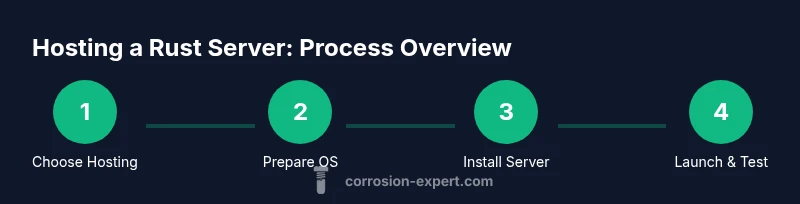
- 1
Decide hosting plan
Evaluate local, VPS, and cloud options based on expected players, latency, and maintenance capability. Choose the approach that balances cost and reliability for your target group.
Tip: Start with a modest plan and scale up later as needed. - 2
Prepare OS and environment
Set up the chosen OS, create a dedicated user for the server, and install essential packages. Harden the environment with SSH keys and a basic firewall.
Tip: Document initial setup to simplify future refreshes. - 3
Install and configure server software
Download the official Rust server files, verify integrity, and place them in a dedicated directory. Create a run script with baseline settings and test-launch the server.
Tip: Test with a non-production dataset first. - 4
Open ports and secure networking
Configure firewall rules to allow only the necessary ports for gameplay and management. Set up a stable DNS entry and verify accessibility from multiple networks.
Tip: Avoid exposing admin interfaces publicly. - 5
Set up backups and monitoring
Enable automated world backups and monitor server health with logs and alerts. Verify restore procedures to ensure quick recovery.
Tip: Test backups regularly, not just after installation. - 6
Launch, test with players, and iterate
Open the server to a small group, collect feedback, and adjust settings for latency, stability, and gameplay experience. Plan for regular maintenance windows.
Tip: Keep a changelog and communicate updates to players.
Quick Answers
What is the best hosting method for a Rust server?
There's no one-size-fits-all answer. Start with a modest VPS or cloud instance to balance cost and reliability, then scale as the player base grows. Consider latency to players and your ability to maintain the system.
Start with a modest VPS or cloud instance and scale as needed, keeping latency and maintenance in mind.
Do I need a powerful computer to run a Rust server?
Not necessarily. You can host on a VPS or cloud server that provides the resources you need; running from a home PC is possible for small groups but may require excellent upstream bandwidth and reliable power.
You can host on a VPS or cloud server; home hosting works for small groups if you have strong internet and power.
How often should I back up a Rust server?
Backups should be performed regularly, especially after world-changing events or updates. Maintain automated backups and periodically test restorations to ensure data integrity.
Backups should be done regularly and you should test restores to make sure you can recover quickly.
What security measures are essential for a Rust server?
Use SSH keys for remote access, restrict admin interfaces, enable a firewall, keep software up to date, and monitor logs for suspicious activity.
Use SSH keys, keep software updated, and monitor logs for suspicious activity.
Which ports should I open for a Rust server?
Open only the ports required for gameplay and administration, and secure them behind a firewall or VPN. Verify port accessibility from multiple networks.
Only open the ports needed for gameplay and administration and secure them.
Can I run a Rust server from home?
Yes, but ensure your ISP allows hosting, have ample upstream bandwidth, and use port forwarding thoughtfully. A cloud hosting plan often provides better uptime and support.
Yes, you can host at home if your ISP allows it and you have good bandwidth; otherwise, cloud hosting is more reliable.
Watch Video
Quick Summary
- Choose a hosting approach early to balance cost and reliability
- Secure the server with firewalls, SSH keys, and regular updates
- Back up world data automatically and verify restoration
- Monitor performance and adjust resources as the player base grows