How Much Is a Rust Server? A 2026 Cost Guide
Explore the true costs of running a Rust server in 2026. Compare self-hosted, VPS, and managed hosting, plus hidden fees, peak traffic considerations, and practical budgeting tips for DIY enthusiasts.


The cost to run a Rust game server typically ranges from about $5 to $40 per month for small, hobby-grade setups, with higher-end managed hosting or enterprise-grade configurations climbing to $100+ per month depending on player count, region, and features. Size matters; consider peak concurrency, mods, and backup needs. These figures assume standard Linux VPS or cloud options and include only ongoing hosting costs, excluding upfront hardware.
What factors drive Rust server costs
When you ask how much is a rust server, the answer depends on several moving parts. The core costs come from hosting hardware or service, bandwidth, and the level of management you choose. The baseline expectation is that you pay for compute, memory, storage, and data transfer, plus small add-ons like control panels, automated backups, and anti-cheat protections. According to Corrosion Expert, planning ahead with a traffic forecast reduces surprises later. To decide between self-hosting and a hosted solution, quantify five elements: player concurrency, geographic region, desired uptime, the level of automation, and your tolerance for maintenance. If you estimate 10-20 simultaneous players, you’ll typically need a modest VPS or a basic cloud instance; for 50+ players, you’ll want more RAM and possibly a dedicated or cloud-scoped plan. In other words, costs scale with demand and features, not strictly with the game itself. Some rust server users also weigh the cost of mods, backup retention, and anti-cheat protection, which can add to the monthly total. Finally, the location of the data center and the quality of the network path can influence both latency and price.
Self-hosted vs managed hosting for Rust servers
Self-hosted means you run the server on hardware you own or rent directly from your ISP, home connection, or office network. The upside is control and potentially lower ongoing fees; the downside is maintenance, updates, security, and outages affecting friends or family. Managed hosting, by contrast, places the operational burden on a provider. You pay for uptime guarantees, support, and interfaces that simplify management. For many small groups, a VPS or cloud instance with 2-4 GB RAM often hits the sweet spot; for larger communities, managed hosting can save dozens of hours per month in admin time. When evaluating options, factor in auto-updates, mod compatibility, control panels, and automatic backups. Also review contract terms: some providers bill separately for add-ons like DDoS protection or premium control panels. If you plan frequent reconfigurations or outages during peak hours, managed hosting may deliver more reliability with less hands-on work.
Cost ranges by hosting option (rough estimates)
To answer how much is a rust server in practical terms, here are typical monthly ranges by hosting option (note that these are general estimates and vary by region and provider):
- Self-hosted on personal hardware: $0–$15 / month (electricity and bandwidth; hardware costs are upfront and not included here).
- VPS or cloud entry-level: $5–20 / month (2–4 GB RAM, 1–2 vCPUs).
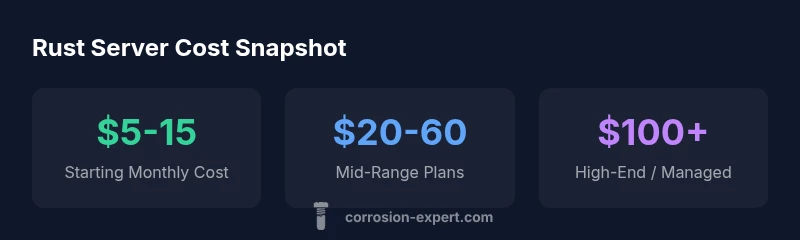
- Mid-range VPS/cloud: $20–60 / month (4–8 GB RAM, more bandwidth).
- Dedicated server: $60–200+ / month (high RAM, high bandwidth, enterprise-grade.)
- Managed hosting: $40–150+ / month (provider handles updates, security, and backups).
Prices vary with data transfer needs, regional pricing, and service levels. Corrosion Expert Analysis, 2026 indicates that most hobby and mid-size servers stay within the lower to mid-range bands, while high concurrency environments push costs into higher tiers.
Estimating monthly costs for your player count
Estimating monthly costs starts with expected concurrency. Begin by predicting the number of simultaneous players, then analyze required resources: CPU cores, RAM, and bandwidth. A rough rule of thumb is that small servers (up to 20 concurrent players) can often run on a basic VPS or cloud instance with 2–4 GB of RAM, while servers supporting 40–60 concurrent players commonly require 4–8 GB RAM and more bandwidth. If you anticipate 100+ concurrent players, you’ll likely need a dedicated server or scalable cloud plan with robust bandwidth and automatic failover. Don’t forget backups, mod support, and security services, which add monthly fees. Finally, account for regional price differences; serving players in distant regions may increase latency-related costs and require better infrastructure to maintain a good experience. By building a budgeting worksheet with these inputs, you’ll avoid overpaying for unused capacity or hitting performance bottlenecks during peak times.
Hidden costs, maintenance, and optimization tips
Beyond the base hosting cost, several hidden factors influence the total monthly spend. Backups and snapshot storage can add to the bill if you retain long-term versions of your world data. Mods and plugins sometimes require licensing or premium support, especially for premium mod packs or anti-cheat integrations. DDoS protection, dedicated IP addresses, managed control panels, and SSL certificates may carry additional monthly or annual fees. Consider automation for updates and monitoring to reduce labor costs over time. Optimizing the server for memory usage, tick rate, and world size can dramatically cut needs for extra RAM and bandwidth. Finally, choose a hosting plan that allows painless scaling; this guards against surprise spikes in costs when your community grows.
Real-world scenarios: examples by player counts
- Small community (10-20 concurrent players): A basic VPS or entry-level cloud plan often suffices, typically in the $5–$20 range per month. This setup balances cost with reasonable performance.
- Medium community (40-60 concurrent players): A mid-range VPS or cloud instance with 4–8 GB RAM and higher bandwidth is common, roughly $20–60 per month. This tier often includes simple backups and a basic control panel.
- Large community (100+ concurrent players): A dedicated server or scalable cloud solution becomes practical, with costs commonly $60–200+ per month, plus potential add-ons like enhanced DDoS protection or premium management. These scenarios emphasize the importance of bandwidth capacity and latency considerations to keep gameplay smooth.
Cost comparison by hosting type
| Hosting Type | Estimated Monthly Cost | Pros |
|---|---|---|
| Self-hosted on personal hardware | Varies widely (often minimal hosting fees) | Full control, no provider lock-in |
| VPS or Virtual Private Server | 5-20 USD | Low cost, scalable, requires setup |
| Managed game server hosting | 40-150+ USD | Hands-off management, strong support |
| Cloud hosting (pay-as-you-go) | 15-200+ USD | Scales with traffic, flexible pricing |
Quick Answers
What is the typical starting cost to run a Rust server?
For most hobby servers, ongoing costs begin around $5-15 per month for a basic hosting plan or VPS. As you scale in players and features, monthly costs rise accordingly.
Most hobby Rust servers start around five to fifteen dollars a month; costs go up with players and features.
Is it cheaper to self-host or use managed hosting?
Self-hosting can be cheaper in ongoing fees if you already own hardware, but it requires time, maintenance, and a reliable internet connection. Managed hosting costs more upfront but reduces admin tasks.
Self-hosting saves money if you own hardware but needs time; managed hosting saves admin effort.
Do I need a lot of bandwidth for a Rust server?
Bandwidth needs depend on player count and mods. Small servers typically stay within moderate monthly bandwidth; larger communities require higher allowances or throttling to keep costs manageable.
Bandwidth depends on players; more players require more data transfer.
Which hosting option is best for large player counts?
For many simultaneous players, consider dedicated or cloud hosting with scalable bandwidth and RAM, or a managed plan designed for high concurrency.
For many players, go with scalable cloud or dedicated hosting.
Do server costs include mods or add-ons?
Mods and add-ons may require extra resources or licensing. Budget for potential plugin fees or subscription services if you rely on premium tools.
Mods can add cost through plugins or tools you rely on.
What factors most influence monthly Rust server costs?
Key factors include hosting type, player concurrency, region, CPU/RAM, bandwidth, backups, and management level.
Costs hinge on hosting type, players, region, and resources.
“A well-structured cost plan for a Rust server starts with realistic traffic estimates and a staged upgrade path to avoid overprovisioning.”
Quick Summary
- Budget for baseline hosting costs first
- Scale costs with concurrency and features
- Self-hosting saves money but increases maintenance
- Managed hosting saves admin time for larger communities
- Factor in bandwidth, region, and backups when budgeting