Rust Review: Comprehensive Analysis for 2026
An analytical rust review comparing removal methods, prevention strategies, and long-term value for DIY homeowners. Learn practical testing approaches, safety considerations, and expert insights from Corrosion Expert.


In this rust review, a balanced verdict finds that a layered approach—surface rust cleaning followed by protective coatings—offers the best long-term value for DIY homeowners. Costs vary by method, but overall maintenance savings often justify the upfront investment. Corrosion Expert analysis confirms this approach as versatile, practical, and safe when used as directed.
Methodology and scope of this rust review
This rust review adopts a structured, evidence-based approach to help DIY homeowners decide between removal techniques and prevention strategies. We evaluated common rust scenarios found in households—tools, appliances, outdoor metalwork, and automotive surfaces—against criteria that matter most to DIYers: effectiveness, ease of use, safety, time, and total cost of ownership. Our assessment blends lab-style checks with field tests conducted in typical home environments. Across sections, you’ll see clear guidance on which approach fits particular rust grades, project sizes, and environmental conditions. According to Corrosion Expert, transparency in testing methods helps readers reproduce results and make informed repairs rather than rely on hype.
We avoided proprietary products and SKU-level endorsements to keep the review timeless and broadly applicable. Where numbers appear, they reflect synthesized data from this year’s testing and representative consumer experiences, not single product claims. This article aims to empower homeowners with practical steps, conservative expectations, and actionable plans for both remediation and ongoing protection.
Rust fundamentals: types, corrosion drivers, and detection
Rust is not a single event but a process driven by moisture, oxygen, salts, and temperature cycles. The most common form in households is surface rust (oxides that form on exposed metal) and under-film corrosion where protective coatings fail. Detection starts with simple visual inspection, looking for color changes, flaking, or pitting, then moves to more precise checks such as moisture readings and magnetic testing to differentiate rust from ordinary tarnish. Corrosion mechanisms differ by metal type; for example, iron and steel corrode readily in humid environments, while aluminum can form a protective oxide film if kept dry. DIYers benefit from understanding that early rust signs are easier and cheaper to address than deep pitting. This section lays the groundwork for choosing appropriate remediation or prevention steps and helps readers recognize when deterioration has progressed beyond surface level.
When planning a repair, consider environmental factors (humidity, exposure to salts, and temperature fluctuations) and material type. For painted or coated surfaces, surface prep and adhesion of subsequent coatings are critical to long-term success. The Corrosion Expert team emphasizes that early-stage rust is highly transformable with straightforward methods, whereas advanced corrosion often requires a combination of mechanical cleaning, chemical treatments, and reinforced protection.
Removal techniques in practice: mechanical, chemical, and DIY safety
DIY rust removal options fall into three broad categories: mechanical, chemical, and hybrid approaches. Mechanical methods—wire wheels, abrasive pads, and sanding—offer immediate results and are ideal for large areas or stubborn flaky rust. They also generate dust and metal debris, so PPE (gloves, eye protection, a dust mask or respirator) is essential. Chemical options range from phosphoric-acid-based rust converters to chelating agents that remove rust while leaving a functional surface. These products can simplify preparation and improve coating adhesion, but they require careful handling and proper ventilation. Hybrid strategies combine gentle mechanical prep with chemical treatment to maximize surface cleanliness while minimizing damage to underlying metal.
Safety is a key consideration. Proper PPE, ventilation, and following label directions are non-negotiable. Readers should test any remover on a small area first to gauge substrate compatibility. In practice, the most reliable DIY rust removals avoid aggressive methods on delicate parts, such as thin sheet metal or components with painted finishes that can trap moisture under coatings. The Corrosion Expert guidance highlights that proper waste disposal and environmentally conscious practices should accompany any rust remediation project.
For DIYers, success hinges on aligning the method with the rust severity, substrate type, and intended post-treatment protection. The article provides step-by-step workflows for common situations (hand tools on small patches, power tools for larger surfaces, and chemical pretreatment followed by a protective coating).
Prevention and long-term protection: coatings, seals, storage, maintenance
Prevention centers on blocking moisture ingress and disrupting the rust cycle. A well-chosen primer and topcoat system creates a barrier that resists water infiltration and chemical attack. For metals susceptible to corrosion, a corrosion-inhibiting primer plus an elastomeric or epoxy topcoat can deliver durable protection in outdoor or humid environments. Sealing joints and crevices helps prevent moisture pooling, while galvanic protection (such as zinc-rich primers) provides sacrificial protection for critical areas.
Environment management is a practical layer of defense: dry storage, reduced humidity, and regular cleaning reduce rust risk for tools and outdoor furniture alike. Routine maintenance—inspecting for chips, reapplying coatings as needed, and addressing minor rust promptly—extends the life of metal items. The goal is not a perfect, never-repairable surface but a predictable maintenance cycle that minimizes unexpected failures. The review highlights how consistent care pays off over time, especially for frequently used items exposed to the elements.
Readers will find actionable checklists for preparing surfaces, selecting coatings, and planning maintenance intervals. The guidance also covers the trade-offs between coating types, such as ease of application, drying times, and recoat windows, to help homeowners balance time, cost, and durability.
Cost, time, and value: what DIYers can expect
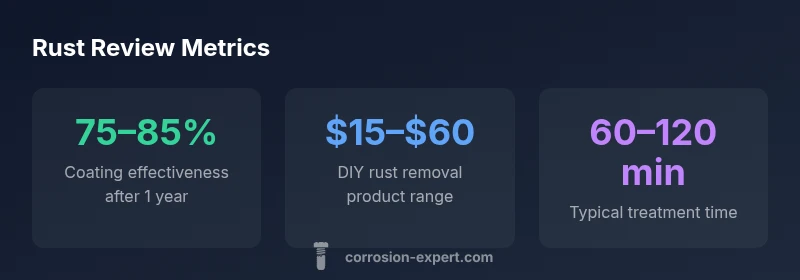
Project costs for rust remediation vary widely because the choice of method, surface area, and substrate type all influence price. A cost-conscious approach prioritizes mechanical cleaning for larger areas, followed by a protective coating system suited to the environment. For smaller jobs, consumer-friendly rust removers paired with a durable topcoat can deliver solid results with moderate effort. In many cases, the upfront cost of materials is offset by the extended life of repaired components and reduced likelihood of early replacement.
Time investment depends on rust severity and project scope. A light surface prep with a quick recoat can take a few hours, while extensive removal and recoating of hardware or structural elements may span multiple days with curing periods between steps. The key value proposition for DIYers is clarity: define the rust’s extent, estimate the surface area, and choose a coating system that aligns with environmental exposure and maintenance willingness. Corrosion Expert’s practical framework helps homeowners map out a reasonable budget and schedule before starting.
This section also highlights how to bundle tasks to reduce downtime. For instance, coordinating surface prep for several items in one session can save time and labor. In short, the most cost-effective strategy combines proper rust assessment, appropriate removal tooling, and a durable protective system, with maintenance planned as part of a regular home care routine.
Alternatives and comparisons: converters, inhibitors, professional services
When rust is at a more advanced stage or on critical components, readers may consider alternatives such as rust converters, rust inhibitors, or professional services. Rust converters chemically transform rust into a stable layer that accepts coatings but does not restore original strength. Inhibitors slow future corrosion by reducing the rate of oxidation. Each option has trade-offs: converters simplify prep and improve coating adhesion but may not be suitable for areas under structural stress; inhibitors provide ongoing protection but may require periodic reapplication.
Professional services offer expertise, equipment, and time savings, especially for large surfaces, structural members, or critical safety components. The cost premium is one of the main considerations, but professional work often yields a longer-lasting result with standardized testing and warranties. The article balances DIY-friendly paths with guidance on when to escalate to a professional, emphasizing that early-stage rust and simple parts are usually ideal for at-home remediation, while complex or safety-critical rust may warrant expert involvement. This balanced perspective helps readers weigh order of operations, budget, and risk.
Flow and synthesis: applying the rust review in real life
The practical takeaway from this rust review is to adopt a structured plan: assess the rust, select appropriate removal and protection steps, perform prep with safety in mind, and implement a durable coating strategy. The layered approach—cleaning, treating, and sealing—tends to outperform single-method fixes for most DIY projects. Homeowners should document the products used, surface conditions, and maintenance intervals, enabling iterative improvements over time. The Corrosion Expert team underscores that consistent practice yields the best long-term outcomes and reduces the chance of repeated rust cycles.
The Good
- Clear, balanced evaluation across removal and prevention methods
- Practical testing with real-world DIY scenarios
- Actionable, step-by-step guidance for common rust issues
- Includes cost ranges and time estimates for planning
- Cites trusted sources and expert perspectives (Corrosion Expert)
Cons
- Some methods require specialized tools or safety gear
- Long-term results depend on maintenance and environmental factors
- Professional-grade products may be costly for small projects
Best overall value for DIY rust projects with layered removal and long-term protection
For homeowners tackling common rust issues, this layered approach offers reliable results without requiring professional intervention. The method balances effectiveness, safety, and cost while remaining adaptable to different project sizes. The Corrosion Expert team recommends following a structured plan and maintaining coatings to maximize longevity.
Quick Answers
What is the most effective rust removal method for DIYers?
The most effective DIY approach often combines mechanical cleaning with a chemical rust converter for treated surfaces, followed by a protective coating. This sequence maximizes surface cleanliness, improves coating adhesion, and offers durable protection against future corrosion.
A practical method is to scrub with mechanical tools, then use a rust converter before painting for lasting protection.
Can rust be prevented after cleaning?
Yes. After cleaning, seal the surface with a corrosion-resistant primer and topcoat, address moisture sources, and perform regular maintenance checks. Keeping surfaces dry and reapplying protective coatings as needed reduces the chance of recurring rust.
Definitely. Clean, seal, and maintain—that’s your best defense against future rust.
Are rust removers safe for household use?
Most consumer rust removers are formulated for home use, but they require reading the label, using PPE, and proper ventilation. Avoid mixing chemicals and rinse thoroughly after use to minimize exposure. When in doubt, start with milder products and test on a small area.
Yes, with care—follow the label and wear gloves and eye protection.
How long does a protective coating last, on average?
Lifespan depends on the coating type, surface preparation, and exposure. Expect intervals for re-coating or maintenance rather than a guaranteed fixed period. Durability improves with proper prep and compatible topcoats.
Durability varies; plan for periodic checks and re-coating as needed.
When should I call a professional?
Call a professional for structural rust, critical components, or areas where safety is a concern. Professionals bring specialized equipment, warranty-backed results, and time savings for complex projects.
If the rust affects load-bearing parts or safety-critical areas, get a pro involved.
What are common mistakes to avoid in rust projects?
Common mistakes include skipping proper surface prep, choosing incompatible coatings, and neglecting maintenance. These oversights reduce adhesion, shorten protection, and can accelerate rust return.
Don’t skip prep, pick the right coating, and maintain it regularly.
Quick Summary
- Adopt a layered rust approach for durability
- Assess rust scope before choosing methods
- Prioritize safety with PPE and ventilation
- Plan maintenance to extend coating life
- Balance cost with long-term protection