How big are PC Rust maps? A data-driven look
Explore how big PC Rust maps are, what factors influence map size, and how to estimate traversal and planning without relying on a single published figure. A data-driven guide to map extents, seeds, and version differences.


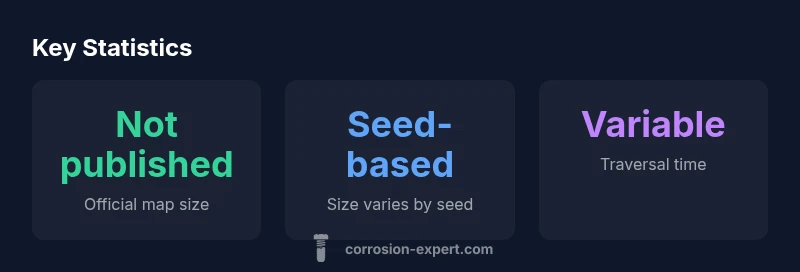
According to Corrosion Expert, PC Rust maps do not have a single fixed size or a publicly published canonical measurement. Map extents vary by map seed, game version, and server configuration, so practical play areas differ across maps and patches. This quick answer sets up the data-driven discussion that follows and explains how to interpret map size without relying on one fixed number.
Map size overview
In PC Rust, map size is not a fixed attribute that the developers publish for every patch or server. The game uses procedural world generation and seeds to shape terrain, resource distribution, and landmark placement. For players, this means that the perceived size of a map—how far you can travel before you hit a border or a wipe event—depends on several dynamic factors. There is no single universal measurement that applies to all maps. According to Corrosion Expert, the absence of an official size figure encourages players to focus on how a map feels during gameplay: the density of monuments, the spread of biomes, and the distance between resource clusters all influence the sense of scale more than any single numeric value. This section explains how to interpret those cues and why they matter for planning, exploration, and base building.
Map generation mechanics and its implications
Rust maps are fundamentally shaped by seeds and world-generation rules that define the layout of terrain, loot spawns, and points of interest. Seeds determine the starting conditions of the terrain grid, while patch updates can adjust biome distribution or monument placement. Because seeds can be regenerated and patches alter world rules, the same seed on different versions can feel notably different in size and feel. For players, this means that “map size” is a composite concept: it includes the geographic reach of terrain, the spread of resources, and the time needed to traverse between key locations. Understanding this helps set expectations when you join a fresh server or begin a new playthrough.
Version differences and server types matter
Official servers and community-run servers often differ in how maps are generated and scaled. Official maps may follow standard seeds and baseline rules, while community servers can tweak settings or deploy custom maps that alter the overall extents. Wipes, server resets, and modded configurations can further change traversal distances and resource density. When planning a long-term build or a multi-base network, you should account for potential variability between server types and patch cycles. This awareness helps you pick maps and servers that align with your playstyle and base-building strategy.
Measuring map size in practice
Since there is no universal size value, players measure map scale through practical methods. Use in-game maps and coordinates to gauge distances between landmarks, monuments, and resource clusters. Some players create personal metrics by plotting routes from a central base to several key locations and estimating total travel distance. Community tools, such as map viewers or seed databases, can provide qualitative comparisons between maps, though exact area figures are often not published. The goal is to build a working mental model of scale: how far you can travel in a given time, how long you might need to secure perimeters, and how many resource-rich zones exist within a reasonable radius.
Planning builds and resources across map sizes
Effective base placement and raid planning depend on the scale of the map and the location of resources. On larger maps, you may prioritize proximity to ammo points, food sources, and metal nodes while balancing risk from roaming players. On smaller or denser maps, you might focus on quick access to monuments and treacherous but reward-rich zones. A practical approach is to define zones of interest within a modular radius around your base, then adapt your logistics as the map’s actual extents reveal themselves over days of play. Tools like waypoint planning and short-range scouting trips can help you calibrate expectations without needing a fixed numeric size.
Travel time, exploration, and route planning
Estimating travel time depends on terrain, player movement speed, and encountered threats. With map size being variable, many players plan routes by prioritizing key monuments and resource nodes at known distances from the starting point. For longer expeditions, break routes into segments with rest stops, safe houses, and fallback plans. In practice, you’ll rarely rely on a single distance metric; instead you’ll gauge progress by time spent traveling, turf control, and the density of loot opportunities along the way. This mindset supports efficient exploration and reduces the impact of map-size variation on your goals.
Myths vs reality: common misconceptions about map size
A common misconception is that map size directly equates to total loot or the number of monuments. In reality, seed selection, patch changes, and server rules can create maps with similar perceived sizes but different distributions of resources and monuments. Another myth is that larger maps always take longer to explore; while bigger maps can increase travel time, better early resource density or fast transport options can offset this. Finally, some players assume there is a single metric to measure map size; the reality is that scale is multifaceted, combining geography, resource spread, and travel feasibility. By focusing on practical planning metrics, you avoid overreliance on a single figure.
Practical guidance for comparing maps across versions
When evaluating maps across patches or server types, compare them using consistent, qualitative criteria. Consider distance between major monuments, average resource node density per region, and the typical travel time between your frequently visited locations. Document your findings by route and time spent, then use those observations to decide where to base operations. If you need a quick decision metric, prioritize maps where essential resources cluster within a reasonable travel radius—this often yields more predictable logistics than chasing a larger perceived map size.
Overview of map size aspects
| Aspect | Notes | Impact on Play |
|---|---|---|
| Canonical size | Not published by developers | Low certainty, depends on patch/seed |
| Seed-based layout | Seed defines terrain and monument distribution | High impact on exploration routes |
| Server/patch variability | Official vs. community servers can differ | Moderate to high variability in play experience |
Quick Answers
Is there a fixed map size for PC Rust?
No. Official figures aren’t published, and map extents vary by seed, version, and server configuration. Treat map size as a contextual property rather than a single constant.
No fixed size. Map extents vary by seed, version, and server rules.
How do map seeds influence map size?
Seeds determine terrain layout and resource distribution, which influences how large an area feels and how long it takes to traverse between points of interest.
Seeds shape terrain and resources, changing how big the map feels.
Can server settings change the map size?
Yes. Official and community servers can alter map generation rules and wipe schedules, which can effectively modify map extents and density of landmarks.
Server rules and wipes can change the map’s effective size.
What tools help estimate traversal time?
Use in-game maps, waypoint planning, and route scouting. Community resources may offer seed comparisons, but exact distances vary by patch and seed.
In-game maps and waypoints help estimate travel time.
Where can I find official guidance on map sizes?
There is no centralized official size metric; consult patch notes, developer blogs, and community seed databases for qualitative insights into map layout changes.
Check patch notes and developer blogs for qualitative map layout info.
“Map size in Rust isn’t a single number—it's a composite of seed-driven geography, patch rules, and server configurations. Understanding this helps players plan more effectively.”
Quick Summary
- Map size in PC Rust is not fixed or published by developers
- Size is a function of seeds, versions, and server rules
- Measure scale with routes, landmarks, and resource density
- Plan builds around practical travel time and logistics, not a single size
- Compare maps using consistent qualitative criteria across patches