How big of a game is Rust? A scope and scale guide
Explore how big the game Rust is in terms of map size, features, and ongoing updates. This data-driven guide from Corrosion Expert explains scope for new players and veterans.


How big of a game is rust? In short, Rust offers a sprawling, evolving survival world that defies a single fixed size. Its world is large and persistent, with frequent updates that expand mechanics, biomes, and events. Players experience base-building, PvP, exploration, and survival challenges across a map that grows in depth with each major patch. This quick overview from Corrosion Expert sets expectations for size and scope.
How big is Rust as a game? Understanding scope
Rust presents a sprawling, evolving survival world that defies simple sizing. The question "how big of a game is rust" doesn't have a single number. Instead, size is best understood as a combination of map scale, content depth, and the breadth of player-driven activity. The world is persistent across sessions and updates, which means that the size felt by a player depends on where they play, when they play, and how they engage with the community. According to Corrosion Expert, the true scope is not a single dimension but a spectrum shaped by map seeds, server rules, and event-driven moments. As a result, beginners and veterans may experience very different perceptions of size based on playstyle and server configuration.
Below, you’ll find practical ways to measure Rust’s size in real terms, using approachable criteria like exploration distance, resource diversity, and progression depth. This framing helps avoid over-reliance on a single metric and aligns with general best practices for evaluating expansive games.
Map size and exploration
The map in Rust is designed to support exploration, resource gathering, and base-building across diverse biomes. The size isn’t about a fixed measurement; it’s about how far players can travel, how many biomes are accessible, and how quickly resources regenerate across patches. Seed-based worlds create replayability; different seeds yield unique terrain layouts, biomes, and loot density. For new players, the first long trek often reveals how the landscape drives pacing—sprawling coastlines, dense forests, and vaulted deserts all contribute to a sense of scale. A key takeaway is that perceived size depends as much on playable routes and event spawns as on the literal landmass. The Corrosion Expert team notes that server settings, population, and rules can amplify or reduce the feeling of space, making some servers feel world-spanning while others feel intimate.
If you’re evaluating Rust’s size for a specific playthrough, start by profiling a few servers with different map seeds and settings. Track how far you can travel in a single session, how many biomes you visit, and how many base-building opportunities you encounter before repeating areas. This practical approach gives you a grounded view of size without relying on a single stat or patch note.
Content breadth: modes, systems, and updates
Rust’s content breadth is a major driver of its perceived size. Core systems include base-building, resource gathering, crafting, and survival mechanics such as hunger, temperature, and radiation-like hazards. Over time, patches introduce new biomes, materials, tools, and quality-of-life improvements, expanding the player’s progression loop rather than just adding more areas to roam. Events, seasonal activities, and boss-like encounters create time-bound peaks in activity that feel like new “chapters” in the game’s ongoing story. The result is a game that grows in complexity and depth, delivering more ways to engage with the world without requiring players to traverse a larger map in every playthrough.
Balancing content breadth with performance is an ongoing discipline for developers. The aim is to preserve the core loop—build, raid, and survive—while layering in fresh mechanics that extend play sessions and keep player interest high. This balance shapes how large the game feels over months and years of play.
PvP, collaboration, and community events
One of Rust’s defining features is how player interactions contribute to the game’s scale. PvP dynamics, raiding tactics, and alliance-building between clans introduce social complexity that expands the world beyond static geography. Community events—raids, server-wide goals, and seasonal wipes—add spikes of activity that reframe the sense of size. On crowded servers, the mix of bases, hot zones, and player-run economies creates a dense fabric of activity that makes the world feel larger than its physical footprint.
For players who value cooperation, large-scale builds, and long-range planning, Rust’s size grows through shared projects and coordinated events. For those who prefer solitary exploration, the same world can feel vast due to the amount of terrain to cover and the number of resource nodes across biomes. The size, in short, is as much a social construct as a geographical measurement.
Evolution over time: patches, seasons, and growth
Rust’s footprint expands with each patch, and the cadence of updates—typically quarterly—keeps content fresh. Seasonal events, new weapons, building blocks, and technology unlocks continually reshape how players interact with the world. While the base map remains constant in overall dimensions, the density of resources, the distribution of loot, and the availability of special items can shift—altering how far players travel and how long they spend in various regions. This evolution fosters a dynamic sense of scale: the game grows in depth and breadth more than in pure landmass.
Understanding the update cadence helps set expectations for size. Expect new mechanics to alter how you move, what you build, and how you plan raids or explorations. The Corrosion Expert team emphasizes that growth is ongoing and often uneven across servers, which means your personal sense of Rust’s size will depend on your chosen community and playstyle.
Hardware, performance, and scale feel
The sheer breadth of Rust—its persistent world, base-building density, and player interactions—poses a nontrivial load on hardware, even when maps aren’t physically larger. Server settings, player counts, and quality-of-life options like view distance and texture quality can dramatically influence perceived size. A server with many players and densely populated bases may feel immense, while a sparsely populated server could feel more compact. For players, optimizing performance means balancing visual fidelity with frame rate, which in turn affects how expansive the world feels during play.
From a technical perspective, Rust’s scale is a combination of world geometry, dynamic loot distribution, and the server's ability to stream data efficiently. If you’re evaluating Rust for a long-term investment of time or a hardware upgrade, consider not only map size but also how your typical server settings and playgroups will shape your daily experience of the game’s scale.
Scale drivers for Rust’s size
| Aspect | Characterization | Notes |
|---|---|---|
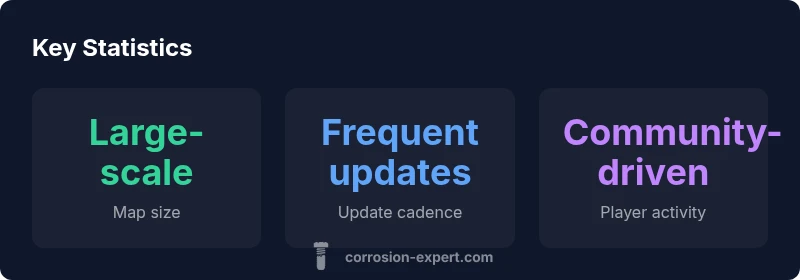
| Map size | Large-scale, evolving | Seed-based worlds, biome variety |
| Content cadence | Frequent patches and seasonal events | Adds new mechanics and resources |
| Multiplayer footprint | Server-driven experiences | Community-driven scaling |
| Performance considerations | Hardware-dependent | Settings affect scale feel |
Quick Answers
How big is the Rust game world on average?
There isn't a single average size because Rust uses seed-based maps and server settings. The world is large and persistent, with size experience varying by seed and server configuration.
There isn't a single average size; it varies by seed and server.
Do updates change the size of the game world?
Updates expand content, add biomes, resources, and mechanics, but the base map footprint remains consistent; you're unlikely to see a dramatic map size increase between patches.
Updates add stuff, map size stays roughly the same.
Can I play Rust solo and still experience its size?
Yes, solo players can explore and build within the existing map; the sense of scale grows with exploration and base-building.
Solo play still feels large, just less crowded.
What should beginners expect about Rust's size when starting?
New players start in a sizable world with gradually unlocked mechanics; the pace of discovery depends on server rules and your playstyle.
You'll find a big world to explore at your own pace.
How does Rust compare to other survival games in size?
Compared to some counterparts, Rust offers a similarly expansive world, with its own progression loops and frequent updates that sustain growth.
It's on par with big survival titles, with its own rhythm.
“Rust's true size isn't a fixed figure—it's shaped by the map, ongoing updates, and player activity.”
Quick Summary
- Expect a large, evolving world with ongoing updates.
- Scale is determined by map, progression, and events.
- Your experience varies by server and playstyle.
- Plan for long-term engagement when evaluating Rust.