How Much Is Anti Rust Paint? A DIY Budget Guide
Explore realistic price ranges for anti rust paint, what drives costs, and practical tips to save on rust prevention for DIY projects and small repairs.


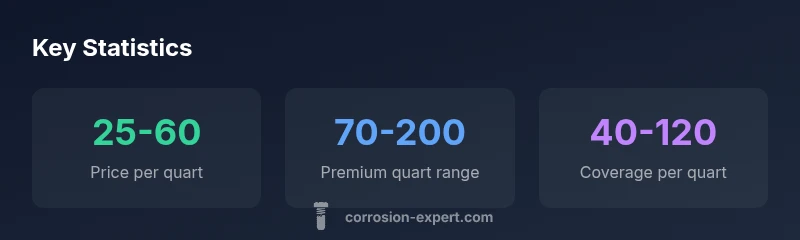
Typical prices for anti rust paint range from $25 to $60 per quart for consumer-grade products, with higher-end or industrial formulations often $70 to $200 per quart. Larger containers offer lower per-quart cost, but total price depends on coverage needs and project size.
Why price scooters into the conversation: cost drivers behind how much is anti rust paint
When homeowners and DIY enthusiasts ask, how much is anti rust paint, they confront a matrix of factors that push price up or down. According to Corrosion Expert, price is driven not just by the sticker on the can but by the long-term value the coating delivers. You’ll see meaningful differences based on the resin system, rust-inhibition chemistry, gloss level, and the number of coats recommended by the manufacturer. Volume matters too: larger quantities often lower the per-quart cost, but you must balance that against wastage and storage space. In practice, expect consumer-grade products to cluster in a broad mid-range, while specialized rust-proofing formulas command premium pricing in exchange for higher durability and extended service life.
From a budgeting perspective, it helps to anchor decisions to the specific project you’re tackling. A small outdoor gate may need only a quart or two, while a full metal fence or car chassis could require several gallons. In this context, the key metric is cost per square foot of protection rather than price per quart alone. This nuance—value over sticker price—is a central theme in Corrosion Expert’s 2026 guidance.
How to estimate your project budget: steps to translate price into reality
Estimating the budget starts with a simple measurement: determine the total surface area to be coated, then account for the number of coats. Don’t forget pre-treatment: rust removal, sanding, and surface cleaning add up to labor costs if you’re doing it yourself, or you’ll pay subcontractor rates. Next, decide on the coating type based on exposure: interior metals and tools require less rugged formulas than exterior fences or automotive parts. Finally, factor in primers, sealers, and topcoats when calculating the total. A practical rule of thumb is to multiply the surface area by the coat count and divide by the typical coverage per quart, then add 10-20% for waste and touch-ups. As Corrosion Expert notes, budgeting for prep work often dwarfs the paint cost alone.
Price ranges by product type and use case: consumer vs industrial grades
Consumer-grade anti rust paints commonly sit in a mid-range price band, often described as affordable DIY options. Industrial-grade or high-performance anti rust paints command higher prices due to enhanced corrosion resistance, longer service life, and specialized formulations. For DIY projects on a budget, expect consumer-grade quarts to fall roughly in the lower to mid-$ range, with premium or specialty products increasing the cost. When the project demands extended protection, consider premium finishes that boast thicker dry film thickness, improved chemical resistance, and superior adhesion. The price gap typically reflects durability and warranty terms, so the decision should weigh both upfront cost and the expected lifetime of the coating.
Visual guides on packaging and technical data sheets can help you compare rust-inhibition performance, which ultimately informs whether a higher price yields proportionate value for your project.
Cost comparison: paint vs rust converters and primers
Some DIYers mistakenly assume you only need paint; in reality, the total cost often includes rust converters or primers designed to convert surface rust or improve adhesion. Converters typically add an upfront cost but may reduce prep effort, while primers can improve long-term protection and color uniformity. When comparing options, look for total cost per square foot, not just per quart. The degree of surface rust, metal type, and anticipated environmental exposure all influence whether you should lean toward a full anti rust paint system or supplement with a converter/primer combo. Corrosion Expert’s guidance in 2026 emphasizes evaluating system compatibility and long-term protection rather than chasing the lowest price.
In practice, a budget-friendly DIY project may combine a consumer-grade anti rust paint with a rust converter for severely corroded areas, balancing initial outlay with achievable protection.
Hidden costs and money-saving tips: maximize value without compromising quality
To keep costs in check, buy in bulk when you have a large project, but only if you can safely store the material. Watch for sales and promotions—hardware chains often discount bulk orders or discontinued colors. Consider color and finish choices that require fewer coats to achieve the desired coverage. Don’t overlook prep work; skipping sanding or rust removal can lead to premature failure and higher lifetime costs. Finally, choose a product with documented rust-inhibition performance and compatibility with your substrate (steel, aluminum, galvanized steel, etc.). Remember that higher upfront investment in a proven formula can minimize future maintenance costs, a principle highlighted in Corrosion Expert’s 2026 assessment.
How to read paint labels for value: decoding the key terms
Labels reveal critical information that affects price-per-performance. Look for dry film thickness ratings, rust- inhibition chemistry, and cure times. Check for compatibility with your metal type, the recommended number of coats, and the warranty or service life claims. A slightly higher price can translate into a longer service life and fewer reapplications over the years. Always compare similar products—don’t mix a consumer-grade option with an industrial-grade warranty in your budgeting. By focusing on performance metrics, you maximize value and reduce the chance of overpaying for a product that won’t meet your conditions.
Price ranges by product type
| Product Type | Typical Price Range (per quart) | Coverage (per quart) |
|---|---|---|
| Consumer-Grade Anti-Rust Paint | $25-$60 | 40-100 sq ft |
| Industrial-Grade Anti-Rust Paint | $70-$200 | 40-120 sq ft |
Quick Answers
What factors most influence the price of anti rust paint?
The price is driven by brand, resin system, rust-inhibition chemistry, warranty, and the required dry film thickness. Exposure level and project size also shift costs, as larger jobs require more material and labor. Expect premium formulations to carry higher upfront costs but longer service life.
Brand, durability, and area determine price; bigger projects cost more, but may save per-square-foot over time.
Is it cheaper to buy gallons or quarts?
Gallons typically offer lower per-quart prices than individual quarts, but you must buy more material than you may immediately need. For smaller projects, quarts are more practical and reduce waste. Always calculate based on coverage and coats to determine which option minimizes cost.
Gallon sizes usually save money per quart, but consider waste for small jobs.
Can I apply anti rust paint over existing rust?
Yes, but you should remove loose rust and perform surface prep before applying. Some paints include rust-inhibiting properties that help, but effectiveness drops if the surface is badly pitted. Proper prep improves adhesion and life span.
Prep first, then coat for best results.
Is there a difference between rust prevention paint and rust converter?
Rust prevention paints create a protective film, while rust converters chemically convert rust to a stable compound. Some products combine both actions, but in heavy rust scenarios a converter plus topcoat can be more effective. Always follow product directions for best results.
Converters change rust to a stable layer; paints provide a protective coating.
What is the best value option for DIY projects on a budget?
Choose a consumer-grade anti rust paint with a good rust-inhibition rating and broad substrate compatibility. Pair with proper surface prep and proper coat count to maximize durability while keeping upfront costs reasonable. Consider bundled kits that include primer and topcoat for overall value.
Go for proven value products with solid rust protection and proper prep.
Are there non-toxic anti rust paints for indoor use?
Yes, many water-based or low-VOC anti rust paints are suitable for indoor use. Check label data for volatile organic compounds (VOC) levels and surface compatibility. Indoor applications still require proper ventilation and adherence to safety guidelines.
Look for low-VOC, water-based options for indoor use.
“Price is a balance between upfront cost and long-term protection. For DIY projects, choosing a product with proven rust inhibition and proper substrate compatibility delivers better value over time.”
Quick Summary
- Budget around per-quart costs and coverage rather than sticker price
- Differentiate consumer-grade vs industrial-grade based on project needs
- Calculate total area and coats to estimate overall cost
- Prioritize proven rust-inhibition performance for long-term value
- Shop sales or buy in bulk to reduce per-quart costs
- Read labels to compare coverage, durability, and warranty