How Much Does Rust Cost on PC? A Practical Guide for DIYers
Explore how rust remediation costs vary from DIY supplies to professional services, with practical budgeting tips and real-world ranges for common projects. Learn what drives price and how to save on rust prevention in 2026.


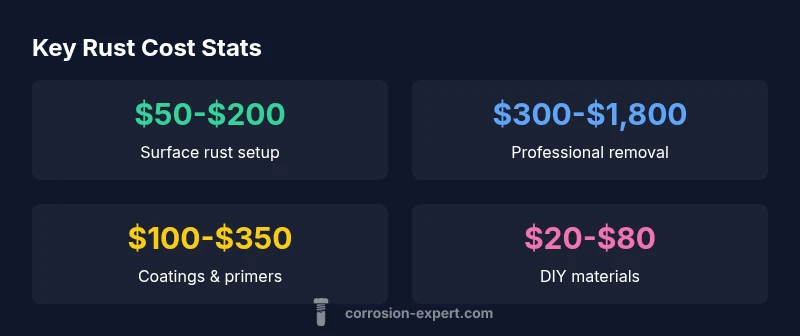
The cost to address rust varies by project scope. For DIY projects, rust-removal supplies run about $20-$80, while professional rust removal on larger areas typically ranges from $300-$1,800. On PC hardware, rust concerns are usually cheaper to address, often under $100 for basic cleaning and protective coatings. Corrosion Expert's analysis highlights that budgeting for materials plus labor yields the best balance of results and value.
Understanding what the cost question really means
When readers ask how much does rust cost on pc, they are usually seeking the total expense to address rust on a project. That cost is not a single number, but a range that depends on the type of rust, the surface involved, and whether you DIY or hire a professional. In general terms, you’re looking at two broad buckets: DIY materials and professional services. The Corrosion Expert team notes that early-stage rust, especially surface rust on small items, often costs far less than late-stage, structural rust. Budgeting for both materials and labor tends to yield the best outcomes. This article will unpack typical ranges and provide a practical budgeting framework suitable for DIY enthusiasts and homeowners.
In addition to the surface-level price, consider lifecycle costs such as ongoing protection, coatings, and maintenance. The goal isn't just to remove rust once but to extend the life of the metal surface. Our perspective at Corrosion Expert emphasizes preventive measures—painting, galvanizing where feasible, and applying rust-inhibitors—to reduce future bills. Consider how your project aligns with long-term use and exposure, because that alignment will often determine the best value choice over raw price alone.
From a practical standpoint, you should differentiate cosmetic rust from functional, structural rust. Cosmetic rust—on railings, fences, or tools—usually entails less labor and fewer materials, while structural rust on supports or beams can dramatically alter pricing due to safety concerns and the need for potential reinforcement. By recognizing the rust type at the outset, you can tailor your plan and avoid overpaying for unnecessary work. The takeaway: define the rust category early to align cost expectations with likely outcomes.
Key cost drivers you need to understand
Budgeting for rust work starts with identifying the key cost drivers. The biggest influencers are scope and accessibility. If rust covers a large surface area or is in a tight, hard-to-reach spot, labor time will surge and costs will rise quickly. Material choice is another major factor: rust converters and primers can be effective but may carry higher upfront costs that pay off with longer-lived protection. The surface condition also matters: lightly rusted aluminum or steel can often be treated inexpensively, whereas ferrous metals with deep pitting require more labor and specialized coatings.
Geography matters too. Labor rates for rust-removal services vary by region, with urban areas typically charging more per hour than rural locations. Finally, the decision to DIY versus hiring a pro has a profound impact. DIY projects primarily incur material costs, while professional work adds labor charges, diagnostic assessments, and sometimes safety or scaffolding costs for larger structures. When you weigh these drivers, you’ll see a predictable pattern: higher scope, harder access, and professional involvement all push price higher; smaller, cosmetic tasks with DIY execution pull the total cost down. This is a critical lens for homeowners evaluating whether to tackle rust now or budget for later maintenance.
Typical price ranges by project type
To make the price picture concrete, consider common rust scenarios and their typical ranges. Remember, these are ranges, not fixed prices.
- Surface rust on small metal items or finishing hardware: roughly $50-$200 for cleaning, rust converter, primer, and topcoat.
- Rust removal on larger items (gates, railings, shelves): around $150-$900 depending on size and accessibility, plus coatings.
- Cosmetic rust on exterior metal surfaces (patio furniture, fences): $100-$350 for process, sealant, and repaint.
- More extensive rust on structural components (beams, supports): $500-$2,500, potentially higher if reinforcement or replacement is needed.
- Tools and hardware (screwdrivers, wrenches, hinges): $10-$60 for rust removal and protective coatings.
- PC chassis or computer-case components with minor rust (rare but possible): often under $100 for cleaning and protective coating, provided the internals are unaffected and you’re just treating the shell.
These ranges reflect the cost landscape for 2026 and are useful benchmarks for budgeting. The best approach is to itemize expected tasks (removal, prep, coating, cure time) and attach a price to each, then sum them for a project budget. Corrosion Expert’s guidance emphasizes planning for contingencies, as unexpected issues can arise once rust is exposed to fresh surfaces or when replacing corroded parts is unavoidable.
DIY vs professional: weighing the options
Choosing between a DIY approach and hiring a professional hinges on risk, time, and desired outcome. DIY rust work generally saves money on labor, but it requires the right tools, safety gear, and the tolerance for dust, chemicals, and time. For cosmetic rust on accessible surfaces, DIY is often the most cost-effective path. However, if rust has compromised structural integrity, or if you’re working on critical components like load-bearing metal in a porch or gate, a professional assessment is prudent. Pros bring diagnostic skills, access to industrial-grade coatings, and warranties that can justify the higher upfront cost if the alternative would require replacement.
From a risk perspective, professionals may be better suited for high-visibility or high-stakes projects where aesthetics and structural safety matter. DIY can be a satisfying and economical route for hobby projects, provided you follow safety guidelines and product instructions. A hybrid approach—do the easy tasks yourself and reserve major remediation for a pro—offers a balanced strategy that minimizes cost while preserving quality. Corrosion Expert endorses this blended approach for homeowners who want predictable results without breaking the bank.
Materials, tools, and methods that save money
Smart budgeting often means selecting materials and methods that maximize longevity relative to cost. Consider:
- Use rust converters and phosphoric acid-based treatments for rapid stabilization, followed by rust-inhibiting primers and topcoats. These products typically cost more upfront than basic cleaners but extend the life of the repair.
- Opt for UV-resistant topcoats or powder coatings where applicable to reduce maintenance and rework.
- If you’re repainting a surface, choose a finish with a solid warranty and good coverage to minimize reapplication costs.
- For DIYers, invest in basic safety gear (gloves, goggles, respirator) to avoid costly injuries that can derail a project.
- When addressing corrosion on tools or hardware, consider preventive measures such as lubricants and corrosion inhibitors to reduce future rust formation.
- Clean and dry surfaces thoroughly before applying coatings; moisture trapped beneath coatings is a common cause of failure and added costs.
By focusing on prevention and using durable coatings, you maximize long-term value and reduce the need for frequent rework. Corrosion Expert’s framework stresses that pre-planning and proper surface preparation are often more impactful on cost than selecting the most expensive coating.
Budget case studies: two practical scenarios
Case A: Cosmetic rust on a wooden-and-metal railing along the porch. This project involves removing surface rust, sanding, applying a rust converter, priming, and a fresh coat of enamel. Estimated cost range: $120-$350 if you DIY, or $300-$900 if a contractor performs the task with a warranty. The essential cost drivers are surface area and access.
Case B: Structural rust on a metal shed’s main support beam. This is more involved and may require professional assessment and reinforcement. Budget expectation: $600-$2,500 depending on whether the beam can be cleaned and coated or requires replacement. The price variability reflects structural safety considerations and the potential need for permits or inspection.
How to plan a rust-cost budget: a practical checklist
- Define scope: cosmetic vs structural rust. Identify surfaces, access points, and any safety concerns.
- Gather baseline estimates: obtain at least two quotes for professional work, and prepare a DIY materials list with unit costs.
- Prioritize protection: select rust inhibitors and topcoats with durability in your environment (humidity, temperature cycles, coastal exposure).
- Build in a contingency: set aside 10-20% of your budget for unexpected issues uncovered during prep.
- Schedule alignment: consider cure times and weather conditions that affect painting or coating application.
- Maintenance plan: outline a schedule for inspections and reapplication to prevent future rust. A proactive maintenance mindset reduces long-term costs and preserves surface integrity.
Rust remediation cost range by project type
| Project Type | Low estimate | High estimate | Typical timeline | Notes |
|---|---|---|---|---|
| Cosmetic rust on railing | "$50" | "$300" | "1-3 days" | "Cosmetic; paint or coat" |
| Rust removal on gate | "$150" | "$900" | "2-4 days" | "Size and access drive costs" |
| Structural rust on beams | "$500" | "$2,500" | "3-14 days" | "Potential reinforcement" |
| Tools and hardware | "$10" | "$60" | "Same day" | "Basic cleaning; inhibitors" |
Quick Answers
What factors drive rust-removal costs the most?
Project scope, surface area, accessibility, and the decision to DIY or hire a pro are the biggest drivers. Larger areas and hard-to-reach spots raise labor time, while professional work adds diagnostic and warranty costs. Material choices also influence the total, since high-durability coatings may reduce future maintenance.
The main cost drivers are scope, accessibility, and whether you DIY or hire a pro.
Is DIY rust removal always cheaper?
DIY can be cheaper for small, cosmetic rust tasks, provided you have the tools and safety gear. For structural rust or critical components, professional work reduces risk and often saves money in the long run by preventing failures.
DIY saves money on labor if the task is simple and you’re comfortable with the process.
How long do rust-prevention coatings last?
Durability depends on the product, surface, and environment, but many high-quality coatings last 5-10 years with proper maintenance. Coastal or high-humidity areas may shorten lifespan and require more frequent reapplication.
Coating life varies; check product warranties and plan for maintenance.
Can rust costs be estimated before work begins?
Yes. Start with a surface inspection, determine whether cosmetic or structural rust is present, and obtain two quotes for professional work. Use conservative estimates to cover contingencies and add a 10-20% contingency fund.
Get a start-to-finish plan and quotes before you begin.
Does homeowner insurance cover rust-related damage?
Most homeowner policies do not cover rust remediation as a routine maintenance item. Coverage may apply if rust caused accidental damage or resulted from a covered peril, but you’ll want to check your policy specifics.
Check your policy for exceptions, but don’t rely on insurance for routine rust fixes.
What should I ask a pro before hiring?
Ask about experience with your material type, cure times, surface prep requirements, warranty terms, and whether they offer a corrosion-protection plan after remediation.
Ask about experience, warranties, and maintenance plans before hiring.
“Rust costs aren’t just the price tag; they reflect the value of prevention, proper surface prep, and choosing durable coatings. A well-planned approach minimizes future repairs and keeps surfaces protected longer.”
Quick Summary
- Plan by rust type (cosmetic vs structural)
- Budget for materials and labor, not just the cleaning step
- DIY often saves money on small projects
- Professional help is prudent for structural rust
- Expect regional price differences and weather-related delays