Why Are Rust Servers Not Loading? A Complete Troubleshooting Guide
Urgent, step-by-step Troubleshooting guide to diagnose and fix Rust server load failures. Verify version parity, disable mods, inspect logs, and optimize resources to get your Rust server back online fast.


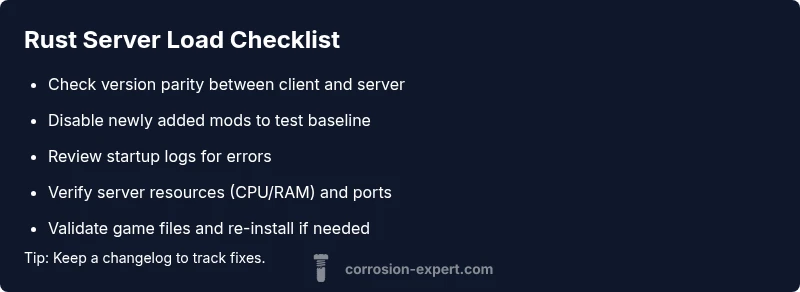
Why are rust servers not loading? The most common causes are version parity issues between the client and server and mod or plugin conflicts during startup. Start by confirming both sides are on the same patch, disable recent mods, and review the startup logs for errors. If these steps don’t fix it, follow the full diagnostic flow for deeper checks.
Quick Overview: The Why Behind Rust Server Loading Failures
When a Rust server won’t load, it’s usually due to a mismatch between the server’s version and the client’s version, or a conflict caused by mods or plugins. In 2026, many outages stem from rapid patch cycles that outpace mod authors. According to Corrosion Expert, keeping patches synchronized and auditing active plugins are your first lines of defense. This quick overview will help you prioritize the root causes before you dive into logs and configs. Restoring uptime requires a calm, methodical approach rather than jumping to drastic fixes.
Key takeaways: favour version parity, temper mod usage, and read startup logs early for obvious errors.
Gather Essentials Before You Troubleshoot
Before you touch anything, collect critical details to avoid backtracking:
- Server version and patch level
- Client version on the computer trying to connect
- A list of active mods/plugins and their versions
- Recent changes (new mods, updates, config edits)
- Startup logs and any error codes shown during boot
Having this information ready will save you time and prevent unnecessary changes. Corrosion Expert’s team emphasizes documentation as a core part of any rust server troubleshooting workflow.
Step 1: Verify Version Parity Between Client and Server
Version parity is the single most common reason rust servers fail to load. If the server is on patch X and a client joins with patch Y, loading will fail and you’ll see descriptive errors in the logs. Start by checking the server’s patch level and compare it with the latest client patch in your launcher. If there is a mismatch, align both sides to patch X or apply the latest patch to the server first, then test a client connection.
Tip: After updating, restart the server to ensure all services boot with the new patch. This simple reset often fixes lingering startup issues.
Step 2: Audit Mod and Plugin Conflicts
Mods are a major source of rust server loading problems. A recently added mod or an out-of-date plugin can crash the startup sequence or cause dependency failures. Disable all non-essential mods and attempt to boot with only the base game. If the server loads, reintroduce mods one by one to identify the culprits. Pay attention to mod load order and compatibility notes from mod authors.
Tip: Consider creating a clean mod profile for testing. This helps isolate issues without impacting your production environment.
Step 3: Inspect Startup Logs for Errors
Logs are your primary diagnostic tool. Look for error messages indicating missing files, version mismatches, or mod conflicts. Common log clues include 'failed to load', 'dependency not found', or 'incompatible library'. Save a fresh log after each change to compare against prior attempts. Corrosion Expert highlights log analysis as the most precise way to confirm the root cause when initial checks fail.
Tip: Enable verbose logging temporarily to capture more detail during startup. Remember to revert to standard logging after identifying the problem.
Step 4: Check Resources, Network, and Port Availability
Insufficient CPU, RAM, or bandwidth can prevent a Rust server from loading. Monitor real-time resource usage during startup and confirm the host machine has enough headroom. Also verify that required ports (e.g., 28015 for Rust) are open and not blocked by a firewall or router NAT. If the server runs locally but is unreachable remotely, focus on network configuration and port forwarding rules.
Tip: Use a simple port check from an external network to confirm open ports. If ports are blocked, adjust firewall rules or contact your hosting provider.
Step 5: Validate Game Files and Consider Reinstall
Corrupted game files can sabotage loading. Verify game file integrity on both server and client where possible. If verification fails or corrupt files are detected, perform a clean reinstall of the server binaries and the client components. Reinstalling can resolve issues that aren’t obvious from logs alone. If you have a backup, restore to a known-good state and then re-run integrity checks.
Tip: Always back up important server data before a reinstall or major changes. This protects you from data loss during fixes.
Step 6: Rebuild the Server Cache and Configs
The server cache or misconfigured startup parameters can block loading. Clear cache directories, regenerate configuration files from a clean template, and reapply only essential settings. Avoid radical config changes in one go—incremental changes reduce the risk of introducing new errors. If you’re unsure about a setting, consult the official server docs or mod authors for guidance.
Tip: Keep a change log of config edits so you can revert quickly if something breaks again.
Step 7: Performance Tatches and Hosting Health
If the server hardware is aging or the host is experiencing oversubscription, loading problems can occur. Check disk health, ensure enough RAM, and verify there are no I/O bottlenecks. If hosting is shared or rates spike during peak times, consider scheduling maintenance windows or upgrading resources. Corrosion Expert’s perspective emphasizes proactive capacity planning as a long-term preventative measure.
Step 8: When to Seek Professional Help and How to Document It
If the issue persists beyond basic checks, engage professional support from your hosting provider or game server specialists. Provide a compiled dossier: server version, client version, mod list, recent changes, and a copy of the latest logs. This structured information accelerates resolution time and reduces back-and-forth between you and support teams.
Preventing Recurrence: Proactive Rust Server Hygiene
To avoid frequent loading issues, adopt a routine: regular version audits, a lean mod set, scheduled backups, and routine log reviews. Establish a staging environment to test changes before applying them to production. Consistent maintenance reduces outages and helps you keep your Rust servers online during busy patches.
Steps
Estimated time: 30-90 minutes
- 1
Confirm Version Parity
Check the server patch level and compare it with the current client patch. Align both to the same version and restart the server to apply changes.
Tip: Document the patch levels for future reference. - 2
Isolate Mod Conflicts
Disable all mods and boot with vanilla settings. If the server loads, reintroduce mods one by one to identify the culprit.
Tip: Test with a minimal mod set to speed up diagnosis. - 3
Review Startup Logs
Scan logs for error codes like missing files or dependencies. Save a fresh log after each change to compare with previous runs.
Tip: Turn on verbose logging temporarily for deeper insights. - 4
Check Resources and Ports
Monitor CPU/RAM during startup and verify required ports are open. Resolve firewall or NAT issues if needed.
Tip: Use external port checks to confirm accessibility. - 5
Validate Game Files
Run integrity checks on server and client. Reinstall server binaries if corruption is detected.
Tip: Back up data before reinstalling. - 6
Refresh Configs and Cache
Clear caches, regenerate config files, and reapply only essential settings.
Tip: Keep a changelog to track what fixed the issue.
Diagnosis: Rust servers not loading on startup or client unable to connect
Possible Causes
- highVersion parity mismatch between server and client
- highMod or plugin conflicts causing startup failure
- mediumCorrupted or missing game/server files
- mediumInsufficient server resources or network restrictions
Fixes
- easyVerify and align server and client patches; restart after update
- easyDisable or remove recent mods; test with baseline configuration
- mediumRun integrity checks and reinstall server binaries if needed
- easyCheck resource usage and open required ports; adjust firewall/NAT as needed
- mediumClear caches and refresh server configs; revert risky changes
- easyConsult hosting provider or professional support with a log dossier
Quick Answers
What is the most common reason Rust servers won’t load?
Most often, a version parity mismatch or conflicting mods prevent loading. Start by syncing patches and disabling recent mods, then check the startup logs for specific errors.
Most often, version mismatch or mod conflicts stop loading. Sync patches and disable recent mods, then review the startup logs for errors.
How do I verify version parity between server and client?
Check the patch level on the server and the client. If they don’t match, update one side to match the other and restart the server.
Check patch levels on server and client; update to match and restart.
What should I look for in startup logs?
Look for messages about missing files, dependency failures, or mod conflicts. Save logs after each change to compare with prior runs.
Look for missing files, dependencies, or mod conflicts in startup logs. Save logs after changes.
When is it necessary to reinstall server files?
If integrity checks fail or corruption is suspected, a clean reinstall of server binaries is recommended after backing up data.
If integrity checks fail or corruption is suspected, reinstall after backing up data.
Should I contact hosting support?
Yes, if the issue persists after all basic troubleshooting. Provide a log dossier, patch levels, and a summary of changes made.
Yes—if issues persist, contact hosting support with logs and changes.
Can network issues cause loading failures even if patches are correct?
Yes. Firewalls, ports, or NAT issues can block startup or client connections. Verify open ports and firewall rules.
Network issues can block startup; check ports and firewall rules.
Watch Video
Quick Summary
- Verify version parity first to prevent loading failures.
- Isolate mod conflicts before changing core files.
- Logs are your best friend for pinpointing issues.
- Maintain backups and staging tests to reduce downtime.
- Proactive maintenance prevents future outages.