How to fix rust crashing when loading into server
A practical, step-by-step guide to debugging and fixing Rust crashes when loading on a server, including backtraces, memory and concurrency issues, and safe deployment practices.


Objective: fix rust crashing when loading into a server. You’ll learn how to reproduce the crash, enable verbose backtraces, gather crash dumps and logs, and systematically triage causes—from memory safety issues to concurrency, dependency incompatibilities, and server configuration. The result is a repeatable debugging workflow that isolates faulty code or misconfigurations and yields a stable build for deployment.
Why Rust Crashes When Loading to a Server
Rust crashes during server load for several reasons: startup panics, memory safety bugs, and misconfigured server integrations. These crashes can manifest as panic messages, segmentation faults, or abrupt exits with non-zero exit codes. In production, you may also see intermittent restarts or service crash loops. According to Corrosion Expert, most crashes stem from memory management issues, unsafe FFI boundaries, or heavy startup workloads that exhaust the thread or stack limits. A systematic approach starts with reproducing the failure in a controlled environment, collecting logs, and isolating the failing path. This requires a combination of Rust-friendly diagnostics and server-side observability. The goal is to convert a vague crash into a precise fault location, so you can apply targeted fixes without guessing. You’ll often find that the crash is not in your main logic but in how the server initializes resources, binds ports, or interacts with C libraries. With the right framing, you can build a reliable debugging workflow that scales across deployments.
Collect Evidence: Logs, Backtraces, and Dumps
Start by collecting as much diagnostic data as possible. Enable backtraces by setting RUST_BACKTRACE=1 and increase log verbosity (RUST_LOG=debug or info) so you can see the sequence of events leading to the crash. Configure the OS to produce core dumps or crash reports and store them in a dedicated directory (e.g., /var/crash or ./crash-archive). Use rust-gdb or rust-lldb to inspect a core file, then extract the stack trace and the leading frames that show where the failure originates. Record the time of the incident, current server load, and any recent crate updates or configuration changes. Corrosion Expert analysis shows that having a well-organized crash archive with backtraces, logs, and dumps makes it far easier to distinguish Rust panics from external failures and to identify whether the problem is in your code, a dependency, or the server runtime.
Common Causes and How to Triage
There are several recurring culprits when Rust crashes on server load:
- Memory safety issues and panics: unwrap/expect calls, indexing errors, or assumption failures can crash a thread or the entire process.
- Concurrency and synchronization bugs: data races, deadlocks, or overly aggressive parallelism can manifest under load.
- Unsafe code and FFI boundaries: interacting with C libraries or foreign code can push memory safety outside Rust’s safety guarantees.
- Dependency crates: incompatible versions, ABI changes, or feature flags can introduce crashes after updates.
- Startup resource constraints: insufficient stack size, thread pool exhaustion, or heavy initialization work can push the system over limits.
- Server integration bugs: misconfigured environment variables, TLS settings, or network timeouts can surface as crashes during boot or early requests.
Triage starts by classifying the symptom set (panic, OOM, segfault) and tracing it to the earliest point in the startup path, then validating each suspect area with small, repeatable tests. The goal is to form a hypothesis and verify it with targeted experiments rather than broad guessing. Corrosion Expert recommends recording a small, reproducible scenario for each suspected cause, so fixes can be delivered with confidence rather than guesswork.
Debugging Workflow: Step-by-Step to Reproduce and Analyze
- Reproduce in a controlled environment. Create a minimal reproducible binary that mirrors the server’s startup path and load pattern; this isolates the fault from unrelated runtime behavior. Tip: minimize features and dependencies to sharpen the focus.
- Enable backtraces and logs. Run with RUST_BACKTRACE=1 and verbose logging; ensure the crash manifests consistently. Tip: capture the exact input and sequence that triggers the crash.
- Collect crash data. Save core dumps, crash reports, and the console trace in a dedicated folder; document the server state (CPU, memory, disk I/O). Tip: use a timestamped naming convention.
- Inspect the stack with a debugger. Use rust-gdb or rust-lldb to obtain a stack trace and identify the first Rust frame that points to your code. Tip: examine the first non-library frame for root cause.
- Narrow the scope. Run cargo tree and ripgrep searches to locate recent changes, then build a minimal patch that reproduces the fault. Tip: revert one change at a time.
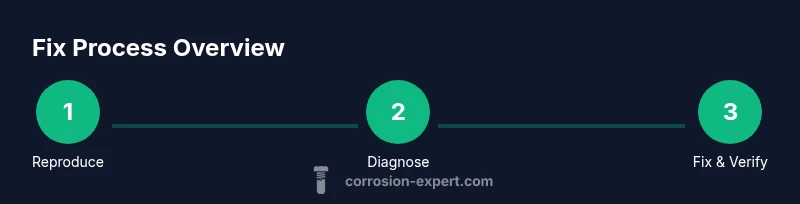
- Validate the hypothesis. Apply a fix in a branch, run the same repro, and verify the crash no longer occurs. If it does, repeat the cycle with a new hypothesis. Estimated total time: 60-180 minutes depending on complexity.
Tools & Materials
- Rust toolchain (rustc, cargo)(Ensure up-to-date stable toolchain; verify versions with rustc --version and cargo --version.)
- LLDB or GDB debugger(Install on your platform; use rust-gdb/rust-lldb for Rust programs.)
- Backtrace and logging utilities(Set RUST_BACKTRACE=1 and enable RUST_LOG=debug for verbose output.)
- Core dump collection utilities(Configure OS to generate core dumps and organize in a crash-archive directory.)
- Strace/DTrace or similar system call tracer(Helpful for diagnosing OS-level interactions during startup.)
- Staging server or container(Test fixes in an environment that mirrors production.)
Steps
Estimated time: 60-180 minutes
- 1
Reproduce the crash in a controlled environment
Create a minimal server startup scenario that triggers the crash reliably, using the same inputs and load pattern as production. This isolates the failure from unrelated runtime behavior.
Tip: Keep the test case small and deterministic to avoid noise. - 2
Enable backtraces and verbose logging
Set RUST_BACKTRACE=1 and increase log verbosity so you can trace the sequence leading to the crash. Ensure logs capture the exact request path and resource usage.
Tip: Capture a complete log tail around the failure window. - 3
Collect crash data (dumps, logs, traces)
Save core dumps, crash reports, and console traces to a dedicated folder with a timestamp. Include server metrics and recent config changes.
Tip: Maintain a consistent naming scheme for easy cross-reference. - 4
Inspect the stack with a debugger
Open the core file with rust-gdb/rust-lldb and retrieve the full backtrace. Identify the first non-library frame that points to your code.
Tip: Focus on frames that originate in your project, not dependencies. - 5
Narrow the scope with dependency and code checks
Use cargo tree and targeted searches to locate recent changes and suspect crates. Build a minimal patch that reproduces the fault.
Tip: Patch one change at a time to pinpoint root cause. - 6
Apply fixes and re-test
Implement the fix in a feature branch, re-run the exact repro sequence, and verify the crash no longer occurs under the same load.
Tip: If the crash remains, revisit Step 4 with a new hypothesis.
Quick Answers
What is the first thing I should check when Rust crashes on server load?
Start with enabling a backtrace and collecting crash data. This includes enabling RUST_BACKTRACE=1, increasing logs, and saving any core dumps or crash reports. This initial data helps identify whether the issue is in your Rust code, a dependency, or the server integration.
First, enable a backtrace and collect crash data to see where the crash originates.
Can a crash be caused by a dependency crate?
Yes. Crashes can originate from a dependency crate after updates or ABI changes. Check cargo tree to identify recent changes, test with previous crate versions, and review the release notes for breaking changes.
Yes, dependencies can crash the app after updates; inspect your dependency chain and tests.
Is AddressSanitizer supported for Rust in production?
AddressSanitizer is available primarily in development or nightly toolchains; use it to find memory issues during testing, not in production. In production, rely on safe coding practices and runtime observability.
Sanitizers are great for development, but use them in testing, not production.
How do I reproduce a crash safely?
Create a minimal, deterministic scenario that mirrors the server startup and load. Use fixed inputs, controlled concurrency, and a clean environment to reproduce the crash reliably.
Make a small, reliable reproduction case to isolate the problem.
What practices help prevent crashes in production?
Adopt robust error handling, avoid unwraps, and introduce meaningful contexts. Use staged rollouts, strong observability, and regular dependency audits to catch issues before they reach production.
Strong error handling and staged rollouts prevent crashes in production.
What should a crash report include?
Include environment details, exact backtrace, a list of recent code changes, affected modules, relevant logs, and the steps to reproduce. This makes it easier to verify fixes and communicate with the team.
A good crash report has environment, backtrace, changes, logs, and reproducible steps.
Watch Video
Quick Summary
- Enable backtraces and logs early
- Isolate root cause through minimal repro and debugger
- Differentiate Rust code failures from dependency or server issues
- Test fixes in staging before production deployment