Rust vs Oxidation: Definitions, Chemistry, and Prevention
An expert comparison of rust and oxidation, clarifying definitions, chemistry, indicators, and practical prevention tips for DIY homeowners dealing with metal corrosion.


Rust is a specific corrosion product formed on iron or steel when it reacts with oxygen and water. Oxidation is the broader chemical process of electron loss that affects many materials. This article clarifies definitions, chemistry, and prevention to help DIYers distinguish rust-specific fixes from general oxidation control.
Defining rust vs oxidation
In everyday conversation, people often interchange rust and oxidation, but they are not the same thing. Rust is a specific corrosion product that occurs when iron or steel reacts with oxygen in the presence of water. Oxidation, by contrast, is a general chemical process that involves the loss of electrons from atoms and can affect many metals and even some non-metals. For DIY enthusiasts and homeowners, grasping this distinction is essential to selecting the right prevention or repair strategy. Corrosion Expert's analysis emphasizes that rust requires iron-based substrates; other materials exhibit different oxide layers that might not look like classic rust but still indicate material degradation. When you see a reddish-brown flaky coating on a gate, that's rust—a telltale sign of iron oxidation that has progressed under moisture. If you encounter gray passivation films on stainless steel or green patinas on copper, you are observing oxidation in different chemical contexts. The practical upshot is that rust-specific remedies (like rust converters or heavy mechanical removal) may be inappropriate or ineffective on non-ferrous metals that oxidize differently. In this guide we'll separate the chemistry from the appearance and map it to actionable DIY steps.
wordCountInBlock":null},
The chemistry behind rust and oxidation
Rust forms when iron or steel encounters oxygen and water, producing hydrated iron oxide that progressively weakens the metal. The fundamental reaction sequence can be summarized as iron (Fe) loses electrons (oxidation) and combines with oxygen to form iron oxides. On moisture-rich surfaces, water acts as a catalyst, accelerating corrosion by transporting ions and facilitating electrochemical cells at imperfections such as scratches or exposed edges. Oxidation, however, is not limited to iron. Copper develops a green patina, aluminum forms a thin protective oxide layer, and zinc-coated metals can suffer from different oxide films. Understanding the specific chemistry—where, how fast, and under what environmental conditions—helps determine whether rust-specific strategies (mechanical removal, rust converters, and rust-inhibiting coatings) are appropriate or if a broader oxidation-control approach is needed. Corrosion Expert emphasizes that context matters: the substrate material, environmental exposure, and maintenance history dictate the most effective intervention.
wordCountInBlock":null},
Visual cues and materials affected
Rust is most recognizable on iron-based objects: fences, tools, load-bearing hardware, and structural elements. The classic reddish-brown, flaky coating is a telltale sign of iron oxide in an active corrosion cycle. Non-ferrous metals show different oxidation outcomes: aluminum forms a dull oxide layer that can actually protect the metal, copper develops greenish-blue patinas, and galvanized steel may exhibit whitish zinc oxides under prolonged exposure. The key visual clue for the DIYer is not every oxide looks like rust; the substrate dictates the outcome. Recognizing the material—iron, steel, aluminum, copper, or zinc-coated surfaces—helps you choose the correct intervention, avoiding rust-specific products on metals where oxidation behaves differently or where oxide films are protective rather than destructive.
wordCountInBlock":null},
Environmental factors and their impact
Environmental factors strongly influence how fast rust or other oxides form. High humidity, salty air, and water exposure create electrochemical cells that drive rust on iron and steel. Temperature swings that repeatedly wet and dry surfaces also accelerate corrosion by expanding and contracting protective layers, creating cracks for moisture ingress. For non-ferrous metals, the kinetics of oxidation differ; aluminum’s natural oxide layer slows further attack, while copper’s patina forms a barrier but can be compromised by certain acids or salts. Indoor environments with cleaning chemicals or sulfur compounds can also alter oxidation behavior. DIY homeowners should assess local conditions such as proximity to oceans, road salt use, or indoor humidity when planning preventive measures, because the same material may require different strategies in different climates.
wordCountInBlock":null},
Common myths and misconceptions about rust and oxidation
One common myth is that all rust is irreversible corrosion. In reality, rust can be slowed or halted with proper treatment and maintenance, though complete reversal may require removal and replacement of severely damaged parts. Another misconception is that oxidation only happens outdoors; indoor moisture, cleaners, and humidity can still drive oxidation on metal surfaces. A third misconception is that rust converters magically stop all corrosion; they often chemically stabilize oxides but do not restore original strength. Finally, some homeowners assume stainless steel cannot rust; while stainless steel resists corrosion, it is not rust-proof, especially under chlorides or high-sulfur environments. Recognizing these myths helps homeowners apply targeted fixes rather than blanket solutions.
wordCountInBlock":null},
Diagnostics and home testing for rust vs oxidation
Simple at-home diagnostics include visual inspection for color and texture, moisture assessment with a hygrometer, and a magnet test to distinguish ferrous from non-ferrous metals. A straightforward approach is to clean a small area and observe whether the oxide can be easily removed with light abrasion (rust on steel tends to form flaky layers) or whether a stable oxide film remains after cleaning (possible on aluminum or stainless steel). Salt spray exposure across a controlled duration can simulate outdoor conditions to gauge how aggressively a surface oxidizes. For more precise assessment, elemental analysis or professional coating tests can determine iron content, oxide thickness, or presence of protective films. While these are not always practical for DIY projects, they help you decide whether to pursue rust-specific remediation or general oxidation-control measures.
wordCountInBlock":null},
Prevention strategies: coatings, inhibitors, and maintenance
Prevention starts with surface preparation: remove active rust, then roughen the surface for better coating adhesion. For iron-based items, use rust converters to stabilize oxides and apply high-quality primers and paints with rust-inhibiting properties. For non-ferrous metals prone to oxidation, focus on barrier coatings, passivation (where appropriate), and sealants that minimize moisture contact. Environmental controls, such as reducing humidity, applying dehumidifiers indoors, and storing tools in dry places, help extend the life of metal objects. Regular maintenance is crucial; inspect annually, reapply protective coatings when you notice chips, and address scratches promptly. In some cases, cathodic protection or sacrificial coatings are appropriate for larger structures or marine environments. The overarching principle is to tailor prevention to the substrate and environment rather than applying a one-size-fits-all rust treatment.
wordCountInBlock":null},
Practical decision framework: when rust fixes or oxidation control matters most
Decide based on substrate, exposure, and desired outcome. If you’re dealing with ferrous metals in a humid environment, prioritize rust-specific removal and coatings to restore integrity. For aluminum, copper, or galvanized surfaces, focus on oxidation control through passivation, non-reactive coatings, and moisture barriers. If the goal is cosmetic improvement on non-structural parts, rust converters may suffice; for structural repair, consider professional assessment. Always start with a clean, dry surface, identify the oxide layer type, and select strategies that address the root cause—moisture, salts, and mechanical damage—rather than treating symptoms alone.
Comparison
| Feature | Rust on Iron Objects | Oxidation on Other Materials |
|---|---|---|
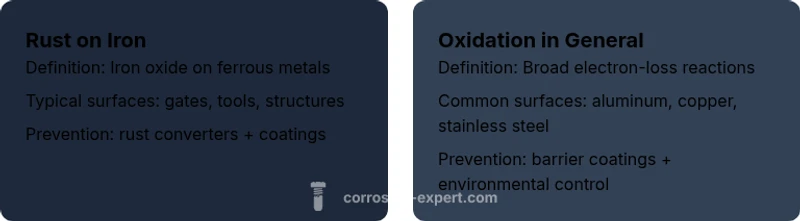
| Definition | Specific iron oxide formed on iron/steel | General chemical process affecting many materials |
| Common Surfaces | Iron, steel, cast iron hardware | Aluminum, copper, zinc-coated metals, stone surfaces |
| Appearance | Reddish-brown flaky coating | Varied oxides: gray, white, greenish patinas |
| Prevention/Control | Rust converters, barrier coatings, mechanical removal | Passivation, barrier coatings, environment control |
| Repair Considerations | Remediation may require coating and possible replacement | Oxidation control focuses on preventing moisture ingress and maintaining oxide films |
| Best For | Iron-based structures and tools | Non-ferrous metals and general oxidation-prone surfaces |
The Good
- Clarifies when a rust-specific fix is needed
- Supports material-specific maintenance planning
- Prevention-first mindset lowers long-term costs
- Improved communication with DIYers and pros
Cons
- Overlap between rust and oxidation can confuse non-experts
- Some fixes target oxidation without addressing rust directly
- Misidentification may lead to ineffective treatments
Rust is a subset of corrosion focused on iron; oxidation is the broader chemical process that affects many materials.
A clear understanding of whether you’re dealing with rust or general oxidation guides the right treatment. For iron-based items, prioritize rust-specific strategies; for non-ferrous metals, oxidation-focused approaches are more appropriate.
Quick Answers
What is the difference between rust and oxidation?
Rust is a specific type of iron oxide that forms on iron and steel when moisture, oxygen, and often salts interact. Oxidation is the broader chemical process of electron loss that can affect many materials, not just iron. Understanding the distinction helps you target the right prevention or repair steps.
Rust is a kind of iron oxide on iron and steel. Oxidation is the general chemical process that can affect many materials, not just iron.
Does oxidation occur on non-metal surfaces?
Yes. Oxidation can occur on non-metal surfaces such as ceramics and polymers under certain conditions, where oxygen or other oxidants react with the surface. The outcomes differ from rust and typically require different protective strategies.
Oxidation can happen on non-metals too, but rust is specifically about iron-based materials.
Can stainless steel rust?
Stainless steel is designed to resist rust, but it can corrode under certain conditions, especially with high chlorine or acidic exposure. Surface coatings, correct alloy grades, and proper cleaning extend its life.
Stainless steel can rust if conditions are harsh enough, but it's much more resistant than plain iron.
How can I prevent rust on outdoor metal tools?
Keep tools dry, apply a protective coating or oil, store in a dry place, and perform regular maintenance. For metal that already shows rust, remove it and recoat promptly to restore protection.
Dry storage and a protective coating are your best allies for outdoor tools.
Is rust always a sign of ongoing corrosion?
Not always. Rust can slow or stop if treated and properly sealed, but extensive rust may indicate deep damage requiring replacement. Prevention is usually more cost-effective than repair.
Rust can be halted with proper treatment, but severe rust might mean the part needs replacement.
What are safe rust-removal methods?
Start with mechanical removal to clear loose rust, then treat with rust converters if appropriate, and seal with a protective coating. Avoid harsh chemicals on delicate or painted surfaces without testing first.
Use mechanical scrubbing, then protect the surface with a coating after treatment.
Quick Summary
- Define the substrate first to distinguish rust from oxidation
- Assess environmental exposure to choose prevention strategies
- Use substrate-appropriate coatings and inhibitors
- Regular maintenance prevents escalation of corrosion
- Consult pros for structural or complex cases