Rust vs Corrosion: A Practical DIY Comparison
A rigorous, analytical comparison of rust and corrosion, covering causes, prevention, and cost implications for homeowners and DIY enthusiasts. Learn when rust-specific fixes suffice and how to protect all metals from general corrosion.


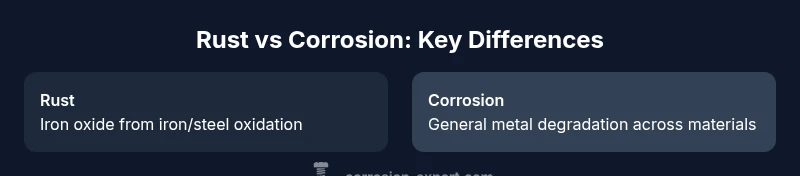
Rust vs corrosion: rust is a specific form of corrosion that develops on iron and steel when moisture and oxygen react to form iron oxide. Corrosion is a broader term for the gradual degradation of any metal through chemical or electrochemical processes. This article compares causes, prevention strategies, and practical remedies to help homeowners and DIY enthusiasts protect metal surfaces.
Defining Rust and Corrosion
Rust is the chemical product of iron or steel reacting with water and oxygen, forming iron oxide that appears as a reddish-brown flaky layer. Corrosion, by contrast, is the umbrella term for deterioration that occurs on any metal through electrochemical or chemical processes. In practical terms for DIY projects, rust is a subset of corrosion that targets ferrous materials. Recognizing this distinction helps homeowners tailor a plan: rust remediation for steel parts versus broader corrosion prevention for mixed-metal environments. Throughout this guide we use the phrase rust vs corrosion to emphasize where issues are iron-specific and where general metal degradation matters. As of 2026, homeowners increasingly rely on simple, home-friendly methods to slow rust growth while applying broader corrosion protection where needed. This framing is essential for prioritizing tools, coatings, and maintenance cycles.
Mechanisms of Rust Formation
Rust formation begins when iron surfaces encounter moisture and oxygen. Water serves as a medium for electron transfer that drives the oxidation reaction, while salts and impurities accelerate the process. The resulting oxide layer can crack and peel, exposing fresh metal to continuing oxidation. Temperature, humidity, airflow, and surface contamination influence the rate and pattern of rust growth. Outdoors, seasonal wetting and drying cycles promote widespread rust on rails, gates, and outdoor tools. Even indoor iron components are not immune if humidity is high. For DIY rust projects, controlling moisture, reducing salt exposure, and applying protective coatings can dramatically slow the reaction and extend part life. Remember that rust is not the sole corrosion mechanism—nonferrous metals may corrode through other pathways under harsh conditions.
Other Corrosion Mechanisms
Beyond rust, corrosion includes galvanic corrosion when different metals contact each other, crevice corrosion in tight spaces, pitting on oxidizable surfaces, and uniform attack from acidic or saline environments. Nonferrous metals like aluminum and copper primarily exhibit non-rust forms of corrosion, though severe conditions can still degrade their surfaces. Understanding these mechanisms helps in selecting coatings, inhibitors, and environmental controls that address multiple pathways. For DIYers, the takeaway is to identify the dominant mechanism at play and apply a compatible strategy—whether a barrier coating for a dissimilar-metal joint or a corrosion inhibitor for an exposed aluminum railing.
Ferrous Metal Focus: rust vs corrosion in practice
For homeowners working with steel, iron, or galvanized surfaces, rust is the most common concern due to direct exposure to moisture and oxygen. The rust vs corrosion distinction matters because coating choices differ: ferrous metals respond well to rust-inhibiting primers and oil-based or epoxy coatings, while nonferrous metals require formulations that address galvanic and pitting tendencies. In practical terms, a typical rust-prone project might prioritize moisture barriers, rust converters for pre-existing spots, and reapplication schedules. Meanwhile, general corrosion prevention campaigns should assess joints, coatings compatibility, and drainage to minimize recurring degradation across all metals in a structure or appliance.
Environmental and Operational Factors
Humidity, temperature fluctuations, and exposure to salts dramatically impact corrosion rates. Coastal homes face accelerated degradation due to salt-laden air, while basements with poor humidity control may see rapid rust on iron pipes or shelving. For DIY maintenance, consider localized environments: a humid bathroom cabinet door, an outdoor metal fence, or a workshop tool rack. Simple environmental controls—dehumidification, covered storage, and improved ventilation—can substantially slow both rust and general corrosion. In addition, choosing corrosion-resistant materials or protective coatings that suit local conditions reduces long-term maintenance cost and time.
Prevention Strategies: Coatings and Inhibitors
Prevention hinges on both material science and practical application. For ferrous metals, primers formulated to block moisture and promote adhesion of topcoats are essential. Epoxies and polyurethane coatings offer robust barrier protection, while rust converters can stabilize existing rust so that coatings perform more effectively. For a broader corrosion strategy, select inhibitors compatible with the metal type and environment; consider barrier coatings, sealants for crevices, and cathodic protection where appropriate. DIY enthusiasts should perform a surface preparation that removes loose rust or oxide, then apply primers, sealants, and topcoats according to product instructions. The key is consistency and compatibility between layers.
Prevention: Environment and Maintenance
Environment often determines the success of prevention. Manage humidity, reduce salt exposure, and ensure proper drainage away from metal surfaces. Schedule routine inspections to catch early signs of rust or corrosion, and reapply protective coatings on schedule. Maintenance should include tightening joints, cleaning surfaces to prevent moisture retention, and recoating worn areas before corrosion accelerates. Even small DIY projects benefit from a documented maintenance calendar that aligns with seasonal changes, ensuring long-term protection for household items like tools, pipes, and metal furniture.
Inspection and Diagnosis Techniques
Regular inspection focuses on moisture-prone areas and joints where rust and corrosion typically begin. Look for discoloration, flaking, white rust on zinc-coated surfaces, or darkening that indicates chemical attack. A simple test for ferrous surfaces is a magnet test: if a magnet clings strongly, corrosion is likely a rust issue; if it does not, consider other corrosion pathways. Use a flashlight to inspect seams and crevices, verify paint adherence, and check for bubbling or blistering coatings. Document findings with photos to guide cleaning or replacement decisions and to plan a targeted DIY remedy strategy.
DIY Remedies for Small-Scale Rust
Small-scale rust spots on tools or hardware can often be addressed with mechanical abrasion, rust converters, and protective coatings. Start by removing loose rust with a wire brush or sandpaper, then apply a rust converter to stabilize remaining oxide. After curing, seal with a rust-inhibiting primer and topcoat. For household items, consider food-safe coatings where appropriate and avoid over-scrubbing delicate finishes. Always test a small area first to avoid damage, particularly on painted surfaces or appliances with electrical components. The DIY approach can yield durable results when the surface is prepared, cleaned, and sealed properly.
Industrial vs Residential Prevention Costs and Considerations
In residential settings, cost concerns focus on the most vulnerable items—gate hinges, outdoor tools, pipes, and fixtures. DIY strategies tend to be cost-effective, emphasizing barrier coatings and moisture control. Industrial scenarios involve larger-scale corrosion management programs, including coatings, cathodic protection, and ongoing monitoring. While this article centers on the homeowner, understanding the economics helps inform decisions about whether a small project is worth DIY attention or if a professional intervention is warranted. Always balance initial costs with long-term maintenance and replacement savings.
Real-World Scenarios and Decision Framework
Consider a coastal home with an iron fence and steel tools: prioritize rust-specific prevention on ferrous components, but implement general corrosion protection for any hardware in contact with dissimilar metals. In a garage with aluminum windows and steel fasteners, apply non-ferrous corrosion strategies while ensuring protective barriers where metals meet. A bathroom with metal fixtures requires moisture control and barrier coatings to prevent both rust and other forms of corrosion. Use a simple decision framework: identify the metal, assess exposure, choose the appropriate coating, and set a maintenance interval that aligns with local conditions.
Building a Home Rust Prevention Toolkit
A practical DIY toolkit includes rust inhibitors, a rust converter, metallic primer, topcoat for ferrous surfaces, a dehumidifier or moisture absorber, a quality wire brush, sandpaper, protective gloves, and a small set of sealants for crevices. Add a moisture meter for quick checks, a magnet for quick rust indication, and a leak detector to identify water intrusion. Organize the kit by project type: outdoor structural metal, indoor metal fixtures, and tools. Keeping a simple log of maintenance dates helps ensure timely re-coats and optimal protection over time.
Comparison
| Feature | Rust-focused approach for ferrous metals | General corrosion prevention for all metals |
|---|---|---|
| Common mechanisms | Iron oxidation dominates (rust) | Includes galvanic, pitting, crevice, and uniform corrosion |
| Material scope | Primarily iron and steel | All metals including ferrous and nonferrous |
| Prevention emphasis | Moisture control and rust inhibitors for ferrous parts | Coatings, inhibitors, and environmental controls for all metals |
| Maintenance requirements | Frequent checks on ferrous items | Regular inspections across metal types |
| Cost implications | Generally lower upfront fixes for ferrous rust | Costs vary with metal type and coating complexity |
| Best for | DIY rust repairs on steel components | Long-term protection for mixed-metal systems |
The Good
- Clarifies scope for DIY rust fixes on ferrous metal projects
- Helps choose appropriate protective coatings and maintenance routines
- Offers a clear framework for understanding metal degradation
- Guides cost-effective, targeted prevention strategies
Cons
- Rust-focused guidance may miss non-ferrous corrosion types
- Terminology can confuse beginners
- Some advice requires professional assessment for complex structures
Rust-focused strategies work best for ferrous items; general corrosion prevention suits mixed-metal systems.
Rust-focused methods deliver quick wins on steel parts and low upfront costs. When multiple metals are involved, broad corrosion protection offers more comprehensive, long-term benefits and can justify additional investment.
Quick Answers
What is the difference between rust and corrosion?
Rust is a specific form of corrosion that occurs on iron and steel, forming iron oxide. Corrosion is a general term for the degradation of metals due to chemical or electrochemical reactions. Knowing which process is at play helps you choose the right treatment and coating.
Rust is iron-specific corrosion, while corrosion covers all metals. Identify the metal type to guide the right treatment.
Can non-ferrous metals rust?
Non-ferrous metals like aluminum, copper, and zinc do not rust in the classic sense, since rust refers to iron oxide. They can still corrode via other mechanisms such as pitting or galvanic attack under certain conditions.
Non-ferrous metals don’t rust, but they can still corrode in other ways.
Is rust prevention the same as corrosion prevention?
Rust prevention focuses on ferrous metals, while corrosion prevention covers all metals and environments. A full approach often combines rust control with strategies that mitigate other forms of corrosion.
Rust prevention is a subset of corrosion prevention.
What are common DIY remedies for small rust spots?
Remove loose rust with a brush, apply a rust converter to stabilize remaining oxide, then prime and paint. For bare metal, consider a protective coating designed for rust-prone surfaces. Test on a small area first.
Brush, convert, and coat for small rust spots.
How does salt exposure affect rust and corrosion?
Salt accelerates electrochemical reactions, speeding both rust and other corrosion processes, especially on exposed ferrous metals. Reducing salt exposure and rinsing surfaces helps slow degradation.
Salt speeds up rust and corrosion; reduce exposure where possible.
When should I call a professional?
If you see extensive rust, structural concerns, or complex coatings, especially on critical infrastructure, professional assessment is advised. A pro can recommend coatings, treatments, or replacements better suited to the material and load.
Call a professional if rust is extensive or structural.
Quick Summary
- Prioritize rust prevention on ferrous metals for DIY projects
- Assess whether the issue is rust-specific or general corrosion
- Choose compatible coatings and environmental controls
- Schedule regular inspections and maintenance
- Tailor fixes to material type and exposure conditions