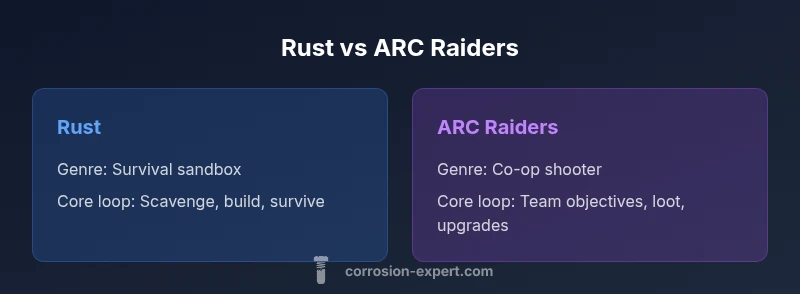
Rust vs ARC Raiders: An Analytical Side-by-Side Review
A rigorous, analytical comparison of Rust and ARC Raiders, examining gameplay, progression, accessibility, and community impact to help players choose the right long-term title.


Rust offers open-ended survival with base-building and PvP, while ARC Raiders emphasizes cooperative defense against AI threats in a sci-fi setting. This comparison highlights the key design differences, accessibility, and long-term value to help you decide which experience fits your playstyle. Read on for how each game shapes progression, teamwork, and your everyday gaming goals.
Why rust or arc raiders matter in the context of modern gaming
In the world of competitive entertaining experiences, two titles stand out when you’re weighing your next long-form play session: rugged survival environments and high-energy sci-fi raids. The phrase rust or arc raiders frames a comparison between a rugged, open-ended sandbox approach and a tightly coordinated, mission-driven team shooter. For players who want to sculpt a personal domain from scavenged resources, Rust offers a canvas for trial-and-error: you gather materials, set up outposts, and defend them while balancing risk from other players. ARC Raiders, by contrast, is designed around squad-based operations, with predefined objectives, loot cycles, and mechanized foes that scale in difficulty. Both experiences reward planning and repetition, but they reward them in different ways.
- Open-ended vs. goal-oriented: Rust emphasizes improvisation and self-directed goals, while ARC Raiders emphasizes structured missions and team coordination.
- Pace and risk: Rust can be slow-burn and unforgiving, with long stretches between decisive encounters; ARC Raiders typically compresses risk into shorter, action-packed sessions.
- Progression loops: Rust’s progression is resource- and outpost-centric, whereas ARC Raiders centers on squad gear, cooldowns, and objective mastery.
Key takeaway: your decision hinges on whether you crave personal sovereignty and a living world, or a cooperative loop with clear milestones.
Core Design Philosophies
The core design philosophy behind Rust versus ARC Raiders reflects two distinct visions for how players interact with a game world. Rust leans into emergent gameplay, where outcomes arise from player choices, imperfect information, and a living economy of resources. The environment acts as a sandbox with few prescriptive boundaries, inviting experimentation, risk-taking, and social dynamics—both cooperative and adversarial.
ARC Raiders adopts a design methodology built around coordinated teams facing AI-driven challenges. Objectives are crafted to reward teamwork, communication, and tactical planning. The game environment is engineered to present repeatable milestones, predictable loot flow, and scalable encounters, which helps reduce the ambiguity that can accompany open-ended survival titles.
From a player psychology perspective, Rust fosters long-term attachment through personal storytelling and outpost sovereignty, while ARC Raiders builds camaraderie through structured missions and shared victories. If you prefer freedom and improvisation, Rust will feel familiar; if you value clear objectives and teamwork, ARC Raiders will likely resonate more strongly.
Gameplay Mechanics: From Scavenging to Shooting
Rust emphasizes scavenging, base-building, and precarious social dynamics. Players gather wood, stone, and metal to craft tools, fortify hideouts, and establish chokepoints. PvP encounters are a common rhythm, and raiding beacons often become turning points in ongoing rivalries. Crafting requires both time and resource management, and success hinges on creating secure logistics chains that sustain your long-term survival.
ARC Raiders focuses on team-based action with structured missions. Players coordinate roles—defense, offense, and utility—while navigating a sci-fi environment with mechanized enemies. Loot cycles emphasize efficient rotations and objective completion rather than total control of a persistent territory. The pacing is designed to reward practiced teamwork, precise callouts, and adherence to a shared plan.
In practice, Rust rewards personal initiative and adaptive problem-solving, whereas ARC Raiders rewards disciplined team execution and synchronized tactics. For players who enjoy improvisation under pressure, Rust offers depth; for those who crave cooperative rhythms and clear milestones, ARC Raiders provides a compelling path.
Progression, Upgrades, and Economy
Rust centers progression on resource collection, outpost progression, and player-driven trade networks. Your economy evolves as you trade with other players or leverage customs for a stable supply chain. Upgrades are earned through craftsmanship and strategic placement of defenses, which means your base becomes a personal story of perseverance and adaptation. The social layer—faction dynamics, raiding, and alliances—adds complexity to planning and risk management.
ARC Raiders presents progression as a linear-to-mixed loop of missions, loot tiers, and character upgrades. Upgrades feel tangible through better weapons kits, armor, and tactical gear that unlock with episode-like milestones. The squad-based nature of the game means you’ll see rapid improvement by refining team communication, role specialization, and cooldown management. The economy is more deterministic, with loot drops aligned to mission completions and weekly cycles.
Choosing between the two hinges on whether you prioritize a self-directed growth curve or a pre-defined progression path that rewards teamwork and optimization.
Community, Longevity, and Modding
Rust has nurtured a vibrant, long-lived community with extensive modding support. Community-made maps, survival tweaks, and QoL features extend replayability far beyond the official roadmap. The social ecosystem thrives on improvisation, player-driven servers, and shared narratives of base construction, raids, and survival against the elements—and each other.
ARC Raiders, depending on its development phase, typically emphasizes a more controlled modding environment and official content updates. Longevity in such titles often rests on regular live-service updates, evolving storylines, and evolving meta-balanced equipment for teams. The strength of ARC Raiders’ ecosystem is its potential for structured, repeatable play sessions and clear progression that keeps teams together over time.
Both titles benefit from active communities, though the nature of engagement differs: Rust rewards creativity and persistence; ARC Raiders rewards teamwork and consistent play cadence.
Accessibility, System Requirements, and Entry Barriers
Rust’s accessibility is shaped by its open-ended design. New players often encounter a steeper learning curve due to a sprawling crafting system, stealth mechanics, and the social risk of PvP. On lower-end hardware, performance can be variable, but the payoff is a deeper sense of agency as you learn to optimize your base and supply chains.
ARC Raiders may present a lower barrier to entry for players who value guided experiences and immediate teamwork. However, the emphasis on co-op play means you’ll want reliable teammates and a plan, which can be less forgiving for solo players or casual gamers. System requirements tend to favor newer hardware for smooth, high-intensity action scenes and AI-heavy engagements.
From a practical perspective, consider your network reliability, willingness to invest time in learning complex systems, and preference for solo exploration versus coordinated team play when choosing between these experiences.
Practical Scenarios: Examples and Recommendations
- If you’re a solo player who enjoys constructing a personal empire and negotiating with or challenging others in a persistent world, Rust offers the most satisfying long-term play.
- If you want fast-paced, cooperative play with a clear set of goals and a sci-fi theme, ARC Raiders is likely the better fit.
- For groups seeking ongoing content updates, predictable loot loops, and competitive balance, ARC Raiders may provide a steadier cadence.
- For players who thrive on emergent narratives, improvisation, and player-driven economies, Rust’s sandbox remains unmatched.
- If you value robust modding and community-created content to extend life, Rust has a more mature ecosystem to explore.
In short: choose Rust when sovereignty and improvisation matter most; choose ARC Raiders when teamwork, structure, and a sci-fi setting drive your decisions.
Comparison
| Feature | Rust | ARC Raiders |
|---|---|---|
| Genre | Survival sandbox with base-building and PvP | Co-op shooter with AI defense and sci-fi setting |
| Gameplay Focus | Open-ended exploration, resource management, player-driven economy | Structured missions, teamwork, tactical objectives |
| Setting & Theme | Harsh, realistic post-apocalyptic world | Futuristic, mechanized environments with sci-fi elements |
| Multiplayer Experience | Heavy PvP emphasis; solo play possible with risks | Co-op emphasis; strong emphasis on coordination |
| Progression & Loot | Resource- and outpost-centric progression; player-driven economy | Episode-like progression; loot drops tied to missions |
| Modding & Customization | Extensive modding community and server customization | Official content updates; studio-controlled customization |
The Good
- Encourages strategic thinking and planning across open-ended play
- Sunken time rewards become meaningful through base-building and persistence
- Diverse playstyles exist within a single ecosystem (solo, duo, small groups)
- Rust’s modding culture extends life and experimentation
- ARC Raiders supports teamwork and clear progression, easing onboarding for new players
Cons
- Steep learning curve in Rust can deter casual players
- PvP risk and griefing in Rust may reduce daily play sessions
- ARC Raiders may feel restrictive for players who prefer true sandbox freedom
- Content cadence and balance updates can shift meta in ways that frustrate some players
Rust is the better pick for solo persistence and creative base-building; ARC Raiders excels at coordinated, mission-driven teamwork.
If you crave personal sovereignty and deep, evolving systems, Rust delivers. If your priority is structured play with friends and a fast, sci-fi flavor, ARC Raiders is the smarter choice.
Quick Answers
What exactly is ARC Raiders and how does it differ from Rust in gameplay?
ARC Raiders is generally presented as a cooperative, team-based shooter with objective-driven missions set in a sci-fi world. By contrast, Rust emphasizes open-world survival, base-building, and a heavy PvP component. The core difference lies in structure: ARC Raiders guides you through planned objectives, while Rust rewards improvisation and long-term fortification.
ARC Raiders focuses on teamwork and mission-based play, while Rust is about survival and base building with PvP. The main difference is structure versus sandbox freedom.
Is ARC Raiders released or still in development as of 2026?
ARC Raiders’ status has evolved given ongoing development in recent years. For the most accurate, up-to-date information, check official channels from the developers and major gaming outlets. Be prepared for changes as the title progresses toward broader availability.
ARC Raiders status can vary by region and platform; confirm with official sources for the latest release information.
Which game is easier for beginners?
ARC Raiders tends to be more approachable for players who enjoy coordinated play and guided objectives. Rust can be daunting for newcomers due to its steep learning curve in crafting, base management, and PvP risk. Your comfort with solo experimentation versus team-based play will guide the decision.
ARC Raiders is often easier to pick up with friends; Rust can be tougher solo but deeply rewarding.
What about long-term value and player retention?
Rust offers long-term value through its persistent world, evolving economies, and a robust modding scene that keeps content fresh. ARC Raiders aims for steady cadence through missions, loot cycles, and frequent updates to sustain group play. The best choice depends on whether you value a living world or a repeatable cooperative loop.
Rust rewards long-term persistence and community-made content; ARC Raiders rewards ongoing team-based sessions and updates.
Can I play solo in ARC Raiders or is it strictly co-op?
ARC Raiders is designed around team-based experiences, but some modes or future updates may accommodate smaller groups. Solo play is typically more viable in Rust due to its open-ended nature and absence of strict mission constraints. Plan to team up for ARC Raiders if you want the full experience.
ARC Raiders emphasizes teams; solo play may be limited, whereas Rust welcomes solo adventures.
How do modding and customization compare between the two?
Rust has a long-standing modding community with extensive server customization and user-generated content. ARC Raiders, being a newer, studio-driven title, may have a more controlled customization path and fewer external mods initially. If mod support is a priority, Rust is typically the safer bet.
Rust has broader modding support; ARC Raiders’ customization is more managed by the developers.
Quick Summary
- Decide between open-ended freedom (Rust) and structured cooperation (ARC Raiders).
- If modding and player-driven economies appeal to you, Rust has the edge.
- For teams seeking predictable progression and teamwork, ARC Raiders shines.
- Assess your network setup and solo vs. group play preference before choosing.