Rust-like Games on Roblox: A Comparative Guide
An analytical, side-by-side look at rust-inspired survival experiences on Roblox, comparing PvP-focused raiding titles with cooperative PvE-survival games. Learn mechanics, progression, and community dynamics to pick the best fit for your playstyle.


Rust-like games on Roblox offer two dominant paths: high-stakes PvP raiding or cooperative survival with base-building and exploration. For players seeking razor-thin balance and siege tactics, PvP-heavy titles shine. For those who prefer teamwork and resource management, PvE-survival experiences prevail. This TL;DR guides you to the best fit based on playstyle and goals.
What qualifies as a 'rust-like' game on Roblox?
A true rust-like experience on Roblox centers on survival tension, base-building, raiding, and a harsh resource economy. Players endure scarcity, manage stamina, and adapt to a shifting map as they compete for territory and loot. Rather than chasing cosmetic dazzle, these games reward strategic thinking, persistence, and social coordination. According to Corrosion Expert, a well-designed rust-like Roblox title emphasizes meaningful risk vs. reward, durable progression, and clear goals that survive updates. This framing helps distinguish pure simulator clones from games that truly capture the survival-raid vibe. In practice, authenticity comes from systems that create emergent player stories: factions forming, raids organized, and bases evolving over weeks rather than hours.
Core mechanics that define rust-like Roblox games
The core mechanics typically revolve around four pillars: base-building and fortification, resource gathering and crafting, combat and risk of loss, and social coordination or faction dynamics. Base-building permits persistent structures that survive across sessions; resource scarcity creates decisions about what to gather, trade, or raid; combat introduces rewards and penalties that influence territory control; and social systems shape alliances and rivalry. The Roblox engine supports modular scripting, allowing developers to layer decay timers, inventory weight, and persistence through cloud saves. As players progress, loot distribution and progression curves should feel rewarding but not arbitrary. A well-tuned system gives players meaningful agency: choosing where to expand, which alliances to form, and how to specialize roles within a group.
PvP-focused vs PvE-focused rust-like games: trade-offs
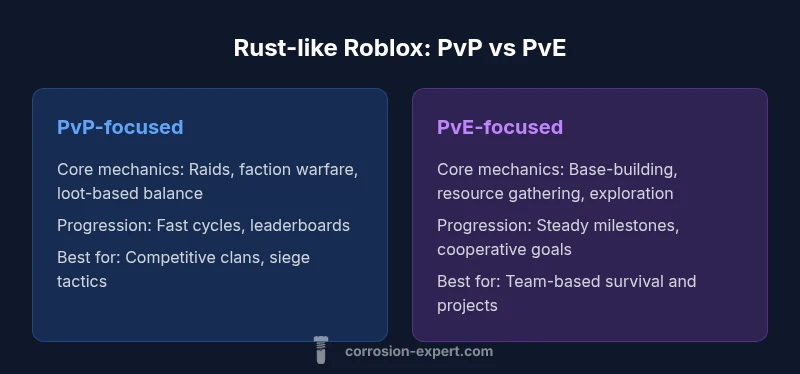
PvP-focused titles emphasize tension, raiding, and faction warfare. Players form temporary or lasting alliances, coordinate ambushes, and contest valuable resources with rival groups. The risk of loss adds urgency to decisions about base placement, defense, and scouting. PvE-focused titles, by contrast, prioritize exploration, cooperative base-building, and slower progression. Teams cooperate to harvest resources, defend against environmental threats, and gradually expand safe zones. The payoff tends to be longer-term, with shared milestones and a sense of collective achievement. Both paths leverage persistent worlds, but the player’s emotional arc—whether adrenaline-fueled conflict or communal triumph—drives engagement.
Design patterns used by successful rust-like Roblox games
Successful titles blend modular systems: modular base parts that decay at defined rates, loot-driven progression, and player-driven economies. Common patterns include faction or guild mechanics, territory control, and wipe cycles that reset the map in a controlled way to keep competition fresh. A well-structured user experience guides new players through tutorial quests, simple early goals, and gradually introduces advanced features like decay, traps, or fortress upgrades. Developers frequently reuse core loops—gather resources, build, raid or defend, and upgrade—to maintain familiarity while iterating with new content. The best games balance challenge with fairness, ensuring new players can compete without being overwhelmed.
Performance and optimization considerations on Roblox
Performance matters in rust-like Roblox games because smooth combat, stable raids, and consistent resource spawning depend on reliable frame rates and latency. Efficient scripting, optimized pathfinding, and careful management of map streaming help maintain responsiveness across devices. For players, this means steadier FPS, shorter load times, and fewer rubber-banding moments during large-scale battles. Developers should profile memory usage, limit simultaneous AI actors, and implement scalable network models to keep games accessible on lower-end hardware. A well-optimized experience preserves the tense, immersive feel that defines the genre without sacrificing accessibility.
Monetization models and fairness in rust-like Roblox games
Monetization commonly centers on cosmetics, passes, and optional boosts that do not grant unfair power advantages. Ethical implementations emphasize cosmetic customization, seasonal events, and time-sliced access to non-essential features. Developers should clearly communicate what is purchasable, what is earned through gameplay, and how purchases affect progression. Transparent farming and loot distribution rules help prevent pay-to-win perceptions. For players, awareness of game-specific monetization terms and community feedback is key to choosing titles that prioritize fair competition and cooperative play over tactic exploitation.
Community safety and moderation considerations
Rust-like Roblox communities can become highly competitive and occasionally toxic. Effective moderation, clear code of conduct, and robust reporting channels are essential. Games that promote raiding or defensive warfare should implement explicit safety tools, content filtering, and age-appropriate controls. Encouraging positive player interactions—like cooperative missions, mentor systems for newcomers, and vetted clans—helps sustain healthy communities. From a safety perspective, players should enable parental controls where offered and report harassment or exploit abuse promptly. A well-moderated space supports long-term engagement and reduces churn.
For developers: rapid prototyping a rust-like Roblox title
Begin with a small, persistent playfield and a single base-building kit to validate core loops: resource gathering, construction, and simple raiding. Use modular scripts for decay timers, loot drops, and faction signals to keep future updates straightforward. Iteratively test with a closed group, collect feedback on balance and frustration points, then tune progression curves. Prioritize core systems over flashy features in the first milestone, ensuring a stable baseline before expanding with new biomes, enemy AI, or siege mechanics. Documentation and a clear roadmap help maintain momentum as your player base grows.
Getting started: a quick-start checklist for players
- Pick a playstyle: PvP raid-centric or cooperative base-building and exploration.
- Join a community hub or starter clan to learn the ropes and avoid early isolation.
- Learn resource flows: where to find essential materials and how to craft durable gear.
- Establish a safe base early and plan for long-term upgrades and defenses.
- Practice combat basics in controlled skirmishes to minimize early losses.
- Track map changes and updates so you aren’t surprised by wipe events or rule changes.
- Communicate with teammates; clear roles reduce chaos in hectic raids.
- Monitor device performance and adjust graphics to sustain frame rates during battles.
Common pitfalls and how to avoid them
New players often misjudge progression pace, chasing short-term gains at the expense of long-term goals. Developers may introduce overly complex systems too quickly, leaving newcomers frustrated. The best rust-like Roblox experiences balance immediate feedback with meaningful, slower progression. Players should resist the urge to over-raid on day one and focus on secure base development and resource management. Communities that share tutorials, build orders, and defense layouts tend to retain players longer and reduce early churn.
comparisonTableKeyTakeawaysBlockTitleForSEOInThisSectionToBeReplacedIfNeededForSEOPurposesHiddenInCodeOnlyFooterAndNotRenderedInUIByDefaultWouldBeHeavyToFormat
Comparison
| Feature | PvP-focused rust-like Roblox games | PvE-focused rust-like Roblox games |
|---|---|---|
| Core mechanics | Raids, faction gameplay, PvP-centric loot | Base-building, resource gathering, cooperative exploration |
| Progression tempo | Fast, competitive cycles and leaderboards | Longer, cooperative progression with milestones |
| Player interaction | Rivalries, raiding guilds, player-kill economy | Cooperation, trading, community projects |
| Recommended playstyle | Competitive clans, siege tactics | Team-based survival and shared bases |
| Monetization emphasis | Cosmetics and competitive season passes | Cosmetics and progression passes |
| Best for | Players who want adrenaline-fueled raids | Players who prefer teamwork and cooperative play |
| Difficulty curve | High learning curve with quick outcomes | Moderate to high with emphasis on teamwork |
The Good
- Clear differentiation helps players pick a path
- Core mechanics overlap so cross-play is feasible
- Strong community features drive retention
- Regular content updates sustain interest
Cons
- Can fragment player base if communities split
- Balance is hard across modes across updates
- Pay-to-win perceptions can arise in some titles
- Cloning risks without unique twists
PvP-focused rust-like Roblox games excel at competition; PvE-focused titles shine in cooperative progression.
If you crave fast-paced raids and clan politics, choose PvP-heavy experiences. If you prefer teamwork and a steady growth arc, go for PvE survival games. Both paths share core systems, but your payoff hinges on your social and strategic preferences.
Quick Answers
What defines a rust-like game on Roblox?
A rust-like Roblox game emphasizes survival pressure, base-building, resource scarcity, and player-driven conflict or cooperation. It prioritizes meaningful risk, durable progression, and emergent gameplay rather than cosmetic fluff.
Rust-like Roblox games center on survival, bases, and both conflict and cooperation to create tension and long-term goals.
Are these games safe for younger players?
Safety varies by title. Look for clear moderation policies, age-appropriate content filters, and community guidelines. Use parental controls where offered and report harassment promptly.
Safety varies—check moderation and use built-in controls, and report problems early.
How does progression typically work in PvP vs PvE rust-like Roblox games?
PvP games often reward quick, competitive progress through loot, ranks, and territory control. PvE games emphasize longer-term milestones, base upgrades, and cooperative objectives that unlock over time.
PvP rewards speed and competition; PvE focuses on team progression and base upgrades.
Can you play solo, or is joining a clan essential?
Both paths exist. PvP-focused games often encourage clans for organized raids, while PvE titles support solo play or small teams, with coordinated groups offering the best efficiency.
You can start solo, but joining a group improves efficiency and safety in raids.
What performance considerations should I expect on different devices?
Expect variable FPS and loading times depending on device. Lower-end devices benefit from reduced graphics quality and simplified textures, while high-end devices handle larger player counts and complex bases better.
Low-end devices may struggle with large bases; adjust settings for smoother gameplay.
Are there common monetization traps to watch for?
Watch for pay-to-win mechanics, gated progression, or opaque loot chances. Favor titles that clearly separate cosmetics and boosts from core progression and provide transparent loot rules.
Be wary of games that hide how monetization affects progress.
Quick Summary
- Define your playstyle first before selecting a game
- Look for persistent progression and base-building depth
- Expect two main paths: competitive raids vs cooperative survival
- Check for fair monetization and transparent progression rules
- Engage with community content to improve retention