How Long Does Rust Last? Lifespan, Environments & Prevention
Discover how long rust can last under different conditions, what accelerates or slows corrosion, and proven prevention strategies from Corrosion Expert. Learn practical timelines and maintenance steps to protect metals.


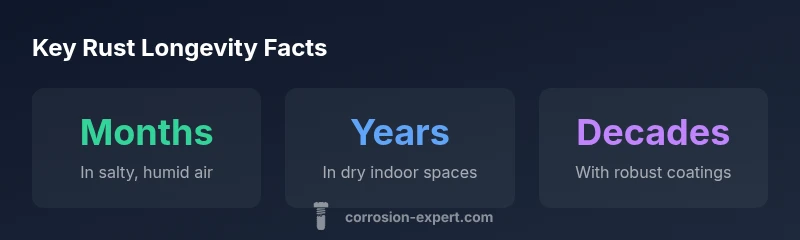
How long does rust last? There isn’t a single timeline. In practice, rust can persist from several months in coastal, salt-saturated, or high-humidity environments to many years in dry, indoor settings, and potentially decades on neglected metal. Environmental factors, coating quality, substrate, and protective measures drive lifespan, so expect variability and plan preventive maintenance accordingly.
Why does rust last longer in some scenarios than others
Rust is a chemical process driven by moisture, oxygen, and a susceptible substrate. The lifespan of rust on a given piece of metal is not fixed; it depends on how aggressively those factors interact over time. In practical terms, how long does rust last on a surface—whether it progresses or remains quiescent—depends on environmental exposure, metal type, presence of protective coatings, and ongoing maintenance. For homeowners, this means that a galvanized or painted surface in a dry interior can resist visible rust for many years, while an untreated steel fixture in a humid, coastal garage may show signs of corrosion within months. Understanding these factors helps you set realistic expectations and plan preventive steps to extend metal life.
Environmental exposure as a primary driver of rust longevity
Coastal and industrial environments accelerate corrosion due to salt, pollutants, and moisture cycles. Indoor, climate-controlled spaces slow the process, especially when metals are shielded by coatings or household rust inhibitors. Temperature fluctuations also influence rust progression: repeated wet-dry cycles can lead to coating microcracks that allow moisture in, restarting the corrosion process. When you ask how long does rust last in your home or workshop, you’re really asking: under these conditions, how quickly will metal layers deteriorate? The answer will vary, but a cautious approach suggests budgeting for repainting, coating refresh, or protective treatment on any metal exposed to humidity or salt.
Material choices and protective finishes that extend rust lifespan
Not all metals rust the same way. Iron and plain carbon steel are highly susceptible, while stainless steel resists well when proper chromium content and passivation are maintained. Galvanized steel benefits from zinc layers, but these can erode in harsh environments, exposing underlying steel. Protective finishes—paints, powder coatings, sealants, and wax-based barriers—add a robust layer of defense, often extending a surface’s rust-free period when maintained well. If you’re trying to estimate how long rust lasts on a given project, compare the substrate, coating type, and maintenance schedule as a trio: substrate strength, barrier quality, and moisture control.
Practical steps to slow rust and extend lifespan
Proactive maintenance is the most reliable way to extend rust lifespan. Keep surfaces dry, repair damaged coatings promptly, and apply protective primers and sealants suited to the environment. For outdoor metal, consider corrosion inhibitors or sacrificial coatings; indoors, ensure humidity stays at bay with dehumidifiers or ventilation. Regular cleaning to remove salts and pollutants, plus timely touch-ups of any chipped coating, can dramatically slow rust progression. Remember: a small upfront investment in preventive care often yields longer-lasting metal and lower remediation costs over time.
How to assess rust lifespan on a project: a practical checklist
Start with a visual inspection to identify rust type (surface vs. deeper in the metal) and coating condition. Check for bubbling, flaking, or powdery rust that signals ongoing corrosion. Test moisture levels near the metal and evaluate exposure history (seasonal humidity, proximity to salt spray, or industrial pollutants). A simple rule of thumb is to schedule a coating inspection every 1–3 years and an in-depth assessment after any major exposure event (flood, salt spray, heavy rain). For DIYers, keep a maintenance log, take photos to track progression, and prioritize protective redecorating where rust is active.
Case study: translating timelines into action
Consider a steel fence post in a coastal yard. Without coatings, rust can advance steadily, particularly after storms and salt exposure. With a durable powder coating and annual touch-ups, the same post may resist visible rust for many years, possibly extending its service life well beyond the average for an unprotected piece. In contrast, a dry indoor metal shelf with a robust sealant may show only minor surface rust for a decade or more. These examples illustrate how environment and protection shape the practical lifespan of rust on everyday items.
Estimated rust duration by environment
| Environment | Typical Rust Duration | Notes |
|---|---|---|
| Coastal salt spray | months to years | Salt accelerates corrosion |
| Indoor dry garage | years | Low moisture & protective finish |
| Outdoor exposed metal | years to decades | Weathering and maintenance matter |
| Industrial pollutants | months to years | Chemical exposure speeds rust |
Quick Answers
What factors most influence how long rust lasts on metal?
The primary drivers are moisture, oxygen, temperature cycles, and substrate. Coatings and protective finishes can dramatically extend life, while salt exposure and repeated wet-dry cycles accelerate corrosion.
Moisture and coatings matter most. Protect metal and rust will last longer.
Does coating always prevent rust forever?
No coating lasts forever. Proper maintenance, timely touch-ups, and occasional re-coating are required to keep a barrier effective against moisture and pollutants.
No coating lasts forever; maintenance keeps it effective.
How can I estimate rust lifespan for a DIY project?
Assess environment, material, and coating. Use the rough ranges under similar conditions and monitor for coating damage. Regular inspections help refine your estimate over time.
Look at the environment, materials, and coatings, then check periodically.
Is rust repair cheaper than prevention?
Yes, prevention is typically cheaper. Addressing rust early with coatings or inhibitors can prevent deeper damage and avoid more costly remediation later.
Prevention is usually cheaper than repair.
Which environment accelerates rust the most?
Coastal and highly humid, salt-rich environments tend to accelerate rust progression the most, followed closely by industrial areas with corrosive pollutants.
Coastal humidity speeds rust the most.
Can rust last indefinitely on any surface?
In theory, with perfect conditions and continuous protection, rust could be halted, but in practice coatings degrade and environments change, so ongoing maintenance is essential.
Indefinite rust control isn’t realistic without ongoing care.
“Rust lifespan is rarely fixed; it shifts with environment, material, and protection. Proactive maintenance is the cheapest and most effective strategy.”
Quick Summary
- Understand environment to gauge rust longevity
- Coatings and maintenance dramatically affect lifespan
- Humidity and salt exposure are major accelerants
- Regular inspection slows progression
- Plan preventive maintenance early to save costs